
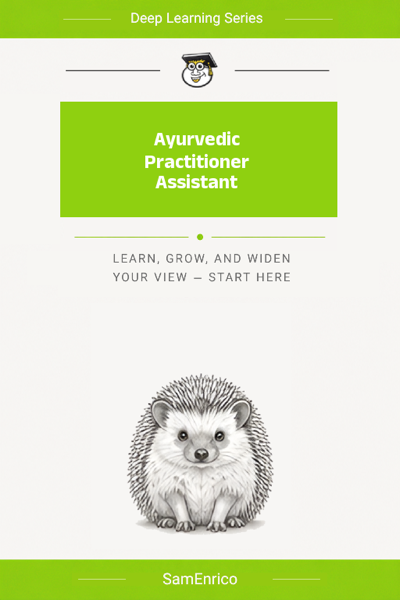
Non-FictionInformativeEducational
Ayurvedic Practitioner Assistant eBook
A Coursebook on Ayurvedic Practitioner Assistant
A Coursebook on Ayurvedic Practitioner Assistant
Formats
Free sample
Chapter 1: Beyond the Stethoscope--–- The first time I walked into an Ayurvedic clinic, I was a massage therapist with calloused hands and a burning chest. For three years, I had been doing deep tissue work on clients who booked sixty-minute appointments, tipped well, and never once asked about their digestion, their sleep, or the quality of their dreams. I touched bodies but not lives. I relieved symptoms but not suffering. I was good at my job, and I was empty at the end of every shift.Then I met Priya.Priya was an Ayurvedic Practitioner Assistant at a small clinic tucked between a yoga studio and an organic grocery store.
She was not the doctor. She was not the owner. She was not even the most experienced person in the room. But when I watched her work, I saw something I had never seen before: a health professional who moved through her day with calm authority, who laughed with patients, who caught details the practitioner missed, and who went home at six o'clock without carrying the weight of the world on her shoulders.She was not burned out. She was not cynical.
She was not looking for an exit strategy.I asked her, over tea after her shift, how she had ended up in this role. She laughed and said, "I started exactly where you are. I wanted to help people, but I didn't want to go to medical school. I wanted to use my hands, but I didn't want to just do massage forever. I found a lane that fit me perfectly."That conversation changed everything.
This chapter is my attempt to have that same conversation with you.The Grand Misunderstanding If you have picked up this book, you probably believe one of three things about Ayurveda. Either you think it is an ancient system of healing that holds profound wisdom for modern life. Or you think it is a collection of pseudoscientific practices best left to history. Or you have no idea what it is and you are just curious.Let me address all three possibilities at once.Ayurveda is not magic. It is not a religion.
It is not a replacement for emergency medicine or surgery. And it is not, despite what some of its most enthusiastic proponents claim, a solution to every human ailment. What Ayurveda is, at its core, is a systematic approach to understanding the relationship between how you live and how you feel. It asks questions that modern medicine often forgets to ask: What are you eating? When are you sleeping?
How is your digestion? What is the quality of your attention? Who are you when no one is watching?These questions matter. Not because they replace blood tests and X-rays, but because they fill in the gaps that blood tests and X-rays leave behind. A patient can have perfect lab results and still feel terrible.
A patient can have normal blood pressure and still live in constant anxiety. A patient can be cleared by every specialist and still know, deep down, that something is wrong.Ayurveda gives names to that something. It offers a language for describing the territory between pathology and vitality. And it provides a toolkit—diet, herbs, bodywork, daily routines—for moving patients from that grey zone of "not sick but not well" into genuine flourishing.But here is the secret that no one tells you: you do not need to master all of Ayurveda to work in an Ayurvedic clinic. You do not need to memorize the Charaka Samhita.
You do not need to spend a decade in study. You need to learn a specific set of practical skills that every clinic requires and that very few people possess.That is what this book teaches. Not the theory of Ayurveda—there are other books for that. But the practice of being an Ayurvedic Practitioner Assistant. The how, not just the why.
The hands, not just the heart.The Three-Tier Reality Every functioning healthcare system, whether conventional or complementary, operates on a division of labor. The most complex, high-stakes tasks go to the most highly trained professionals. The routine, protocol-driven tasks go to assistants. And somewhere in the middle, you find the coordinators, the educators, and the support staff who make everything run.Ayurveda is no different.At the top of the pyramid sits the Vaidya—the Ayurvedic doctor. This person has completed five to seven years of formal education, including clinical training, pharmacology, and diagnosis.
The Vaidya performs pulse diagnosis, prescribes complex herbal formulas, designs Panchakarma protocols, and bears legal responsibility for patient outcomes. In most countries, the Vaidya holds a license or certification that allows them to practice independently.At the bottom of the pyramid, you find the roles that require the least training but often the most patience: receptionists, housekeepers, kitchen staff. These roles are essential but not clinical.And in the middle—the sweet spot that this book is about—you find the Ayurvedic Practitioner Assistant. The APA has enough training to perform clinical tasks safely but not enough to practice independently. The APA works under the Vaidya's supervision, following protocols rather than creating them, documenting rather than diagnosing, supporting rather than directing.This is not a lesser role.
In fact, in a well-run clinic, the APA may have more direct patient contact than the Vaidya. The APA is the one who spends an hour performing Abhyanga. The APA is the one who sits with the patient during Shirodhara. The APA is the one who answers the phone when the patient has a question about their herbs. The APA is the face of the clinic, even when the Vaidya is the brain.Why This Role Exists You might be wondering: why not just train everyone to be a Vaidya?
Why create a separate assistant role?The answer is simple: cost, time, and scope.Becoming a Vaidya requires a significant investment. In India, where Ayurveda is regulated by the government, a Bachelor of Ayurvedic Medicine and Surgery (BAMS) takes five and a half years. In the United States, where Ayurveda is less regulated, becoming a certified practitioner still requires two to three years of full-time study, plus clinical hours. Not everyone can afford that time or money. Not everyone wants that level of responsibility.
Not everyone needs that depth of knowledge to do meaningful work.The APA role exists for everyone else. It exists for the massage therapist who wants to expand their skills without going back to school full-time. It exists for the yoga teacher who wants to work more deeply with students but does not want to become a therapist. It exists for the career-changer who is forty-five years old and cannot afford five more years of education. It exists for the recent graduate who wants clinical experience before committing to a full practitioner program.The APA role also exists for the clinics themselves.
A Vaidya who tries to do everything—intake, therapy, pharmacy, follow-up, administration—will burn out within two years. The math does not work. There are only so many hours in a day, and the most expensive person in the clinic (the Vaidya) should be doing only the tasks that require their…
This is the end of the free sample. Get the eBook to keep going. Buy now
About this book
Details
- Author
- Everhart Brenton
- Publisher
- SamEnrico
- Language
- English
- Genre
- Non-Fiction, Informative, Educational
- Released
- 2026-05-23
- Pages (approx.)
- 140
- Available as
- eBook, Audiobook

Read better in the ZLOADR app
Your eBooks on your phone or tablet. Sign in with your SamEnrico account and start reading.
More by Everhart Brenton
 Workplace Anger for New ManagersEverhart Brenton$11.99
 Theatre Arts Essay AI GuideEverhart Brenton$11.99
 Polite Interruption Deflection Scripts WorkbookEverhart Brenton$11.99
 Indian Agent Motivation PlaybookEverhart Brenton$11.99
 The Abraham Isaac Kook MysticismEverhart Brenton$11.99
 The Vanishing of the SS Gotheborg: A Victorian-Era Maritime Mystery with Underworld TiesEverhart Brenton$11.99
 Understanding PlexosarcomaEverhart Brenton$17.99
 QuickBooks Automation RulesEverhart Brenton$12.99
 Industrial Gas M&A GuideEverhart Brenton$12.99
 How to Start a Optical Fibre Cables for Coded Data Transmission Business (Beginners Guide)Everhart Brenton$11.99
You may also like
 Hong Kong Handover 1997Dunn Johnnie$11.99
 Zumba For Postnatal Recovery CourseNeal Christian$11.99
 Zumba for BeginnersLadner Nikia$11.99
 YouTube Comment Mining GuideHumes Pandora$12.99
 Worry Box MeditationCarlin Rudy$11.99
 Workplace Stress MeditationNguyen Lynn$11.99
 Workplace Stress and Sleep RepairHawley Ivory$11.99
 Workplace Perfectionism CureDelaney Jeffry$11.99
 Workplace Injustice Anger GuideWallen Isabelle$11.99
 Work Addiction and Burnout LinkGreenwood Ester$11.99
 Women in Yoga and WellnessBeattie Galina$11.99
 Women in Stand Up ComedyChun Evangeline$11.99