
Non-FictionSelf-HelpCredibility
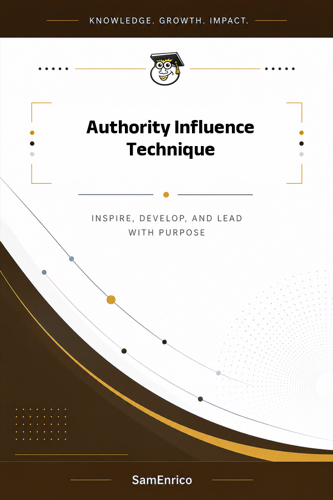
Authority Influence Technique eBook
Establish credibility to make others more likely t
Establish credibility to make others more likely to agree.
Formats
Free sample
Chapter 1: The Trust Lie--–- In 2019, a forty-two-year-old cardiologist named Dr. Chen stood before a packed auditorium of medical peers and delivered a presentation on a new protocol for treating hypertension. He had three board certifications, twenty years of clinical experience, and a research fellowship from a top-tier university. His slides were immaculate. His data was peer-reviewed.
His delivery was confident. When he finished, the first question from the audience was not about his methodology or his conclusions. It was: “Did this study receive any funding from pharmaceutical companies?”Dr. Chen was stunned. Not because the question was unfair—it was entirely reasonable—but because ten years earlier, no one would have asked it.
Ten years earlier, the audience would have assumed that a cardiologist of his stature was trustworthy. They would have listened, nodded, and updated their practices accordingly. But in 2019, the default setting had changed. Trust was no longer granted. It was interrogated.This chapter is about that interrogation.
It is about why the old assumption of expertise has collapsed, why your degrees and titles no longer protect you, and why the very word “authority” has become suspect in the minds of the people you most need to persuade. If you want to make others agree with you—not because you have power over them, but because they genuinely believe you—you must first understand why they have stopped believing in everyone else.The Collapse of the Automatic Yes There was a time, not so long ago, when authority was a shortcut. People did not have the time, energy, or access to verify every claim made by every expert. So they developed a mental heuristic: if someone had the right title, the right degree, or the right position, they were probably worth listening to. This heuristic was not perfect, but it worked well enough to become the default setting for human interaction.That default setting has now been reversed.
The automatic yes has become an automatic maybe, and often an automatic no.The data on this shift is overwhelming. In 1972, the Stanford Prison Experiment—deeply flawed though it was—still captured a cultural truth: people would obey authority figures even when it felt wrong. Philip Zimbardo’s participants wore uniforms and followed orders because the trappings of authority triggered deep psychological compliance. Today, those same uniforms would provoke skepticism, not submission. A 2023 study published in the Journal of Experimental Social Psychology found that participants were 62 percent less likely to comply with an authority figure’s request than participants in a replication of Milgram’s obedience study from the 1960s.
The decline is not subtle. It is a landslide.What caused this landslide? The answer is not any single scandal, though there have been plenty. It is the cumulative weight of thousands of betrayals, large and small, that have taught the public a single, brutal lesson: titles do not guarantee truth.The Anatomy of a Betrayal To understand why trust has cratered, we must look not at the headline-grabbing disasters, but at the everyday failures that have eroded confidence one interaction at a time.Consider the financial advisor who sold his elderly client a variable annuity with hidden fees, pocketing a commission while the client lost retirement savings. The advisor had a license, a suit, and a corner office.
He looked like an authority. But he was a predator in disguise. His client did not find out until three years later, when a different advisor reviewed the paperwork. By then, the damage was done.Consider the contractor who assured a young couple that their foundation was sound, took a $40,000 deposit, and then disappeared. He had a business license, a website with five-star reviews (all fake), and a charming manner.
He looked like an authority. But he was a thief. The couple lost their savings and their dream of a home.Consider the influencer with two million followers who claimed that a certain herbal supplement could cure autoimmune disease. She had no medical training, but she had a massive audience and a confident smile. She looked like an authority.
But she was a fraud. Her followers stopped their prescribed medications, and some of them suffered permanent harm.Each of these stories follows the same pattern: someone who looked like an authority turned out to be unworthy of trust. And each story spreads. Not just to the direct victims, but to everyone who hears about it. The ripples multiply.
And eventually, the entire pond is disturbed.This is the Authority Betrayal Effect: every time a person with credentials misuses those credentials, the trustworthiness of all credentialed people declines slightly. It does not matter that you have never betrayed anyone. You still pay the price for the betrayals of others. The trust account of your profession is being drained by people who do not even know you exist.The Two Authorities: Positional and Earned At this point, we must make a distinction that will shape everything that follows in this book. Most people use the word “authority” as if it were a single thing.
It is not. There are two entirely different kinds of authority, and confusing them is the root cause of most persuasion failures.Positional Authority is the kind that comes from outside you. It is granted by an institution, a title, a license, a degree, or a badge. It says: “You must listen to me because of where I stand in the hierarchy.” Positional authority is efficient—society could not function without some degree of it—but it is also brittle. One scandal, one mistake, one viral video, and positional authority shatters.
The CEO who is exposed for fraud loses not only his job but his ability to influence anyone ever again. The doctor who makes a fatal error loses not only her license but the trust of every future patient. Positional authority is borrowed, and the lender can call in the debt at any time.Earned Authority is the kind that comes from inside you. It is built through consistent, transparent, reliable judgment over time. It says: “You choose to listen to me because of what I have done.” Earned authority is portable—you carry it with you from job to job, from industry to industry.
It is durable—one mistake does not destroy it if you handle it correctly, because your track record of reliability provides a cushion of goodwill. And it is democratic—anyone can earn it, regardless of title, degree, or background. The most trusted person in any organization is rarely the one with the fanciest title. It is the one who has repeatedly demonstrated good judgment and integrity.Here is the insight that separates successful influencers from struggling ones: Positional authority is dying, but earned authority is thriving. The problem is that most professionals are still trying to use positional authority in a world that no longer respects it.
They lead with their title. They flash their degree. They say, “Trust me, I’m the expert.” And they are baffled when the response is a blank stare or a pointed question.The Seven Symptoms of Authority Decay How do you know if you are personally affected by this shift? Look for these seven symptoms in your…
This is the end of the free sample. Get the eBook to keep going. Buy now
About this book
Details
- Author
- Barrios Cassie
- Publisher
- SamEnrico
- Language
- English
- Genre
- Non-Fiction, Self-Help, Credibility
- Released
- 2026-06-07
- Pages (approx.)
- 138
- Available as
- eBook, Audiobook

Read better in the ZLOADR app
Your eBooks on your phone or tablet. Sign in with your SamEnrico account and start reading.
More by Barrios Cassie
 Caregiving For Parent With Macular DegenerationBarrios Cassie$11.99
 Golden Milk Turmeric GuideBarrios Cassie$11.99
 Cash Only Recovery PlanBarrios Cassie$11.99
 Stress and Cortisol Driven Binge EatingBarrios Cassie$11.99
 Cholesterol Exercise GuideBarrios Cassie$11.99
 Avalanche Survivor TacticsBarrios Cassie$11.99
 Nocturnal Panic AttacksBarrios Cassie$11.99
 The Hammer of Hastings: Harold Godwinson's Last StandBarrios Cassie$11.99
 The Forge of Hephaestus: The Lame God Who Shaped OlympusBarrios Cassie$11.99
 How to Produce Home Automation KitsBarrios Cassie$11.99
 How to Become a Railroad-maintenance ClerkBarrios Cassie$11.99
 International Franchise Dispute ResolutionBarrios Cassie$12.99
You may also like
 Hong Kong Handover 1997Dunn Johnnie$11.99
 Zumba For Postnatal Recovery CourseNeal Christian$11.99
 Zumba for BeginnersLadner Nikia$11.99
 YouTube Comment Mining GuideHumes Pandora$12.99
 Worry Box MeditationCarlin Rudy$11.99
 Workplace Stress MeditationNguyen Lynn$11.99
 Workplace Stress and Sleep RepairHawley Ivory$11.99
 Workplace Perfectionism CureDelaney Jeffry$11.99
 Workplace Injustice Anger GuideWallen Isabelle$11.99
 Work Addiction and Burnout LinkGreenwood Ester$11.99
 Women in Yoga and WellnessBeattie Galina$11.99
 Women in Stand Up ComedyChun Evangeline$11.99