
Non-FictionBusiness BriefAudit PrepStartup Guide
Audit Preparation Guide eBook
Organizes records for potential review.
by Dugas Reta
Organizes records for potential review.
Formats
Free sample
Chapter 1: The Panic Notice--The envelope arrived on a Tuesday. Standard white business envelope, government return address, nothing on the outside to suggest the chaos it would unleash within hours. Maria Chen, owner of a twelve-employee logistics company, opened it during her morning coffee. Three pages. An IRS audit notice requesting forty-seven specific documents spanning four tax years.
The deadline: thirty days. She had ninety minutes before her first meeting of the day.What happened next is a story told in thousands of offices every single day, yet almost no one talks about it publicly. Maria spent the next four hours pulling open every file cabinet drawer in her office, searching through stacks of paper on her desk, calling her bookkeeper (who was on vacation), texting her former accountant (who had retired), and eventually sitting on the floor of her storage room surrounded by eight cardboard boxes labeled with nothing more than "2019–2022 – Misc." Her hands were shaking. Her stomach was in knots. She was certain she was going to be fined, possibly audited again next year, and absolutely sure she looked incompetent.Forty-seven documents.
After six hours of searching, she found twelve.This is not a story about fraud or negligence. Maria was a competent business owner who paid her taxes on time, kept reasonable records by small business standards, and had never been in trouble with any regulatory agency. But she had never been audited before. No one had ever taught her what auditors actually request, how to organize for a potential review, or what the difference is between "good enough for daily operations" and "good enough for a federal auditor." She was operating under what we will call throughout this book the illusion of control: the false belief that because she understood her own filing system, anyone else would too.Maria eventually hired an emergency document retrieval service, paid $4,700 in rush fees, and barely met the deadline. Her audit concluded with no penalties, but the experience cost her three weeks of productive work, untold stress, and the lingering fear that the next notice would be worse.
She is not unusual. She is the rule.The Brutal Truth No One Tells You Let us begin with a painful reality documented in every major audit study over the past two decades: audit clients receive significantly less formal education on audit processes than auditors themselves. This is not an accident or a conspiracy. It is simply how the system evolved. Auditors undergo years of training, certification exams, continuing education requirements, and supervised fieldwork before they are allowed to lead an audit independently.
The organizations being audited? They receive nothing. No training. No handbook. No warning beyond the notice itself.This knowledge gap creates chronic anxiety, inefficiency, and costly mistakes.
According to data compiled from IRS enforcement statistics and private audit firms, the average organization spends 187 hours responding to an audit request—and nearly 60 percent of that time is spent searching for documents, recreating lost records, or verifying information that should have been readily available. The actual review of documents by auditors accounts for less than a quarter of total audit time. The rest is chaos.The costs extend far beyond wasted hours. Direct financial losses from penalties and missed deductions are obvious. Less obvious but equally damaging are the promotional setbacks: audits that delay loan applications, derail contract bids, postpone business sales, and freeze expansion plans.
Banks and investors view an active audit as a liability. Potential buyers walk away. Opportunities evaporate.Then there is the reputational damage. A messy audit does not stay private forever. Regulators share information.
Industry groups maintain records. And in regulated industries like healthcare, financial services, and government contracting, a poor audit outcome can trigger enhanced scrutiny for years, including more frequent audits, shorter response deadlines, and a presumption of noncompliance that you must disprove rather than the other way around.The good news—and the entire reason this book exists—is that none of this is necessary. Every single hour of chaos, every dollar of panic spending, every sleepless night before a deadline can be prevented with a fundamentally different approach to record organization. Not a more expensive approach. Not a more time-consuming approach.
A different approach.The Reactive Trap Before we can build a better system, we must understand why almost everyone defaults to the wrong one. The reactive approach to audit preparation follows a predictable pattern that you have likely experienced yourself or witnessed in your organization.Phase one is ignorance. No one thinks about audits during normal operations. Records are kept in whatever way seems convenient at the moment. Receipts go into folders, boxes, or (most commonly) digital photo albums on phones.
Invoices are saved to desktops with names like "invoice final final 3.pdf." Spreadsheets multiply without anyone tracking which version is current.Phase two is panic. An audit notice arrives, and suddenly everything becomes urgent. The person who receives the notice immediately starts searching, calling, and demanding documents from colleagues. Calendars are cleared. Other work stops.
The entire organization shifts into crisis mode.Phase three is scramble. People search randomly because there is no master index telling them where documents live. They search the same places multiple times because no one is tracking what has been checked. They request documents from people who no longer have them because retention schedules were never established. They recreate documents that should have been saved originally.Phase four is exhaustion.
The audit concludes. Everyone swears they will be better organized next time. And then nothing changes because daily operations take priority again. The cycle resets, waiting for the next notice.This pattern is so common that it has a name in audit literature: reactive audit syndrome. It affects organizations of every size, from sole proprietorships to Fortune 500 companies.
The difference is that larger organizations have dedicated compliance teams whose entire job is to manage the scramble. Smaller organizations simply suffer.The reactive trap persists because it feels productive in the moment. Searching frantically feels like action. Finding a document after hours of hunting feels like success. But these feelings mask a terrible inefficiency: you are spending ten hours to accomplish what should take ten minutes.Throughout this book, we will replace the reactive trap with what we call the SHIELD framework.
You will see this acronym repeatedly because it structures every system and process we build together. SHIELD stands for six principles that, when implemented systematically, transform audit preparation from a source of terror into a routine administrative function.Systematize your filing architecture so documents go to predictable locations based on clear rules rather than momentary convenience. Hunt for gaps before reviewers do, using mock audits and self-assessments to find weaknesses when the only cost is your time. Index everything for five-second retrieval using a universal addressing system that any employee or auditor can follow. Evidence your controls in writing so you can prove your systems work rather than just asserting they do.
Log every request and response using a register that prevents duplicate work and creates accountability. Debrief and improve after every cycle so each audit makes your next one easier rather than harder.By the end of this chapter, you will have diagnosed your current…
This is the end of the free sample. Get the eBook to keep going. Buy now
About this book
Details
- Author
- Dugas Reta
- Publisher
- SamEnrico
- Language
- English
- Genre
- Non-Fiction, Business Brief, Audit Prep, Startup Guide, Auditing
- Released
- 2026-06-09
- Pages (approx.)
- 138
- Available as
- eBook, Audiobook

Read better in the ZLOADR app
Your eBooks on your phone or tablet. Sign in with your SamEnrico account and start reading.
More by Dugas Reta
 Workplace Esteem for Career ChangersDugas Reta$11.99
 International Expansion Business Planning HandbookDugas Reta$11.99
 The Train Window JourneyDugas Reta$11.99
 Genetic Testing for OsteoporosisDugas Reta$11.99
 Parent Death Practical Estate GuideDugas Reta$11.99
 Beneath the Phantom Waves: The Lost Sub of the Bermuda TriangleDugas Reta$11.99
 The Last Spice Seekers: Rediscovering the Amazon’s Hidden Treasures (1980s)Dugas Reta$11.99
 How to Start a Solid Waste Landfill BusinessDugas Reta$11.99
 Gold TradingDugas Reta$11.99
 Ray Kroc Cash Franchise WorkbookDugas Reta$12.99
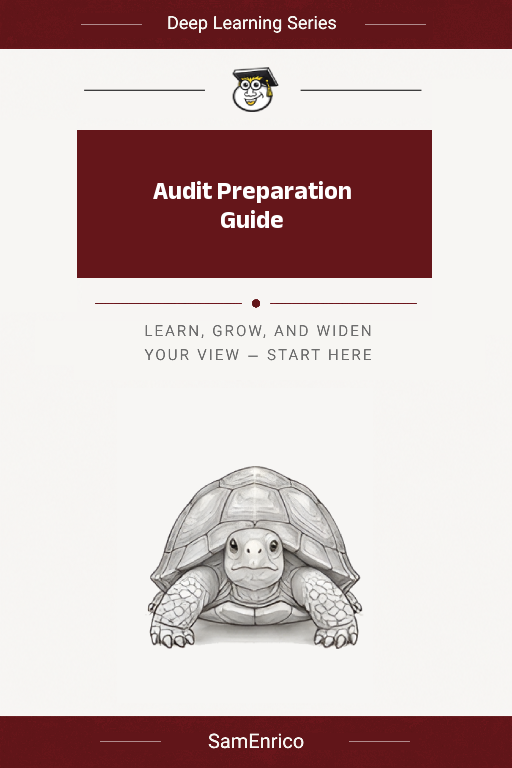 Audit Preparation GuideDugas Reta$12.99
 Understanding Gibson's SyndromeDugas Reta$17.99
You may also like
 Hong Kong Handover 1997Dunn Johnnie$11.99
 Zumba For Postnatal Recovery CourseNeal Christian$11.99
 Zumba for BeginnersLadner Nikia$11.99
 YouTube Comment Mining GuideHumes Pandora$12.99
 Worry Box MeditationCarlin Rudy$11.99
 Workplace Stress MeditationNguyen Lynn$11.99
 Workplace Stress and Sleep RepairHawley Ivory$11.99
 Workplace Perfectionism CureDelaney Jeffry$11.99
 Workplace Injustice Anger GuideWallen Isabelle$11.99
 Work Addiction and Burnout LinkGreenwood Ester$11.99
 Women in Yoga and WellnessBeattie Galina$11.99
 Women in Stand Up ComedyChun Evangeline$11.99