
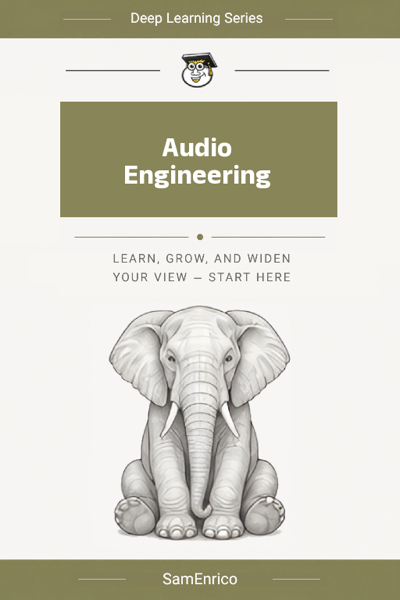
Non-FictionInformativeEducational
Audio Engineering eBook
A Coursebook on Audio Engineering
A Coursebook on Audio Engineering
Formats
Free sample
Chapter 1: The Listening Lie...--– Your ears are lying to you right now. Not because there's anything wrong with them, but because human hearing was never designed for audio engineering. Evolution tuned your ears to detect predators, locate prey, and understand speech in a noisy savanna – not to judge whether a kick drum has too much 60 Hz or a vocal track needs 2 d B less compression. Every listening decision you make is filtered through a biological system that is fundamentally flawed for the task of critical listening. This is not a weakness.
It's the starting line.The single greatest obstacle to becoming an audio engineer is not the gear, not the software, not even the budget. It's the difference between what you hear and what is actually there. Your ears compress loud sounds automatically (the acoustic reflex). They are less sensitive to low frequencies at quiet volumes (the Fletcher-Munson effect). They cannot tell the difference between a delayed sound and a louder one (the precedence effect).
And the longer you listen, the more your judgment drifts (auditory fatigue). Professional engineers are not people with perfect ears. They are people who have learned to compensate for their ears' built-in lies.This chapter is not about physics equations or gear specifications. It is about the biology and psychology of hearing – because until you understand how your ears deceive you, you will spend years chasing problems that don't exist and missing problems that do. By the end of this chapter, you will know why your mixes sound different at different volumes, why you can't trust your ears after an hour of mixing, and why the brain is often a better engineering tool than the ears.
More importantly, you will have a set of practical strategies to defeat every lie your ears tell you.The First Lie: Loudness Is Not Volume What you hear: When you turn up your monitors, everything sounds better. The bass feels punchier. The vocals sit more clearly. The whole mix seems more professional.The truth: You have just fallen for the single most dangerous lie in audio engineering. Louder always sounds better to human ears – regardless of the actual quality of the mix.
This is not a matter of opinion; it is a measurable, repeatable psychological fact. The phenomenon is called the equal-loudness contour, discovered by Harvey Fletcher and Wilden Munson in 1933 and refined by the International Organization for Standardization (ISO 226:2003).Here is what actually happens when you turn up the volume. Your ears are not linear sensors. They are most sensitive to frequencies between 1 k Hz and 5 k Hz – the range of human speech and the frequencies that once told your ancestors whether that rustle in the bushes was wind or a predator. At low listening levels (conversation volume, around 70 d B SPL), your ears are significantly less sensitive to low frequencies (below 100 Hz) and very high frequencies (above 10 k Hz).
As you turn up the volume, the ear's response becomes flatter. At high levels (85 d B SPL and above), low frequencies finally feel as loud as mids.This means that a mix that sounds balanced at 85 d B SPL will sound thin and bass-weak when played at 70 d B SPL. Conversely, a mix that sounds balanced at 70 d B SPL will sound boomy and overwhelming when played at 85 d B SPL. Professional engineers know this. They check their mixes at multiple volumes – quiet, medium, loud – before making final decisions.The fix: Never make final EQ or balance decisions at only one volume.
Use this protocol:70 d B SPL (conversation level): Check vocal intelligibility and high-frequency balance. If the mix sounds thin, don't boost bass yet – check it at high volume first.85 d B SPL (control room standard): Make your primary mix decisions here. This is where the ear's response is flattest.90+ d B SPL (brief checks only): Check low-end punch and kick/bass relationship. Do not mix at this level for more than a few minutes – you will fatigue your ears and damage your hearing.Myth Buster – "Professional engineers mix at loud volumes because it sounds better." False. Professional engineers mix at 73–85 d B SPL for most of their day.
They turn up loud only to check low end or to impress clients. The engineer who constantly cranks the volume is usually compensating for poor acoustic treatment or untrained ears.Studio Challenge – The Volume Test: Load a mix you trust (a commercial release you admire). Listen at 70 d B SPL (conversation level). Note what you hear: is the bass still present? Are the cymbals too loud?
Now turn up to 85 d B SPL. The bass should become more prominent. Now turn down to 60 d B SPL (quiet conversation). The bass may disappear entirely. This is not a flaw in the mix – it is the Fletcher-Munson effect.
Your job is to create a mix that still sounds musical across all these volumes, even though the ear's response changes.The Second Lie: Your Ears Have a Volume Knob You Can't Control What you hear: After mixing for an hour, the track starts to sound dull. You add more high end. Another hour passes, and it sounds dull again. You add more. By the end of the session, your mix is unbearably bright, but it sounded balanced when you made each change.The truth: Your ears have an automatic volume control, and you cannot turn it off.
It's called the acoustic reflex, or the stapedius reflex. Two tiny muscles in your middle ear – the tensor tympani and the stapedius – contract in response to loud sounds. This tightens the connection between your eardrum and the inner ear, reducing the amount of sound energy that reaches the cochlea by approximately 15–20 d B. It is an evolutionary adaptation to prevent hearing damage from sudden loud noises like thunder or a predator's roar.The problem is that the acoustic reflex does not reset instantly. It adapts over minutes to hours.
When you mix at the same moderate level for an extended period, the reflex slowly engages, making everything sound quieter and duller. You compensate by turning up the volume or boosting high frequencies. But the acoustic reflex adapts again. You turn up again. This is the loudness war treadmill, and it ends only when you stop mixing, take a break, and let your ears reset.The fix: The 20-minute rule.
For every 20 minutes of active mixing, take a 5-minute break in silence or near-silence. During this break, do not listen to music, do not watch videos, and do not check your mix on headphones. Walk away. Get water. Look at something far away (which also resets your eye's accommodation reflex).
When you return, your acoustic reflex will have partially reset. For longer sessions, take a 20-minute break after 90 minutes of mixing. This is not optional. It is as essential as saving your session.What Bob Katz actually does: The legendary mastering engineer uses the "20/20 rule" – 20 minutes of listening, 20 seconds of silence to reset ear sensitivity. For critical decisions, he listens at 77 d B SPL (lower than most) and periodically checks at 83 d B SPL for bass balance.
He has maintained pristine hearing for over 40 years.Critical Listening Exercise – Auditory Fatigue: Schedule a 90-minute mixing session on…
This is the end of the free sample. Get the eBook to keep going. Buy now
About this book
Details
- Author
- Benitez Bridgette
- Publisher
- SamEnrico
- Language
- English
- Genre
- Non-Fiction, Informative, Educational
- Released
- 2026-05-04
- Pages (approx.)
- 160
- Available as
- eBook, Audiobook

Read better in the ZLOADR app
Your eBooks on your phone or tablet. Sign in with your SamEnrico account and start reading.
More by Benitez Bridgette
 24/7 Support Time Zone StrategyBenitez Bridgette$11.99
 Attention Residue Management GuideBenitez Bridgette$11.99
 Medical School Essay PromptsBenitez Bridgette$11.99
 The Public Speaking Memory GuideBenitez Bridgette$11.99
 Divorce and Military BenefitsBenitez Bridgette$11.99
 The Alchemists of the Royal Court: Turning Science into GoldBenitez Bridgette$11.99
 How to Start a Ophthalmic Eyeglasses Business (Beginners Guide)Benitez Bridgette$11.99
 Logistics M&A GuideBenitez Bridgette$12.99
 Understanding Plague, PneumonicBenitez Bridgette$17.99
You may also like
 Hong Kong Handover 1997Dunn Johnnie$11.99
 Zumba For Postnatal Recovery CourseNeal Christian$11.99
 Zumba for BeginnersLadner Nikia$11.99
 YouTube Comment Mining GuideHumes Pandora$12.99
 Worry Box MeditationCarlin Rudy$11.99
 Workplace Stress MeditationNguyen Lynn$11.99
 Workplace Stress and Sleep RepairHawley Ivory$11.99
 Workplace Perfectionism CureDelaney Jeffry$11.99
 Workplace Injustice Anger GuideWallen Isabelle$11.99
 Work Addiction and Burnout LinkGreenwood Ester$11.99
 Women in Yoga and WellnessBeattie Galina$11.99
 Women in Stand Up ComedyChun Evangeline$11.99