
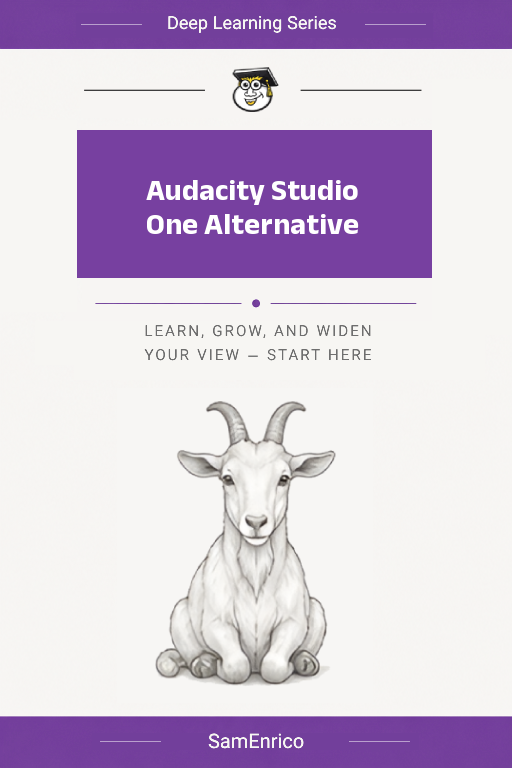
Non-FictionStartup GuideAudio ProductionFree DAW
Audacity Studio One Alternative eBook
Record, mix, and master podcasts or music using fr
Record, mix, and master podcasts or music using free Audacity instead of Pro Tools.
Formats
Free sample
Chapter 1: The Subscription Trap--–- On a rainy Tuesday afternoon in Nashville, a first-time podcaster named Marcus sat staring at his credit card statement. He had just been charged $29.99 for his monthly Pro Tools subscription—a fee he had reluctantly agreed to three months earlier after watching a You Tube tutorial that insisted he couldn't sound "professional" without it. The problem was that Marcus had only opened the software twice. His podcast, a heartfelt interview series about local musicians, had exactly zero episodes released. The subscription cost had already exceeded the price of his modest audio interface.
And deep down, Marcus suspected the real barrier wasn't the software—it was the paralyzing belief that he needed expensive tools before he could even begin.Marcus is not alone. Every day, thousands of aspiring podcasters, indie musicians, voice-over artists, and audiobook narrators sign up for Pro Tools subscriptions they cannot afford, using features they do not need, while a completely free, remarkably capable alternative sits waiting on their hard drives. That alternative is Audacity, and the only thing preventing it from being the go-to choice for independent creators is a persistent myth: that free software cannot deliver professional results.This chapter is not a dry software manual. It is an intervention. We are going to dismantle the psychological biases that make you equate price with quality.
We are going to compare Audacity 3.6 feature-for-feature against Pro Tools Artist and Pro Tools Studio, using actual data rather than marketing hype. We will introduce the 80/20 Rule of audio production—a principle that will save you hundreds of dollars and dozens of hours of frustration. And by the end of this chapter, you will have performed a blind test that proves, beyond any reasonable doubt, that Audacity can produce audio indistinguishable from Pro Tools for the vast majority of real-world projects.Welcome to the rebellion against the subscription economy. Your wallet will thank you. Your listeners will never know the difference.The Psychology of Price: Why We Believe Expensive Means Better Before we talk about software features or audio fidelity, we need to address the elephant in the recording studio: your own brain.
Humans are not rational creatures when it comes to pricing. We are influenced by a cognitive bias known as the Veblen effect, named after the economist Thorstein Veblen who observed that people often perceive higher-priced goods as higher-quality goods, regardless of objective performance. This is why a 50bottleofwinecantaste"better"thana50 bottle of wine can taste "better" than a 50bottleofwinecantaste"better"thana15 bottle in blind taste tests, even when the wines are identical. This is why luxury handbags cost thousands of dollars despite using the same materials as mid-range bags. And this is why Pro Tools can charge $30 per month while Audacity charges nothing, and many beginners still assume Pro Tools must be superior.The Veblen effect is particularly dangerous in creative fields because it preys on insecurity.
When you are learning a new skill—whether it is audio engineering, photography, or video editing—you lack the internal confidence to trust your own judgment. You look for external validation. And expensive software provides that validation through sheer price tag. You tell yourself, "If professionals use Pro Tools, and if Pro Tools costs money, then using Pro Tools makes me feel like a professional." This is an emotional purchase masquerading as a practical one.But here is the truth that software companies do not want you to hear: the cost of a tool has almost no correlation with the quality of the output when the user is a beginner or intermediate creator. A world-class guitarist can make a 200acousticguitarsoundbreathtaking.Abeginnerwillsoundlikeabeginnerona200 acoustic guitar sound breathtaking.
A beginner will sound like a beginner on a 200acousticguitarsoundbreathtaking.Abeginnerwillsoundlikeabeginnerona5,000 Martin. The same principle applies to digital audio workstations. The bottleneck is never the software. It is always the skill of the user.Audacity has been downloaded over 200 million times. It has been used to produce Grammy-nominated recordings, award-winning podcasts, and best-selling audiobooks.
The software is not the limitation. The belief that you need to spend money to sound good—that is the limitation.What Pro Tools Actually Does That Audacity Cannot (The Honest List)Let us be ruthlessly honest. Pro Tools is extraordinary software. It dominates professional studios for good reasons. If you are scoring a Hollywood film, editing a 128-track orchestral recording, or synchronizing audio to video for a television broadcast, Pro Tools is likely the right tool for the job.
This book will never claim that Audacity can do everything Pro Tools can do. That would be a lie. Instead, we are going to draw a clear line between what professionals need and what independent creators actually need.Here is what Pro Tools does that Audacity cannot, in plain English:First, advanced MIDI composition. Pro Tools includes a piano roll editor, virtual instrument hosting, and real-time MIDI quantization. If you want to compose electronic music using software instruments like synthesizers or sampled orchestras, you need a DAW with MIDI support.
Audacity has no MIDI capabilities whatsoever. You cannot draw in a bassline with a mouse. You cannot trigger drum samples from a keyboard controller. This is Audacity's single biggest limitation, and it is the primary reason why electronic music producers should look elsewhere (or use the hybrid workflow described in Chapter 13).Second, video synchronization and post-production features. Pro Tools includes a video timeline, frame-accurate editing, and the ability to import video files for scoring or dialogue replacement.
Audacity cannot import video. If you are editing audio for film or television, Audacity is not your tool.Third, surround sound and immersive audio. Pro Tools supports up to 7.1.4 surround sound, Dolby Atmos, and ambisonics for virtual reality. Audacity is strictly stereo (two channels). For podcasters and indie musicians recording in stereo, this limitation does not matter.
For post-production engineers, it is a dealbreaker.Fourth, hardware control surfaces out of the box. Pro Tools integrates seamlessly with physical mixing consoles like the Avid S1 or SSL UF8. You can touch faders and have them move automatically. Audacity has no native support for control surfaces. This matters for large commercial studios.
It does not matter for a solo podcaster recording in a bedroom.Fifth, advanced routing and side-chaining. Pro Tools allows you to route audio from one track to another for parallel processing, side-chain compression (where a kick drum triggers compression on a bass track), and complex auxiliary sends. Audacity's routing is basic. You cannot set up a side-chain compressor. You cannot create multiple effects sends.
This limitation becomes relevant for advanced mixing, but as you will learn in Chapter 8, there are workarounds for most common scenarios.That is the honest list. Five major features that Audacity lacks. If you need any of them, this book will help you understand when to upgrade to a full DAW like Reaper or Ardour (see Chapter 13). But for the remaining 90% of podcasters, voice-over artists, audiobook narrators, and musicians recording live instruments, these missing features are irrelevant. They are solutions in search of problems.What Audacity Does Better (Yes, Better) Than Pro Tools Now for the counterpunch.
There are several areas where Audacity genuinely outperforms Pro Tools—not because it is free, but because the developers have focused…
This is the end of the free sample. Get the eBook to keep going. Buy now
About this book
Details
- Author
- Castleberry Santina
- Publisher
- SamEnrico
- Language
- English
- Genre
- Non-Fiction, Startup Guide, Audio Production, Free DAW
- Released
- 2026-05-30
- Pages (approx.)
- 144
- Available as
- eBook, Audiobook

Read better in the ZLOADR app
Your eBooks on your phone or tablet. Sign in with your SamEnrico account and start reading.
More by Castleberry Santina
 Interruption Recovery ScriptCastleberry Santina$11.99
 Talking About SuicideCastleberry Santina$11.99
 Loneliness Improv Comedy ClassCastleberry Santina$11.99
 Construction Industry Relationship BuildingCastleberry Santina$11.99
 Agoraphobia HypnosisCastleberry Santina$11.99
 Senior Sleep Esteem GuideCastleberry Santina$11.99
 Stage Four SurvivorCastleberry Santina$11.99
 Burnout Recovery for LawyersCastleberry Santina$11.99
 Antwerp Heist Evidence RoomCastleberry Santina$11.99
 Xochiquetzal and Tezcatlipoca: The Flowered Serpent's Forbidden LoveCastleberry Santina$11.99
 The Iron Spine of Asia: How a Forgotten Engineer Defied Colonial Powers to Build the Godavari BridgeCastleberry Santina$11.99
 The Great Space Race: How Two Nations Split the CosmosCastleberry Santina$11.99
You may also like
 Hong Kong Handover 1997Dunn Johnnie$11.99
 Zumba For Postnatal Recovery CourseNeal Christian$11.99
 Zumba for BeginnersLadner Nikia$11.99
 YouTube Comment Mining GuideHumes Pandora$12.99
 Worry Box MeditationCarlin Rudy$11.99
 Workplace Stress MeditationNguyen Lynn$11.99
 Workplace Stress and Sleep RepairHawley Ivory$11.99
 Workplace Perfectionism CureDelaney Jeffry$11.99
 Workplace Injustice Anger GuideWallen Isabelle$11.99
 Work Addiction and Burnout LinkGreenwood Ester$11.99
 Women in Yoga and WellnessBeattie Galina$11.99
 Women in Stand Up ComedyChun Evangeline$11.99