
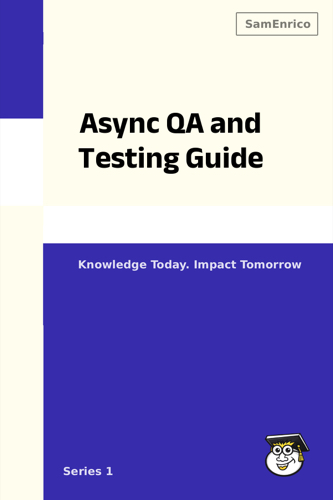
Async QA and Testing Guide eBook
Report bugs, review test cases, and sign off on re
Report bugs, review test cases, and sign off on releases asynchronously using issue trackers and checklists.
Formats
Free sample
Chapter 1: The Fragile Hour--–- The first time I saw a QA engineer cry was not over a production outage or a missed deadline. It was over a calendar invitation. The invite read: “Recurring Daily Standup – 30 minutes – 9:30 AM.” She had been in that meeting for eighteen months. Eighteen months of giving the same three updates, watching the same two people dominate the conversation, and losing the same ninety minutes of deep testing work every single week. She was not burning out because the software was hard.
She was burning out because the process was synchronous.This chapter is the foundation of everything that follows. Before we discuss bug reports, test cases, checklists, or release sign-offs, we must answer a single question: Why async? Why would a team choose to abandon the comfort of the daily standup, the war room, the quick sync, and the tap on the shoulder? The answer is not convenience. It is not about liking Slack better than a conference room.
The answer is economic, psychological, and empirical. Synchronous QA is silently stealing your team's time, crushing its focus, and injecting bias into its decisions. Asynchronous QA is not a compromise. It is an upgrade.We begin with a story. Then we build a case.
Then we establish the rules that will govern every chapter that follows.The $10,000 Interruption Consider a typical afternoon in a typical software team. A QA engineer named Priya is testing a payment flow. She has been in flow state for forty-seven minutes. She has discovered two edge cases, written half a bug report, and is mentally tracing the path of a transaction from the front end to the database. Her focus is absolute.
Then a Slack notification appears: “Hey, quick question about the login ticket?” She glances. She replies. She returns to the payment flow.According to research from the University of California, Irvine, it will take her twenty-three minutes to return to her previous level of focus. That quick question cost twenty-three minutes. If Priya experiences three such interruptions in a day, she loses over an hour of deep work.
Over a forty-week year, that is nearly two hundred hours. At a conservative billing rate of fifty dollars per hour, that is ten thousand dollars of lost productivity per engineer per year. And that is just Slack interruptions. It does not include the thirty-minute standup, the forty-five-minute bug triage meeting, the hour-long test case review, or the fifteen-minute “quick sync” that derails an entire afternoon.This is the hidden cost of synchronous QA. It is not that meetings are evil.
It is that meetings are fragments. They break the one thing that makes testing valuable: sustained, uninterrupted cognitive focus. Testing is not typing. Testing is thinking. And thinking cannot be scheduled in thirty-minute increments.Defining the Terms: Async Versus Real-Time Let us be precise.
Asynchronous QA is any testing-related activity where participants contribute information, decisions, or approvals without requiring simultaneous presence. A bug report filed at 10 PM that a developer reads at 8 AM is asynchronous. A test case reviewed via comments over forty-eight hours is asynchronous. A release signed off with a checklist and a timestamp is asynchronous. The defining characteristic is temporal decoupling: the contributor and the consumer do not need to occupy the same moment.Real-time QA is the opposite.
A sprint demo where everyone watches a screen share is real-time. A war room where five people stare at a dashboard is real-time. A live pair testing session is real-time. A bug triage meeting where tickets are read aloud is real-time. The defining characteristic is temporal coupling: everyone must be present simultaneously.The argument of this book is not that real-time QA has no place.
It is that real-time QA has been grossly overused. Teams default to meetings because meetings are easy to schedule and hard to measure. Async requires discipline. Async requires artifacts. Async requires writing things down.
But async also preserves the one thing that makes testing effective: the tester's ability to think without interruption.The Three Harms of Synchronous QATo understand why async is superior, we must understand what sync destroys. There are three distinct harms.Harm One: The Cost of Interruptions We have already introduced the twenty-three-minute recovery time. But this research deserves fuller treatment. The University of California, Irvine study tracked information workers in their natural environments. It found that the average worker was interrupted every eleven minutes.
After each interruption, it took twenty-three minutes to return to the original task. This means that a single interruption does not cost eleven minutes. It costs thirty-four minutes: eleven minutes lost to the interruption itself, plus twenty-three minutes of recovery. Over a seven-hour workday, the typical worker experiences fifty-six minutes of interruption cost. That is nearly an hour of pure waste.For QA engineers, the cost is higher.
Testing requires holding a mental model of the system: preconditions, inputs, expected outputs, edge cases, state transitions. Interruptions collapse that mental model. When Priya returns to the payment flow after answering a Slack message, she does not simply resume typing. She must rebuild her mental map. Which test data was she using?
What step was she on? Had she already verified the database entry? This reconstruction time is not captured in the twenty-three-minute average. It is additional. The true cost of a synchronous interruption for a tester may be closer to forty-five minutes.Harm Two: Cognitive Overload In a live meeting, a tester must perform multiple cognitive tasks simultaneously.
They must listen to whoever is speaking. They must process the information. They must formulate a response. They must watch any screen shares. They must remember the context of previous comments.
They must monitor the clock. And they must suppress the urge to check their other work. This is cognitive overload: the demand on working memory exceeds its capacity.Asynchronous work separates these tasks. You read the ticket first. You think about it.
You write your response. You review it. You send it. Each cognitive operation occupies its own temporal slot. This separation reduces errors, reduces stress, and produces higher-quality outputs.
A bug report written asynchronously is almost always better than a bug described verbally in a meeting. The written report can be edited, clarified, and linked to logs. The verbal description is ephemeral.Harm Three: Bias Amplification This is the subtlest harm and the most insidious. Real-time discussions amplify two specific biases: recency bias and authority bias.Recency bias is the tendency to weigh the most recent information more heavily than earlier information. In a meeting, the last person to speak often carries the day, not because they are correct, but because their argument is fresh in everyone's mind.
The first person to speak, no matter how brilliant, is forgotten by minute twenty. Asynchronous comments are timestamped and displayed in a linear order. No comment benefits from recency unless a reader chooses to sort that way. The playing field is leveled.Authority bias is the tendency to defer to the highest-status person in the room. In a meeting, the senior engineer or the manager can shape the outcome simply by speaking first or by speaking with confidence.
Junior testers often remain silent, even when they have identified a genuine bug. Asynchronous communication anonymizes authority. The comment is…
This is the end of the free sample. Get the eBook to keep going. Buy now
About this book
Details
- Author
- Galarza Neoma
- Publisher
- SamEnrico
- Language
- English
- Genre
- Non-Fiction, Business Brief, QA, Software Testing
- Released
- 2026-06-12
- Pages (approx.)
- 137
- Available as
- eBook, Audiobook

Read better in the ZLOADR app
Your eBooks on your phone or tablet. Sign in with your SamEnrico account and start reading.
More by Galarza Neoma
 TM Daily Practice RoutineGalarza Neoma$11.99
 Meth Recovery Legal Issue GuideGalarza Neoma$11.99
 Counseling with MAT GuideGalarza Neoma$11.99
 Side Hustle Comparison CureGalarza Neoma$11.99
 The Velvet Underground: Exploding the Art of RockGalarza Neoma$11.99
 The Forgotten Broadcast: The Day the BBC VanishedGalarza Neoma$11.99
 Remote Work Lease ImpactGalarza Neoma$12.99
 Chat Support Free GuideGalarza Neoma$12.99
 Understanding Cote–adamopoulos–pantelakis SyndromeGalarza Neoma$17.99
 Cue SportsGalarza Neoma$11.99
 How to Start a Prepared Meat Dishes Business (Beginners Guide)Galarza Neoma$11.99