
Non-FictionInformativeEducational
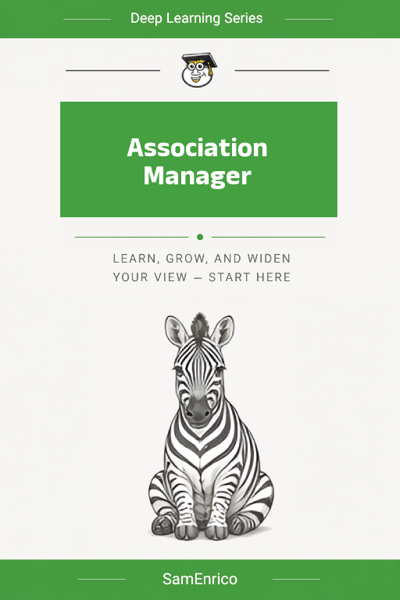
Association Manager eBook
A Coursebook on Association Manager
A Coursebook on Association Manager
Formats
Free sample
Chapter 1: The Two Pillars--–- The first time Maria Sanchez sat in an association board meeting, she thought she had walked into the wrong room. The agenda was eight pages long. Two board members were arguing about the color of a fence. A third was silently scrolling through emails. The president, a well-meaning retired accountant, had no idea how to run a motion.
Forty-five minutes into the meeting, they had accomplished exactly nothing—except alienating three homeowners who came to complain about a leaky roof.Maria had been hired as the new community association manager for a 220-unit condominium in suburban Phoenix. She had a degree in business administration, five years of experience as a property assistant, and a certification that took her six months to earn. But nothing—not one single page of her training—had prepared her for the raw, chaotic, exhausting reality of managing volunteers who thought they were her bosses, owners who thought they were her only client, and a board that couldn't agree on whether to fix the elevator or plant new petunias.That was seven years ago. Today, Maria manages a portfolio of twelve associations: six residential HOAs, four condominium complexes, and two trade associations—a local chapter of real estate agents and a professional society for medical coders. She has learned that the specific rules, documents, and physical assets may change from one property to the next, but the human dynamics remain stubbornly identical.This book is for every association manager who has ever felt like Maria.
It is for the community association manager who is exhausted by the midnight emails about dog waste. It is for the trade association executive who is tired of board members who treat the organization's reserve fund like their personal petty cash. It is for anyone who has ever wondered: Is there a better way to do this?There is. And it starts with understanding the two pillars.The Great Divide That Doesn't Exist The association management industry suffers from a strange and costly delusion. Ask a community association manager—someone who runs an HOA or condominium—what they do, and they will likely describe property management: roofs, landscaping, pools, fences, parking, and the endless cycle of maintenance and enforcement.
Ask a trade association manager—someone who runs a professional society or membership organization—and they will describe strategic planning, member engagement, advocacy, and event logistics.These two groups attend different conferences, earn different certifications, subscribe to different magazines, and rarely speak to one another. The Community Associations Institute (CAI) serves one world. The American Society of Association Executives (ASAE) serves the other. They might as well operate on different planets.But here is the truth that the industry does not want to admit: The differences are almost entirely surface-level.Both types of associations are governed by volunteers who serve on boards. Both rely on a paid manager to execute board decisions.
Both struggle with apathy, conflict, and burnout. Both must balance budgets, enforce rules, communicate with members, and plan for the future. Both operate under state statutes that impose fiduciary duties. And both succeed or fail based on the same factor: the quality of the relationship between the manager, the board, and the members.This book introduces the Two Pillars Framework to bridge this artificial divide. Pillar One is Place-Based Management—community associations that exist because people share physical space, common walls, or common infrastructure.
Pillar Two is People-Based Management—trade and professional associations that exist because people share a vocation, an interest, or a mission.The laws are different. The documents are different. The physical assets are wildly different. But the psychology of association management is identical. And psychology, not plumbing, is what determines success or failure.Pillar One: Place-Based Management (The Common Interest)Community associations—including HOAs, condominiums, cooperatives, and planned communities—exist to solve a collective action problem.
When multiple people own or occupy property that shares walls, roofs, driveways, or amenities, someone must manage the shared elements. Someone must decide when to replace the roof. Someone must enforce the rule about trash cans. Someone must collect money to pay for the lights in the parking garage.The legal vehicle for this is the common interest development. Property owners automatically become members of the association when they purchase their unit or lot.
Membership is not voluntary. You cannot opt out of the HOA fees any more than you can opt out of paying property taxes—at least not without losing your home.This involuntary membership is the defining characteristic of Pillar One. It creates a dynamic that does not exist in trade associations: people who never wanted to be members, who resent the fees, who ignore the rules, and who only show up to board meetings when they are angry. The community association manager must serve these reluctant members with the same professionalism as the engaged ones.The concept of Common Interest, drawn from John Carona's influential work, captures the economic reality of Pillar One. Owners have a shared financial stake in physical assets.
A poorly maintained roof damages every unit. An unfunded reserve study leads to special assessments that bankrupt retirees. A lawsuit from selective enforcement reduces every property value. The manager's job is to protect that common interest, even when individual owners would rather not pay for it.Place-based management requires mastery of: real estate law, construction and maintenance, reserve studies, insurance for physical assets, architectural review, and the delicate art of telling a homeowner that their pink door violates the CC&Rs. But beneath all that technical knowledge lies a simpler truth: the community association manager is the guardian of physical assets that people call home.
When you manage a place, you are managing people's largest investment, their sense of safety, and often their identity.Pillar Two: People-Based Management (The Common Purpose)Trade associations, professional societies, and membership organizations exist for an entirely different reason. No shared walls bind their members together. No roof will leak if they fail to pay. They can walk away at any time—and they often do.The defining characteristic of Pillar Two is voluntary membership. People join a trade association because they want something: networking, education, advocacy, certification, or simply the credibility that comes from belonging to a professional body.
They pay dues year after year only as long as the perceived value exceeds the cost. The moment that equation flips, they leave.This voluntary dynamic creates pressures that do not exist in Pillar One. The trade association manager must constantly prove the organization's worth. Every newsletter, every conference, every webinar, every lobbying effort must deliver tangible value—or members vote with their wallets. The board is not elected by captive homeowners but by engaged professionals who have options.The concept of Common Purpose, drawn from the ASAE body of knowledge, captures the psychological reality of Pillar Two.
Members share a mission or vocation, not a parking lot. They gather around ideas, not infrastructure. The manager's job is to articulate, defend, and deliver on that purpose, even when individual members would rather pursue their own narrow interests.People-based management requires mastery of: membership recruitment and retention, event planning, non-profit accounting, grant writing, advocacy and lobbying…
This is the end of the free sample. Get the eBook to keep going. Buy now
About this book
Details
- Author
- Torrence Steffanie
- Publisher
- SamEnrico
- Language
- English
- Genre
- Non-Fiction, Informative, Educational
- Released
- 2026-06-02
- Pages (approx.)
- 159
- Available as
- eBook, Audiobook

Read better in the ZLOADR app
Your eBooks on your phone or tablet. Sign in with your SamEnrico account and start reading.
More by Torrence Steffanie
 The Zen Commuter PodcastTorrence Steffanie$11.99
 Deep Work Interruption Protection CourseTorrence Steffanie$11.99
 IELTS Task 2 Essay PromptsTorrence Steffanie$11.99
 Divorce and Sibling RelationshipTorrence Steffanie$11.99
 The Nutrition Sleep Memory LinkTorrence Steffanie$11.99
 The Phantom of the Grand Canal: Venice's Architectural EnigmaTorrence Steffanie$11.99
 How to Start a Temporary Shelters BusinessTorrence Steffanie$11.99
 Banking M&A GuideTorrence Steffanie$12.99
 QuickBooks Inventory TrackingTorrence Steffanie$12.99
 Understanding Piussan–lenaerts–mathieu SyndromeTorrence Steffanie$17.99
You may also like
 Hong Kong Handover 1997Dunn Johnnie$11.99
 Zumba For Postnatal Recovery CourseNeal Christian$11.99
 Zumba for BeginnersLadner Nikia$11.99
 YouTube Comment Mining GuideHumes Pandora$12.99
 Worry Box MeditationCarlin Rudy$11.99
 Workplace Stress MeditationNguyen Lynn$11.99
 Workplace Stress and Sleep RepairHawley Ivory$11.99
 Workplace Perfectionism CureDelaney Jeffry$11.99
 Workplace Injustice Anger GuideWallen Isabelle$11.99
 Work Addiction and Burnout LinkGreenwood Ester$11.99
 Women in Yoga and WellnessBeattie Galina$11.99
 Women in Stand Up ComedyChun Evangeline$11.99