
Non-FictionSelf-HelpTenantsHousing
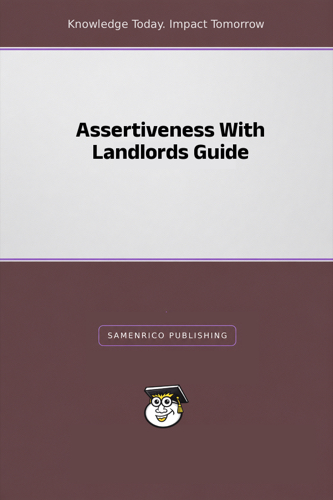
Assertiveness With Landlords Guide eBook
Request repairs, dispute rent increases, and enfor
Request repairs, dispute rent increases, and enforce tenant rights respectfully.
Formats
Free sample
Chapter 1: The Silence Tax--–- Every month, millions of tenants pay a hidden fee that never appears on any lease. It is not listed as "late fee" or "utility surcharge." It does not show up on payment portals. And yet, it costs renters more than all illegal junk fees combined. This chapter names that fee, diagnoses why you have been paying it, and introduces the single psychological shift that separates tenants who suffer in silence from those who live in repaired, respectful homes.The $3,800 Question You Have Never Been Asked Let us begin with a simple experiment. Think about every rental unit you have lived in over the past five years.
Now answer one question: What repair did you never request because you assumed the landlord would say no?For most tenants, the answer comes instantly. A crack in the window seal that lets in cold air. A bathroom fan that sounds like a lawnmower. A sticky door lock that requires three jiggles and a prayer. A slow drain that you have learned to live with.
A missing smoke detector cover. A rusted water heater drip pan. A garbage disposal that has not worked since the day you moved in, but you never reported it because you were afraid of being labeled "difficult."Now multiply the cost of fixing each of those items by the number of months you tolerated them. Add the hours of frustration. Add the cold mornings.
Add the quiet resentment you felt every time you looked at that crack, heard that noise, or wiped up that drip. Add the security deposit dollars you never saw again because you did not document the pre-existing damage.That total is what this book calls The Silence Tax.Based on a synthesis of tenant surveys, housing court data, and academic research on rental housing quality, the average renter pays between $1,200 and $3,800 per year in The Silence Tax—not in cash handed to the landlord, but in diminished quality of life, unreimbursed minor repairs, forfeited security deposit dollars, unnecessary rent increases, and the slow erosion of the belief that your home should actually work. Over a decade of renting, that is $12,000 to $38,000. Enough for a down payment on a small house in many markets. Enough to pay off a car.
Enough to fund an emergency savings account.The Silence Tax is not charged by landlords. It is charged by fear. And you have been paying it for years without knowing.This chapter will name that fear, trace its origins, and give you the psychological tools to stop paying. Because before you can learn a single statute or send a single certified letter, you must believe that you are worth fighting for. And right now, most tenants do not.Why This Chapter Exists Before Any Legal Advice Every other tenant rights book makes the same mistake.
It begins with statutes, lease clauses, and sample letters. It assumes you are rational, informed, and ready to act. But you are not—not yet. Because before you can assert a right, you must believe you have a right to assert. And most tenants do not.Think about that for a moment.
You have the legal right to working heat, running water, a roof that does not leak, walls without mold, and floors without hazards. These are not privileges. They are guarantees under the Implied Warranty of Habitability, a legal doctrine that exists in every single state in slightly different forms. And yet, millions of tenants live with violations of these guarantees every day. They shiver.
They breathe mold spores. They place buckets under leaks. They do not call. They do not write. They do not assert.Why?
Because somewhere along the way, they learned that assertiveness does not work. They learned that complaining leads to retaliation. They learned that landlords have all the power. They learned that the law is for people with lawyers. And they learned these lessons not from books but from experience—from the landlord who ignored their first three repair requests, from the property manager who raised rent after they complained, from the leasing agent who laughed when they asked about a broken appliance.This chapter is the psychological foundation for everything that follows.
Without it, the remaining chapters are just words on paper. You will read about repair-and-deduct statutes and retaliatory eviction presumptions and small claims procedures, but you will never use them. You will nod along and then, when your own heat goes out in January, you will shiver in silence.The problem is not your landlord. The problem is what years of renting have done to your brain. And the solution is not a legal citation.
The solution is a cognitive reset.Learned Helplessness: The Tenant's Hidden Disability In 1965, a young psychologist named Martin Seligman began a series of experiments that would later win him awards and reshape the field of psychology. But the experiments themselves were brutal. He placed dogs in a cage and administered mild electric shocks. Half of the dogs could stop the shock by pressing a panel with their noses. The other half could not—no matter what they did, the shocks continued at random intervals.The first group learned quickly.
They pressed the panel and escaped. The second group learned something else: nothing they did mattered. They stopped trying. They lay down, whimpered, and accepted the shocks.Then came the crucial second phase. Seligman placed all the dogs in a new cage with a low barrier in the middle.
On one side, they received shocks. On the other side, safety. To escape, all they had to do was jump the barrier—a simple action that any healthy dog could perform.The dogs that had previously been able to control the shocks jumped immediately. They had learned that action leads to results. But the dogs that had experienced uncontrollable shocks did something heartbreaking.
They did not even try. They lay down, whimpered, and accepted the shocks on the unsafe side of the cage. They had learned, through repeated failure, that nothing they did would matter. Even when escape was easy, they could not see it.Seligman called this learned helplessness.Now replace the cage with your apartment. Replace the shocks with broken appliances, ignored repair requests, illegal rent increases, and stolen security deposits.
Replace the low barrier with a phone call, an email, a certified letter, or a small claims filing. And replace the dogs with you.If you have ever experienced a landlord who did not respond to a repair request, who raised rent after you complained, who kept your deposit for bogus reasons, or who made you feel small for asking for something you paid for, you have been conditioned. Your brain has learned a dangerous lesson: Assertiveness does not work. Silence is safer. Nothing I do will change anything.This is not weakness.
This is neurology. This is your brain trying to protect you from repeated disappointment. And it can be unlearned.The most important word in that last sentence is "unlearned." Helplessness is not a personality trait. It is not who you are. It is a pattern of behavior that your brain adopted to survive a difficult environment.
And patterns can be rewired. Seligman himself spent the later part of his career studying learned optimism—the process by which…
This is the end of the free sample. Get the eBook to keep going. Buy now
About this book
Details
- Author
- Wharton Carlo
- Publisher
- SamEnrico
- Language
- English
- Genre
- Non-Fiction, Self-Help, Tenants, Housing
- Released
- 2026-06-09
- Pages (approx.)
- 147
- Available as
- eBook, Audiobook

Read better in the ZLOADR app
Your eBooks on your phone or tablet. Sign in with your SamEnrico account and start reading.
More by Wharton Carlo
 The Emotional Boundary WorkbookWharton Carlo$11.99
 Menopause Body Self EsteemWharton Carlo$11.99
 Depreciation for Commercial PropertyWharton Carlo$11.99
 Developing EQ in Children GuideWharton Carlo$11.99
 The Great Escape of John 'Red' Kelly: The Outlaw Who Outwitted the LawWharton Carlo$11.99
 Payment Run Optimization HandbookWharton Carlo$12.99
 Strategy Meeting Closing TechniquesWharton Carlo$12.99
 Mangosteens HarvestingWharton Carlo$11.99
 Understanding Malformations In Neuronal MigrationWharton Carlo$17.99
 How to Become a Senior-commissary AgentWharton Carlo$11.99
You may also like
 Hong Kong Handover 1997Dunn Johnnie$11.99
 Zumba For Postnatal Recovery CourseNeal Christian$11.99
 Zumba for BeginnersLadner Nikia$11.99
 YouTube Comment Mining GuideHumes Pandora$12.99
 Worry Box MeditationCarlin Rudy$11.99
 Workplace Stress MeditationNguyen Lynn$11.99
 Workplace Stress and Sleep RepairHawley Ivory$11.99
 Workplace Perfectionism CureDelaney Jeffry$11.99
 Workplace Injustice Anger GuideWallen Isabelle$11.99
 Work Addiction and Burnout LinkGreenwood Ester$11.99
 Women in Yoga and WellnessBeattie Galina$11.99
 Women in Stand Up ComedyChun Evangeline$11.99