
Non-FictionSelf-HelpConflict Resolution
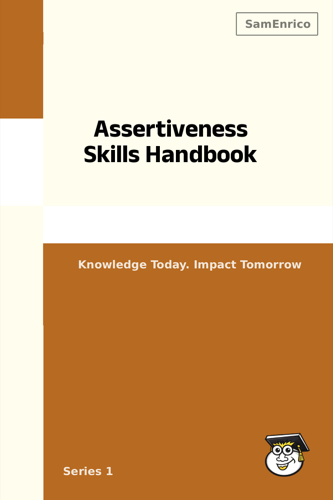
Assertiveness Skills Handbook eBook
Complete reference for handling criticism, conflic
by Hickey Tad
Complete reference for handling criticism, conflict, and confrontation with grace.
Formats
Free sample
Chapter 1: The Quiet Cost...--–- Every time you bite back what you really mean, you pay a small price. At first, it feels like safety. You avoid the argument, dodge the awkwardness, keep the peace. But peace bought with silence is not peace at all. It is a loan, and the interest compounds daily.
The resentment builds behind your ribs. Your jaw tightens at the dinner table. You lie awake replaying what you should have said. And then, one day, the bill comes due—not as a calm conversation, but as an explosion over something trivial, like a dishwasher loaded wrong or a mildly worded email.This is the quiet cost of not being assertive. And most people pay it every single day without ever realizing there is another way.If you are holding this book, you have likely experienced the exhaustion of passivity—the feeling of being a ghost in your own life, agreeing to things you hate, tolerating treatment you would never wish on a friend.
Or perhaps you have known the bitter loneliness of aggression—winning the battle but losing the relationship, hearing the silence that follows your raised voice, wondering why no one seems to trust you anymore. Or worst of all, you may have tried the muddy middle: passive-aggression, where you say "fine" but stomp around the house, or send the silent email, or make the cutting remark disguised as a joke.These are the three default responses to interpersonal tension. They are what evolution gave us. And they are all wrong for modern life.This chapter is not a set of techniques. It is an intervention on your entire philosophy of conflict.
Before you learn one single phrase or script, you must understand the map of human responses, the hidden architecture of why you react the way you do, and the radical alternative that most people never even consider. That alternative is assertiveness. But not the pop-psychology version you have seen on social media—the one that sounds like selfishness with better branding. Real assertiveness is something far rarer and more difficult: the ability to stand fully in your own dignity without stepping one inch into someone else's.Let us begin by looking honestly at the three failed paths.The Three Failed Paths Imagine you are at work. A colleague has just taken credit for your idea in a meeting.
The room is quiet. The manager nods approvingly at your colleague. Your face is warm. Your heart is pounding.What do you do?Most people will choose one of three responses, none of which work.Path One: Passivity The passive person says nothing. They sit in silence, perhaps offering a weak smile.
Later, they will complain to their spouse, cry in the bathroom, or update their résumé in secret. In the moment, passivity feels like survival. You avoid the confrontation. You do not risk being seen as difficult. You tell yourself a soothing story: "It's not worth the fight," "Pick your battles," "I'll handle it differently next time."But passivity is not peace.
It is a pressure cooker with the lid welded shut. The problem with passivity is that it solves nothing and teaches everyone around you a dangerous lesson: that your boundaries are optional. Every time you remain silent when you are disrespected, you train the other person—and yourself—that your feelings do not matter.Psychologists call this "learned helplessness." The passive person stops believing that speaking up will change anything, so they stop speaking. But the resentment does not stop. It metastasizes.
It turns inward as anxiety, depression, or physical symptoms—chronic headaches, back pain, insomnia. Or it turns outward in passive-aggressive acts: forgetting promises, showing up late, making cutting remarks that they can later deny.Passivity feels safe. It is actually the most dangerous path of all, because it slowly erases you.Path Two: Aggression The aggressive person does not stay silent. They explode. They point a finger.
They say, "That was my idea, and you know it, you lying snake." They raise their voice. They make threats. They may even stand up and loom over the table.In the moment, aggression feels powerful. There is a rush of adrenaline, a dopamine hit of righteous anger. You said what you meant.
You didn't back down. You won.But winning is not the same as being effective. Aggression destroys trust instantly. Even if you are right, you become the problem. Your colleague may back down publicly, but they will never trust you again.
The manager will remember not the credit theft but your outburst. You have won the battle and lost the war.Aggression also escalates. Human beings are wired for reciprocity. If you attack, the other person will defend—and then counter-attack. You have started a cycle that is very hard to stop.
Worse, aggression begets aggression. The person who yells gets yelled back at. The person who humiliates gets humiliated in return. And unlike passivity, which at least keeps you physically safe, aggression often invites retaliation, ostracism, or professional consequences.The aggressive person confuses volume for virtue. They think being loud means being strong.
In reality, aggression is almost always a mask for fear—the fear of being seen as weak, the terror of losing control. But the mask does not fool anyone.Path Three: Passive-Aggression The passive-aggressive person splits the difference and gets the worst of both worlds. They do not confront directly, but they cannot let it go quietly. So they find indirect ways to express their anger: the sarcastic comment wrapped in a smile, the "forgot" report, the backhanded compliment, the strategic silence.In the meeting example, the passive-aggressive person might say, "Well, I'm glad someone finally figured out my idea," with a tight laugh. Or they might later send an email copying the manager: "Just to clarify the timeline of the proposal..." Or they might simply give the colleague the silent treatment for two weeks.Passive-aggression feels like a clever way to express anger without taking responsibility for it.
But it is poison. It creates an atmosphere of mistrust and confusion because no one ever knows where they stand. The target feels attacked but cannot point to any single offense. The passive-aggressive person feels justified but never gets resolution. Relationships under passive-aggression do not end in a bang or a whimper.
They just rot.The Common Thread All three failed paths share a single, fatal flaw: they are reactions, not responses. A reaction is automatic, unconscious, driven by the oldest parts of your brain. A response is chosen, deliberate, aligned with your values and goals.Passivity is a reaction to fear. Aggression is a reaction to threat. Passive-aggression is a reaction to powerlessness.
None of them ask the fundamental question that separates animals from adults: What do I actually want here?A Fourth Path Exists What if there was a way to stand up for yourself without tearing anyone else down? What if you could say, "That was my idea," in a tone that invited conversation rather than combat? What if you could name a problem without becoming the problem?There is. It is called assertiveness.But we need to be very careful here. Assertiveness has…
This is the end of the free sample. Get the eBook to keep going. Buy now
About this book
Details
- Author
- Hickey Tad
- Publisher
- SamEnrico
- Language
- English
- Genre
- Non-Fiction, Self-Help, Conflict Resolution
- Released
- 2026-06-07
- Pages (approx.)
- 140
- Available as
- eBook, Audiobook

Read better in the ZLOADR app
Your eBooks on your phone or tablet. Sign in with your SamEnrico account and start reading.
More by Hickey Tad
 Mountain Retreat Sleep GuideHickey Tad$11.99
 OKRs for Reducing Screen TimeHickey Tad$11.99
 Pornography and Self EsteemHickey Tad$11.99
 Journaling Prompts for Recovery MilestonesHickey Tad$11.99
 The Stone Poets: Visionaries of the Gothic CathedralsHickey Tad$11.99
 How to Start a Mounted Piezo-electric Crystals Business (Beginners Guide)Hickey Tad$11.99
 Understanding Idiopathic Thrombocytopenic PurpuraHickey Tad$17.99
 Sale Day DriverHickey Tad$11.99
 JPMorgan Chase BaaS Compliance GuideHickey Tad$12.99
 Cellular Agriculture GuideHickey Tad$12.99
You may also like
 Hong Kong Handover 1997Dunn Johnnie$11.99
 Zumba For Postnatal Recovery CourseNeal Christian$11.99
 Zumba for BeginnersLadner Nikia$11.99
 YouTube Comment Mining GuideHumes Pandora$12.99
 Worry Box MeditationCarlin Rudy$11.99
 Workplace Stress MeditationNguyen Lynn$11.99
 Workplace Stress and Sleep RepairHawley Ivory$11.99
 Workplace Perfectionism CureDelaney Jeffry$11.99
 Workplace Injustice Anger GuideWallen Isabelle$11.99
 Work Addiction and Burnout LinkGreenwood Ester$11.99
 Women in Yoga and WellnessBeattie Galina$11.99
 Women in Stand Up ComedyChun Evangeline$11.99