
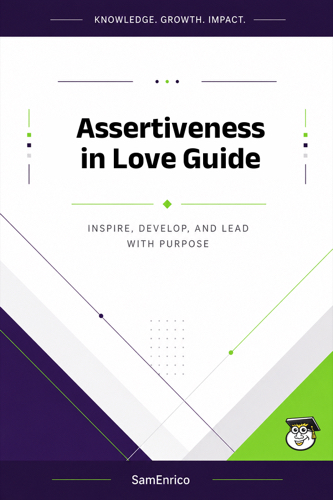
Non-FictionSelf-HelpAssertiveness
Assertiveness in Love Guide eBook
Teaches expressing needs and boundaries in relatio
Teaches expressing needs and boundaries in relationships without fear of abandonment.
Formats
Free sample
Chapter 1: The Silence Lie--–- Every unspoken need is a tiny funeral. You may not feel the casket dropping, but something inside you is buried each time you swallow the truth to keep the peace. The relationship looks fine on the outside—no fighting, no drama, no conflict—but beneath the surface, you are slowly disappearing. This is the most dangerous and least recognized dynamic in modern love: the slow erosion of self disguised as kindness. And it is killing your relationships far more effectively than any argument ever could.The Quiet Collapse Let me describe a scene that you will recognize, even if you have never named it before.You are sitting on the couch.
Your partner is scrolling on their phone, or watching television, or working late again. Inside your chest, something is gathering weight—a thought you want to say, a request you want to make, a boundary you want to draw. "I would like you to put the phone down when I am talking." "It hurts me when you cancel plans last minute." "I need more affection than this." The words form on your tongue. You can feel them right there, ready to be spoken.And then the fear arrives.It comes not as a thought but as a physical event. Your throat tightens.
Your stomach drops. Your heart begins to race. In that moment, your brain is doing exactly what it evolved to do: protecting you from perceived danger. But here is the problem—the danger is not a saber-toothed tiger or a falling rock. The danger is your partner's potential response.
The danger is that they might get angry, or withdraw, or—the thought you cannot bear—leave.So you swallow the words. You tell yourself you are being kind. You tell yourself you are choosing your battles. You tell yourself that keeping the peace is more important than making a request. And the moment passes.
The words retreat back down your throat. The relationship remains calm. You have succeeded at keeping things smooth.Except you have not succeeded at all. You have just conducted a small funeral.Every silenced need is a burial of something real: your desire, your preference, your boundary, your truth. And here is what no one tells you—the person you are burying is yourself.
Not all at once. Not in a dramatic collapse. But slowly, steadily, word by swallowed word, you are teaching yourself that you do not matter as much as the relationship's comfort. You are training your partner that your silence is the price of admission. And you are building a resentment that will eventually poison everything.The Neuroscience of Silence Why does this happen?
Why do intelligent, capable, otherwise assertive people turn into passive ghosts the moment love enters the equation?The answer lies in the oldest part of your brain. Neuroscientists call it the limbic system—a collection of structures deep in the brain that process emotion, memory, and most importantly for our purposes, threat detection. Your limbic system does not know the difference between a physical threat and a social threat. To your ancient brain, being rejected by your tribe was a death sentence. Humans cannot survive alone.
So your brain evolved a hair-trigger response to anything that might lead to social exclusion.When you consider stating a need to your partner, your limbic system does not hear "I am going to ask for what I want." It hears "I am about to risk abandonment." And it responds accordingly. Adrenaline floods your system. Cortisol rises. Your prefrontal cortex—the rational, planning part of your brain—gets partially shut down. You are, in that moment, literally less intelligent than you were thirty seconds earlier.
You cannot find the right words. You cannot think clearly. You can only feel the fear.This is not a character flaw. It is not weakness. It is biology.But biology is not destiny.
The moment you understand that your fear is a survival reflex misfiring in a modern context, you gain the power to override it. The question is not "How do I stop feeling afraid?" The question is "How do I feel afraid and speak anyway?"The Abandonment Trap Here is the cruel irony that lies at the heart of this book: the more afraid you are of abandonment, the more likely you are to behave in ways that guarantee it.Let me explain the mechanism. When you silence yourself to avoid conflict, you do not actually eliminate conflict. You merely postpone it and transform it. The need you swallowed does not disappear.
It goes underground, where it becomes resentment. Resentment is silenced need that has gone sour. And resentment leaks. It leaks through your tone of voice, your body language, your passive-aggressive comments, your withdrawal of affection, your sudden inexplicable coldness.Your partner feels this. They may not know what is wrong, but they know something is wrong.
They sense your distance, your irritability, your lack of presence. And because humans are meaning-making creatures, they will invent an explanation. They will assume you are falling out of love, or that you are angry at them for no reason, or that you are hiding something. None of these assumptions are correct. The truth is far simpler and far more tragic: you have a need you have not expressed.Meanwhile, you are suffering in a different way.
Every silenced need is a small betrayal of yourself. Over time, these betrayals accumulate. You stop trusting your own judgment. You stop knowing what you want because you have trained yourself to ignore your own signals. You become a stranger to yourself, living in a relationship that looks peaceful but feels hollow.This is the abandonment trap.
Your fear of being left causes you to behave in ways that erode intimacy, create distance, and ultimately make abandonment more likely. You are not protecting your relationship by staying silent. You are slowly killing it.The Three Attachment Styles To understand why some people fall into this trap more easily than others, we need to look at attachment theory—one of the most well-researched frameworks in modern psychology. Developed by John Bowlby and Mary Ainsworth and popularized for a general audience by Amir Levine and Rachel Heller in their book Attached, attachment theory describes how our early relationships with caregivers shape our patterns of relating to romantic partners as adults.There are three primary attachment styles in adults:Secure Attachment (approximately 50% of the population). Securely attached individuals were raised by caregivers who were consistently responsive to their needs.
As adults, they are comfortable with intimacy, able to express their needs directly, and not terrified of abandonment. When a conflict arises, they can say "I need you to listen right now" without falling apart. When their partner needs space, they can give it without spiraling. Security is not the absence of fear—it is the ability to feel fear and still act in alignment with your values.Anxious Attachment (approximately 20% of the population). Anxiously attached individuals had inconsistent caregiving as children—sometimes responsive, sometimes neglectful.
They learned that love is unpredictable and that they must perform, please, or cling to keep connection alive. As adults…
This is the end of the free sample. Get the eBook to keep going. Buy now
About this book
Details
- Author
- Mcfarlane Margot
- Publisher
- SamEnrico
- Language
- English
- Genre
- Non-Fiction, Self-Help, Assertiveness
- Released
- 2026-06-08
- Pages (approx.)
- 141
- Available as
- eBook, Audiobook

Read better in the ZLOADR app
Your eBooks on your phone or tablet. Sign in with your SamEnrico account and start reading.
More by Mcfarlane Margot
 Franchising Your Local Brand Across Borders Carbon FootprintMcfarlane Margot$11.99
 Alcoholism and Parenting Recovery WorkbookMcfarlane Margot$11.99
 HIIT for Over 60 GuideMcfarlane Margot$11.99
 Infidelity Recovery StressMcfarlane Margot$11.99
 Senior Housing REIT AnalysisMcfarlane Margot$11.99
 Joint Pain and Food AddictionMcfarlane Margot$11.99
 Bookkeeping For Tech FoundersMcfarlane Margot$11.99
 The Crown’s Digital Dilemma: How the Royal Family Navigated Social Media ScandalsMcfarlane Margot$11.99
 The Bay Street Betrayal: How a Stockbroker’s Threats Shook Canada’s Financial EliteMcfarlane Margot$11.99
 A Collector's Handbook to the Delage D8-120Mcfarlane Margot$11.99
 Student Work Culture DifferencesMcfarlane Margot$12.99
 EU VAT Export and Import GuideMcfarlane Margot$12.99
You may also like
 Hong Kong Handover 1997Dunn Johnnie$11.99
 Zumba For Postnatal Recovery CourseNeal Christian$11.99
 Zumba for BeginnersLadner Nikia$11.99
 YouTube Comment Mining GuideHumes Pandora$12.99
 Worry Box MeditationCarlin Rudy$11.99
 Workplace Stress MeditationNguyen Lynn$11.99
 Workplace Stress and Sleep RepairHawley Ivory$11.99
 Workplace Perfectionism CureDelaney Jeffry$11.99
 Workplace Injustice Anger GuideWallen Isabelle$11.99
 Work Addiction and Burnout LinkGreenwood Ester$11.99
 Women in Yoga and WellnessBeattie Galina$11.99
 Women in Stand Up ComedyChun Evangeline$11.99