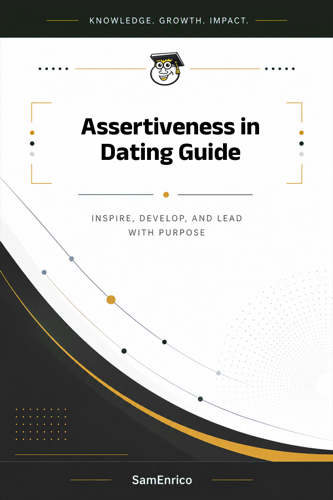
Assertiveness in Dating Guide eBook
Express your needs and boundaries early in relatio
Express your needs and boundaries early in relationships using this practical workbook.
Formats
Free sample
Chapter 1: The Silence Tax--–- You are about to discover something uncomfortable: the nicest moments of your dating life have probably been the most expensive.Not expensive in dollars. Expensive in sleepless nights. In the low-grade anxiety that lives in your chest between texts. In the mornings you wake up and realize you spent another three months in a situationship with someone who never once asked what you actually wanted.You have been paying a tax on every date, every conversation, every "it's fine, no worries" that was not fine at all. And you have been paying it in a currency more precious than money: your own sense of self.This chapter is called The Silence Tax because that is exactly what it is.
Every time you stay quiet about a need, every time you laugh at a joke that stung, every time you say "I don't mind" when you absolutely do mind, you are writing a check that your future self has to cash. The temporary relief of being "easy-going" feels like kindness. It is not. It is self-abandonment in a cute outfit, and it is the single biggest predictor of dating misery that therapists see.Let me prove it to you.The Myth of Going With the Flow You have been told your whole life that the best partners are low-maintenance. That being "chill" is a virtue.
That asking for what you want makes you demanding, and demanding is the opposite of lovable.This is a lie. It is one of the most expensive lies modern dating has ever sold you.Let me define something right now that will appear throughout this book: self-abandonment. Self-abandonment is the act of overriding your own needs, values, or physical discomfort to secure someone else's approval or avoid their disappointment. It is not kindness. Kindness is a choice made from abundance.
Self-abandonment is a reflex made from fear.The difference matters more than almost anything else in early dating.When you choose kindness, you feel expanded afterward. You gave something because you wanted to, and there is no residue of resentment. When you self-abandon, you feel smaller afterward. You gave something because you felt you had to, and there is a low hum of resentment that you cannot quite name.Most people mistake one for the other. They think they are being "easy-going" when they are actually disappearing.Here is how you know the difference: Ask yourself one question after any interaction with a date.
Did I say what I actually wanted to say?If the answer is no, you just paid the Silence Tax.The Real Cost of a Single "It's Fine"Let me walk you through a typical example. It is Tuesday night. You have been texting someone for two weeks. You have been on two dates. Both felt promising.
Tonight, they text you at 6:47 PM: "Hey, really sorry, something came up. Can we do tomorrow instead?"You have plans tomorrow. You have been looking forward to tonight all day. You rearranged your gym time. You did not eat a late snack because you wanted to be hungry for dinner.
You are genuinely disappointed.You type: "No worries! Tomorrow works."Then you close the app and feel something shift in your chest. It is not anger. It is not sadness. It is something quieter.
A small betrayal you cannot quite locate.That feeling is the Silence Tax clearing your account.Let me break down exactly what you just paid for:The immediate cost: You did not express your disappointment. You told them that canceling an hour before is fine. It is not fine. You have now taught them that your time has no penalty attached. They will do this again.The overnight cost: You will spend the next hour feeling vaguely irritated but unwilling to name why.
You will pick up your phone six times to see if they apologized again. They will not. You will go to bed feeling unseen.The cumulative cost: If you do this ten times with ten different people, you will start to believe that your time is not valuable. You will stop making firm plans because "people always cancel anyway." You will begin dating from a posture of low expectations, which is just self-protection disguised as realism.The relationship cost: When you finally meet someone who would never cancel last minute, you will not recognize them. You have trained yourself to expect flakiness.
Consistency will feel boring. Unpredictability will feel exciting. You will chase the wrong people and ignore the right ones.All of that from a single "no worries."Now multiply that by every "it's fine" about being left on read. Every "I don't mind" about where you eat. Every "maybe some other time" about exclusivity.
Every laugh at a joke that was actually cruel.This is not a small problem. This is the architecture of your dating life.Why Your Silence Feels Like Safety You are not stupid for staying silent. You are not weak. You are not broken.You are trained.Your brain has learned, probably over many years and many relationships, that speaking up leads to negative consequences. Maybe you grew up in a house where expressing a need was met with dismissal or anger.
Maybe you had a partner who called you "dramatic" every time you asked for something. Maybe you have simply absorbed the cultural message that women who ask for things are "high maintenance" and men who ask for things are "needy."Whatever the source, your brain has wired itself to equate silence with safety and self-expression with danger.This is not a character flaw. This is classical conditioning. Your brain is doing exactly what it evolved to do: avoid pain and seek reward. It has learned that the pain of speaking up (conflict, rejection, being called "too much") is worse than the pain of staying silent.
So it chooses silence automatically, before you even have a chance to decide.Here is what that looks like in real time:You are on a date. They make a comment that lands wrong. Something about your job. Or your appearance. Or your relationship history.
It is not overtly cruel, but it stings. Your body reacts first. A small clench in your stomach. A slight tightening in your throat. Your brain registers the discomfort for less than a second before a much louder signal arrives: Do not say anything.
If you say something, you will ruin the vibe. You will seem difficult. They will not call you again.So you laugh. Or you change the subject. Or you say "it's fine" when it is not fine.Your brain registers relief.
The conflict did not happen. The date continues. They smile. You survived.And you just reinforced the wire. Your brain learned again: silence = safe, speaking = dangerous.This is how people spend years in relationships with people who have never once heard their actual opinion about anything that matters.Dating Intentions vs.
Dating Expectations Before we go any further, I need you to understand a distinction that will be the foundation of everything else in this book.Dating Intentions are what you actually want. They are the truth of your needs, values…
This is the end of the free sample. Get the eBook to keep going. Buy now
About this book
Details
- Author
- Skidmore Giuseppe
- Publisher
- SamEnrico
- Language
- English
- Genre
- Non-Fiction, Self-Help, Dating Skills
- Released
- 2026-06-11
- Pages (approx.)
- 135
- Available as
- eBook, Audiobook

Read better in the ZLOADR app
Your eBooks on your phone or tablet. Sign in with your SamEnrico account and start reading.
More by Skidmore Giuseppe
 Sleep Meditation Retreat GuideSkidmore Giuseppe$11.99
 Postnatal HIIT Return GuideSkidmore Giuseppe$11.99
 Hornist High Pressure HeroicsSkidmore Giuseppe$11.99
 The OCD Intrusive Thoughts GuideSkidmore Giuseppe$11.99
 The Hapsburgs: Masters of Imperial EleganceSkidmore Giuseppe$11.99
 Grave Digging (Professional)Skidmore Giuseppe$11.99
 How to Become a Loom StarterSkidmore Giuseppe$11.99
 Surprise and Delight GuideSkidmore Giuseppe$12.99
 Fitness App Free to PaidSkidmore Giuseppe$12.99
 The Breeder's Guide to Hereford PigsSkidmore Giuseppe$11.99