
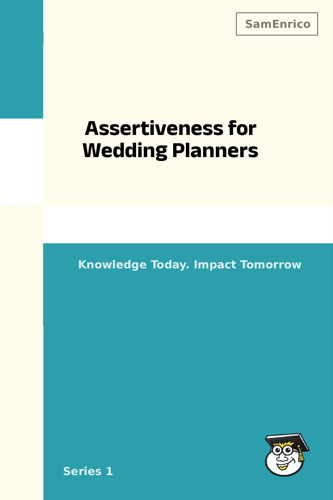
Assertiveness for Wedding Planners eBook
Navigate bridezilla moments, vendor disputes, and
Navigate bridezilla moments, vendor disputes, and family drama professionally.
Formats
Free sample
Chapter 1: The Hidden Mirror...--You are about to read something that most wedding planning books will never tell you. Here it is: the most difficult person you will ever manage in this industry is not the screaming bride, the demanding mother, or the vendor who no-shows on the morning of the reception. The most difficult person is the one you see in the mirror every morning. That is not a motivational slogan. It is a professional reality that separates planners who last twenty years from planners who burn out in twenty months.Before you learn a single script for handling a client meltdown, before you revise a single contract clause, before you mediate a single family feud, you must understand one thing: assertiveness is not something you do to other people.
It is something you cultivate within yourself. Every failed boundary, every unpaid hour of emotional labor, every resentment you carry home from a wedding weekend—those did not happen because your clients were monsters. They happened because you did not know which version of yourself was showing up to the conversation.This chapter introduces the foundational framework of this entire book: the six hats of the assertive planner. You will learn why wearing the wrong hat at the wrong moment destroys your authority, your energy, and your love for this work. You will take a self-assessment that reveals your conflict-avoidance patterns before they cost you another client relationship.
And you will finally understand the difference between internal scope creep—the silent killer of wedding planning careers—and the external kind that your contract can solve.But first, let me tell you about Melissa.The Planner Who Quit on a Tuesday Melissa had been planning weddings for eleven years. She had a waiting list. She was featured in two regional magazines. Brides drove two hours for her initial consultation. By every external measure, she had succeeded.She quit on a random Tuesday in March.There was no catastrophic vendor failure.
No bride threw a centerpiece at her head. No lawsuit. She simply sat down to answer emails at 7:00 AM, stared at the screen for forty-five minutes, and realized she would rather clean her bathroom floor with a toothbrush than respond to another client who needed "just one small favor."When I asked her what happened, she said something that I have since heard from dozens of burned-out planners: "I forgot that I was allowed to say no."Melissa had started her career as a people pleaser. She said yes to last-minute venue changes. She said yes to mediating between a bride and her estranged father.
She said yes to forty-five minute phone calls at 10:00 PM about napkin folds. She said yes so many times that she forgot the word no existed in her vocabulary. And then one day, she had nothing left to give.Here is what Melissa learned too late: she was not wearing one hat. She was wearing seven hats simultaneously, switching between them so rapidly that she had no idea which version of herself was driving at any given moment. One minute she was a service provider drawing a professional boundary.
The next minute she was a friend listening to a client's marriage anxieties. The next minute she was a psychologist diagnosing family dysfunction. The next minute she was a mediator caught between competing demands. By the end of each day, she was exhausted not because the work was hard, but because she was trying to be seven different people for seven different expectations—none of which she had consciously chosen.This chapter exists to ensure that you do not become Melissa.The Six Hats of the Assertive Planner (Revised and Consolidated)Most industry training tells new planners that they must wear many hats. Some books list as many as twelve.
The problem with that approach is that it creates role confusion rather than role clarity. When you believe you are supposed to be everything to everyone, you end up being nothing to yourself.After analyzing hundreds of planner-client conflicts and drawing from The Wedding Consultant's Handbook, I have consolidated the essential roles into six distinct hats. Every wedding planner wears these hats. The difference between a planner who burns out and a planner who thrives is not which hats they wear—it is whether they know which hat they are wearing in any given moment.Hat One: Service Provider This is the transactional hat. When you are wearing it, you are exchanging specific services for specific payment.
You are not a friend. You are not a therapist. You are not a mediator. You are a professional who has agreed to deliver a defined scope of work within a defined timeline for a defined fee.The service provider hat is your foundation. Every other hat exists to support this one, not to replace it.
When you find yourself doing work that is not in your contract, staying late without charging, or absorbing emotional labor that should be billable, you have taken off the service provider hat and put on something else. That is not generosity. That is scope creep, and it will destroy your business.Hat Two: Decision Maker The decision maker hat is the one that most new planners are terrified to wear. When you wear it, you are not asking for permission. You are not offering options.
You are not facilitating a committee vote. You are making a professional judgment and communicating it clearly.This hat is essential during crises. The florist delivers the wrong centerpieces fifteen minutes before the reception? You decide whether to rearrange, send someone to buy replacements, or let it go. You do not call the bride to ask what she wants.
You do not form a committee. You make the call and move forward. Indecision is not kindness—it is the abdication of your professional responsibility.Hat Three: Organizer The organizer hat is the one that most planners associate with the job. Timelines, checklists, vendor confirmations, seating charts, rehearsal coordination—this is the logistical machinery of a wedding. When you wear this hat, you are systematic, detail-oriented, and methodical.The danger of the organizer hat is that it can become a way to hide from harder conversations.
Many planners retreat into spreadsheets and checklists because those things do not talk back. They do not cry. They do not demand emotional labor. If you find yourself obsessing over the font on a place card while avoiding a conversation with a difficult mother-of-the-bride, you are using the organizer hat as a shield. That is not professionalism.
That is avoidance.Hat Four: Artistic Designer The artistic designer hat is the creative role. Color palettes, floral arrangements, lighting design, table settings, stationery suites—this is the visual and sensory world of the wedding. When you wear this hat, you are an artist helping a couple translate their vision into reality.The danger of this hat is that it can become ego-driven. Planners who fall in love with their own aesthetic stop listening to what the couple actually wants. They become defensive about their choices.
They mistake client feedback for personal criticism. If you have ever thought, "The bride just doesn't understand my vision," you…
This is the end of the free sample. Get the eBook to keep going. Buy now
About this book
Details
- Author
- Blackwell Antony
- Publisher
- SamEnrico
- Language
- English
- Genre
- Non-Fiction, Self-Help, Weddings
- Released
- 2026-06-07
- Pages (approx.)
- 131
- Available as
- eBook, Audiobook

Read better in the ZLOADR app
Your eBooks on your phone or tablet. Sign in with your SamEnrico account and start reading.
More by Blackwell Antony
 Single Parent Healing GuideBlackwell Antony$11.99
 Curiosity Shift TechniqueBlackwell Antony$11.99
 Constraint ThinkingBlackwell Antony$11.99
 The French Wars Religion PrimerBlackwell Antony$11.99
 Iron Behemoths of Cambrai: The First Tank Assault That Shook the WorldBlackwell Antony$11.99
 Understanding Piebald Trait Neurologic DefectsBlackwell Antony$17.99
 How to Start a Chemistry Research and Experimental Development Business (Beginners Guide)Blackwell Antony$11.99
 Customer Support VA Hiring GuideBlackwell Antony$12.99
 JEE Inorganic Chemistry MasteryBlackwell Antony$12.99
 Alerce HarvestingBlackwell Antony$11.99
You may also like
 Hong Kong Handover 1997Dunn Johnnie$11.99
 Zumba For Postnatal Recovery CourseNeal Christian$11.99
 Zumba for BeginnersLadner Nikia$11.99
 YouTube Comment Mining GuideHumes Pandora$12.99
 Worry Box MeditationCarlin Rudy$11.99
 Workplace Stress MeditationNguyen Lynn$11.99
 Workplace Stress and Sleep RepairHawley Ivory$11.99
 Workplace Perfectionism CureDelaney Jeffry$11.99
 Workplace Injustice Anger GuideWallen Isabelle$11.99
 Work Addiction and Burnout LinkGreenwood Ester$11.99
 Women in Yoga and WellnessBeattie Galina$11.99
 Women in Stand Up ComedyChun Evangeline$11.99