
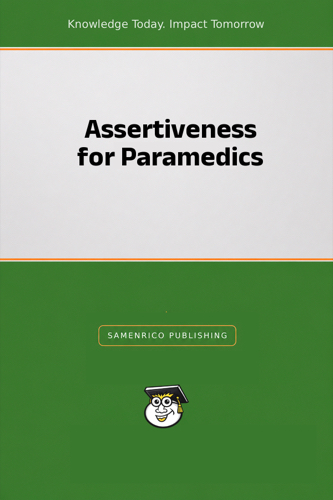
Assertiveness for Paramedics Audiobook
Patient and hospital handoff communication.
by Amato Lenora
Patient and hospital handoff communication.
Formats
Free sample
Chapter 1: The Vulnerability Gap--The paramedic’s hands moved with practiced efficiency. She had secured the airway, stabilized the cervical spine, and established two large-bore intravenous lines before the ambulance had even stopped moving. The patient—a sixty-seven-year-old male with chest pain radiating to his jaw—had received aspirin, nitroglycerin, and a twelve-lead ECG that clearly showed an anterior ST-segment elevation myocardial infarction. By every clinical measure, the pre-hospital care had been textbook perfect.Then the ambulance doors opened.The emergency department hallway was a wall of sound: cardiac monitors beeping, a dementia patient screaming from a gurney in the corner, a nurse arguing on the phone with the blood bank. The charge nurse glanced at the stretcher, pointed toward a empty bay, and said four words that would undo forty-five minutes of meticulous care: "Just put him there."What happened next was not malice.
It was not incompetence. It was the vulnerability gap.The paramedic attempted to give her handoff. She opened her mouth to say, "This is a sixty-seven-year-old male with an anterior STEMI, onset of pain forty-five minutes ago, aspirin given, twelve-lead in the packet—" But the nurse had already turned away to answer a call light. A passing resident grabbed the ECG printout, glanced at it for two seconds, and said, "Get him on the monitor." No one asked for the patient's name. No one confirmed the time of symptom onset.
No one acknowledged the paramedic’s concern about the patient's dropping blood pressure.Forty minutes later, the patient arrested. The cardiology fellow later noted in the morbidity and mortality conference that they had not been aware the patient had received ten milligrams of morphine, which had contributed to his hypotension. The paramedic had mentioned the morphine in her handoff. But no one had been listening.This chapter opens with a sobering reality: the most dangerous part of any patient's journey is not the extraction from a wrecked car, not the sedation of a seizing child, not even the administration of a high-risk medication. The most dangerous moment is the handoff—that brief, chaotic, often interrupted window when a patient leaves the controlled environment of the ambulance and enters the understaffed, overwhelmed Emergency Department.The statistics are unforgiving.
According to the Joint Commission, nearly eighty percent of serious medical errors involve miscommunication during patient handoffs. Not clinical incompetence. Not equipment failure. Communication. A landmark study published in…
This is the end of the free sample. Get the Audiobook to keep going. Buy now
About this book
Details
- Author
- Amato Lenora
- Publisher
- SamEnrico
- Language
- English
- Genre
- Non-Fiction, Self-Help, EMS
- Released
- 2026-06-12
- Pages (approx.)
- 143
- Available as
- eBook, Audiobook

Listen in the VoxFlicks app
Audiobooks and audio dramas wherever you go. Sign in with your SamEnrico account and press play.
More by Amato Lenora
 Aggressive Driver Encounters GuideAmato Lenora$11.99
 Divorce and In Law SeparationAmato Lenora$11.99
 Electronics Inventory AIAmato Lenora$11.99
 Benign Breast Conditions HandbookAmato Lenora$11.99
 Strategic Priorities ListAmato Lenora$11.99
 Constraints for FreelancersAmato Lenora$11.99
 Chunking Memory JournalAmato Lenora$11.99
 The Forgotten Stand at Pork Chop Hill: Korea's Last Desperate BattleAmato Lenora$11.99
 The Battle of Nakano: Yamato's Last Stand (757 AD)Amato Lenora$11.99
 How to Produce Packing MaterialsAmato Lenora$11.99
 Chipmunks: TamiasAmato Lenora$11.99
 USP University Admission GuideAmato Lenora$12.99
You may also like
 Nonverbal Cues for ParamedicsSprouse Clair$11.99
 Paramedic PTSD Prevention GuideMoreland Lorna$11.99
 Paramedic Emotional ResilienceFrederickson Jake$11.99
 Action Planning for ParamedicsBatchelor Ginette$11.99
 Remote Work for ParamedicsDupuis Lorriane$11.99
 Paramedic Shift Recovery GuideLara Jaunita$11.99
 Group Creativity for ParamedicsSessions Chieko$11.99
 EMT Paramedic Anger GuideMansfield Theola$11.99
 The Paramedic Shift Stress GuideStaples Etta$11.99
 Pomodoro for ParamedicsGalvan Catheryn$11.99
 Financial Stress for ParamedicsCuellar Merrie$11.99
 Success Without Burnout for ParamedicsSolano Lesia$11.99