
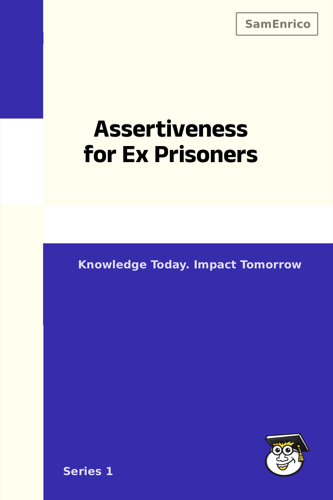
Assertiveness for Ex Prisoners eBook
Teaches reentry boundary setting, employer communi
by Butts Leeann
Teaches reentry boundary setting, employer communication, and probation officer relations.
Formats
Free sample
Chapter 1: The Permission Principle--The first time Marcus walked into his new boss’s office for a routine check-in, he stood with his shoulders back, chin slightly raised, and eyes fixed in a hard stare. He had learned this posture over twelve years inside—feet shoulder-width apart, never blink first, never look down. It had kept him alive in the yard. It had signaled to COs and cellies alike that he was not prey. Thirty seconds into the conversation, his new boss—a soft-spoken woman in her fifties who ran a small warehouse—asked him to step outside.
Later, the HR manager called to say it wasn’t working out. “You seemed… confrontational,” she said. Marcus was confused. He hadn’t said a single aggressive word. He had simply stood there the way he had been taught to stand.
The way that meant don’t mess with me.What Marcus didn’t understand yet—and what this entire chapter exists to teach—is that the posture, tone, and energy that signal survival inside a prison signal danger on the outside. Not danger to others. Danger to yourself. Because when a boss, a landlord, a police officer, or a potential employer reads you as aggressive, they do not respond by backing down the way an inmate would. They respond by calling security, terminating your employment, filing a report, or revoking your parole.
The rules of engagement are not just different out here. They are opposite.This chapter dismantles the most dangerous assumption a returning citizen can carry: what kept me alive inside will help me succeed outside. It introduces the single most important mindset shift in this entire book—the Permission Principle—and gives you the tools to begin re-wiring instincts that may have saved your life but will now put your freedom at risk.The Prison Body: Why Your Survival Instincts Are Now a Liability Let us name what you learned inside. You learned that eye contact must be held just long enough to communicate non-violent confidence, but broken away at exactly the right moment to avoid a challenge. You learned that your voice should drop in pitch and increase in volume when someone tests you.
You learned that physical space must be claimed—never back up, never step aside, never let someone stand behind you. You learned that the word “sorry” is a sign of weakness and that an apology is an invitation for exploitation.None of these lessons were wrong. Inside, they were correct. They were evidence-based survival strategies in an environment where formal rules existed but informal violence governed daily life. The problem is not the lessons.
The problem is that you are no longer in that environment.On the outside, those same behaviors trigger a completely different set of responses. A hard stare at a coworker is not read as “non-victim.” It is read as “threatening” and reported to HR. A loud, deep voice correcting a supervisor is not read as “establishing respect.” It is read as “insubordination” and grounds for termination. Claiming physical space by standing too close or blocking a doorway is not read as “dominance.” It is read as “assaultive behavior” and results in a police call.The tragedy of reentry is that many returning citizens are sent back to prison not because they committed a new crime, but because they communicated like they were still inside. A missed curfew becomes a revocation not because the PO is cruel, but because the citizen responded to the PO’s question with a defensive, aggressive posture that triggered the PO’s “Cop Mode” (a concept we will explore in depth in Chapter 4).
A failed drug test becomes a hearing not because of the dirty urine, but because the citizen walked into the reporting office with a prison stare and a tone that said “don’t push me.”This chapter is not about blaming you for your survival instincts. It is about giving you permission to lay them down.The Permission Principle: Strategic Submission as Freedom The central concept of this chapter—and arguably of this entire book—is the Permission Principle. It states this: You must give yourself permission to be perceived as soft, hesitant, or even weak in the moment, because strategic submission now prevents handcuffs later.Read that again. Out loud, if you can.Most returning citizens have been taught that any display of softness invites exploitation. And in prison, that was true.
But on the outside, the opposite is often true: a display of softness—a calm voice, a deferred opinion, an apology, a request for clarification, a step back—disarms the person in front of you. It signals that you are not a threat. And when you are not a threat, you are not someone they need to neutralize.Consider two versions of the same interaction with a PO after a missed curfew:Version A (Prison Survival Mode): The citizen stands with arms crossed, feet planted. He makes hard eye contact. He says, “The bus was late.
That ain’t my fault. You gonna violate me for a bus?”Version B (Strategic Submission): The citizen stands with arms at sides, shoulders slightly relaxed. He looks at the PO’s chin, not the eyes. He says, “I missed curfew. The bus broke down.
I have a photo. I understand if there are consequences, but I’m asking respectfully if we can handle this with a warning.”Which citizen is more likely to receive a warning? Which citizen is more likely to be filed on? The answer is obvious, and it has nothing to do with who is “stronger” or “more right.” It has everything to do with who made the PO feel safe, respected, and in control.The Permission Principle requires you to do something that feels wrong: to voluntarily lower your guard, to soften your voice, to use words like “respectfully” and “if possible” and “I understand.” It requires you to give up the satisfaction of being right in the moment for the freedom of being free in the long term.This is not weakness. This is strategy.
In military terms, this is a tactical retreat—not a surrender of the war, but a repositioning for a better battle. In legal terms, this is not a confession of guilt but a demonstration of cooperation that invites discretion. In human terms, this is not cowardice but the courage to tolerate the discomfort of looking soft so that you do not end up back in a cell.The Aggression-Assertion Spectrum: Where Do You Live?To understand the Permission Principle, you must first understand where your current communication style falls on what we call the Aggression-Assertion Spectrum. Imagine a line with three zones:Red Zone (Aggression): Demanding, threatening, loud, physically intrusive, interrupting, name-calling, profanity used as a weapon, posturing, hard staring, refusal to back down even when wrong. The goal of aggression is to dominate.
The outcome inside was often safety. The outcome outside is almost always escalation: police calls, termination, revocation, arrest.Black Zone (Passivity): Silent, head-down, agreeing to everything, apologizing excessively, avoiding eye contact entirely, shrinking physically, saying “yes” when you mean “no,” allowing violations of your boundaries without response. The goal of passivity…
This is the end of the free sample. Get the eBook to keep going. Buy now
About this book
Details
- Author
- Butts Leeann
- Publisher
- SamEnrico
- Language
- English
- Genre
- Non-Fiction, Self-Help, Reentry
- Released
- 2026-06-11
- Pages (approx.)
- 140
- Available as
- eBook, Audiobook

Read better in the ZLOADR app
Your eBooks on your phone or tablet. Sign in with your SamEnrico account and start reading.
More by Butts Leeann
 Relationship Nightmare GuideButts Leeann$11.99
 The Self Validation WorkbookButts Leeann$11.99
 Psychology Palace GuideButts Leeann$11.99
 Wholesaling Absentee OwnersButts Leeann$11.99
 The Panax Ginseng GuideButts Leeann$11.99
 ED Penile Implant GuideButts Leeann$11.99
 Freelance Focus TechniquesButts Leeann$11.99
 The Navigators of the Indian Ocean: The Swahili Mariners' Golden AgeButts Leeann$11.99
 Blood and Lone Stars: The Texian Rebellion That Ignited a WarButts Leeann$11.99
 How to Produce RicersButts Leeann$11.99
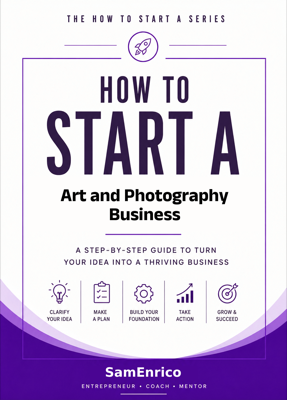 How to Start a Art and Photography Business (Beginners Guide)Butts Leeann$11.99
 Idea Pins for Pinterest ManagersButts Leeann$12.99
You may also like
 Hong Kong Handover 1997Dunn Johnnie$11.99
 Zumba For Postnatal Recovery CourseNeal Christian$11.99
 Zumba for BeginnersLadner Nikia$11.99
 YouTube Comment Mining GuideHumes Pandora$12.99
 Worry Box MeditationCarlin Rudy$11.99
 Workplace Stress MeditationNguyen Lynn$11.99
 Workplace Stress and Sleep RepairHawley Ivory$11.99
 Workplace Perfectionism CureDelaney Jeffry$11.99
 Workplace Injustice Anger GuideWallen Isabelle$11.99
 Work Addiction and Burnout LinkGreenwood Ester$11.99
 Women in Yoga and WellnessBeattie Galina$11.99
 Women in Stand Up ComedyChun Evangeline$11.99