
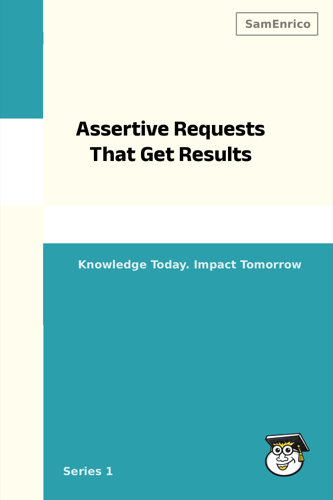
Non-FictionSelf-HelpPersuasion
Assertive Requests That Get Results eBook
Ask for what you want clearly and increase the lik
Ask for what you want clearly and increase the likelihood of a yes.
Formats
Free sample
Chapter 1: The Nine-Word Cage--–- Megan had been passed over for promotion three times in five years. She was brilliant, hardworking, and universally liked. But when her boss asked why she hadn't applied for the director role, she said something that would haunt her: "I didn't think I had to ask. I thought you could see my work."That moment cost her $127,000. Not because her boss was cruel or blind, but because Megan had committed the most common and most expensive error in human communication.
She confused a hope with a request. She assumed that excellence speaks for itself. It does not. Excellence whispers. Requests shout.This book exists because of Megan, and because of the thousands of people I have coached who share her quiet desperation.
They want things—a raise, a boundary, a favor, a change—but they cannot bring themselves to ask. Or worse, they ask so poorly that they guarantee a "No" before the sentence leaves their lips. They mumble. They hint. They apologize in advance.
They bury their ask inside a paragraph of justification. And then they wonder why the world does not bend to meet them.The answer is brutal but liberating: you are not getting what you want because you are not asking for it clearly. Not because you don't deserve it. Not because people don't like you. Not because the system is rigged.
You are failing at the moment of articulation. And the good news is that articulation is a skill, not a personality trait.This chapter will introduce you to the single most important tool in this book: The Nine-Word Rule. Master it, and you will never again leave a conversation wondering whether the other person understood what you needed. Ignore it, and you will continue to confuse your wishes with your requests, wondering why the world keeps saying "No" to a question you never actually asked.The Cost of Vagueness Let me tell you about a study that changed how I think about everyday communication. Researchers set up a simple experiment in a busy train station.
A stranger approached passengers and asked, "Excuse me, I need to get to the airport. Can you give me directions?" Seventy-two percent of people helped. That is a good baseline.Then the researchers changed one thing. The stranger asked, "Excuse me, I need to get to the airport. I'm lost.
I've been walking for twenty minutes. My phone is dead. I'm supposed to meet my sister who I haven't seen in two years. Can you give me directions?"The helping rate dropped to thirty-four percent.Why? Because the second ask was more polite, more detailed, and more emotionally compelling.
But it was also longer, more complicated, and more exhausting to process. The listener's brain heard a story, not a request. And when the brain cannot instantly identify what is being asked, it defaults to "No." Not out of malice. Out of cognitive efficiency.This is the hidden cost of vagueness. Every unnecessary word you add to a request increases the likelihood of rejection.
Every justification, every apology, every "if it's not too much trouble" is not politeness—it is noise. And noise kills clarity.I have seen this pattern destroy careers, marriages, and business deals. A software engineer who spent six months building a feature nobody asked for because he "hinted" at the idea instead of requesting approval. A wife who resented her husband for three years because she "wished" he would help with laundry instead of asking him to take Tuesday nights. A startup founder who lost a $2 million contract because she sent a ten-paragraph email when a one-sentence request would have closed the deal.These are not failures of effort.
They are failures of precision.The Nine-Word Rule: Your New Standard Here is the rule that will change everything for you: Every effective request can be stated in nine words or fewer.Not ten. Not "about nine." Nine. Why nine? Because psychological research on working memory shows that the average person can hold approximately seven to nine discrete pieces of information in their mind at once. When you exceed nine words in a request, you force the listener to choose between listening to you and processing your ask.
They will almost always choose to listen to you—and then forget what you asked for.The nine-word limit is not arbitrary. It is a cognitive constraint. Respect it, and you work with the brain's architecture. Ignore it, and you work against it.A nine-word request follows a simple structure: Subject + Action + Deadline.Subject: Who is being asked? (Usually "you" or a name.)Action: What specific behavior is required?
(One verb, no modifiers.)Deadline: When does this need to happen? (A time, a date, or a clear condition.)Examples of nine-word requests:"Please send the report by 3 PM." (6 words)"Can you cover my meeting at 2?" (7 words)"I need a decision by Friday." (6 words)"Please confirm you received this email." (5 words)"Can we reschedule our call to tomorrow?" (6 words)Notice what is missing from these examples. No "I'm sorry to bother you." No "If you have time." No "Whenever you get a chance." No "I know you're busy, but." No justifications, no apologies, no pre-excuses. Just the subject, the action, and the deadline.Now compare those to the way most people ask:"Hey, I was wondering, if you're not too swamped, could you maybe take a look at the report when you have a second, no rush though…" (23 words, zero clarity, guaranteed "No" or "maybe" which is a "No" in disguise.)The 23-word ask is not polite. It is cowardly.
It hedges because the asker is afraid of the answer. And the listener instinctively knows this. They smell the fear. And they exploit it by saying "I'll try to get to it" (which means never) or "Let me check my schedule" (which means no).The nine-word ask, by contrast, is courageous. It takes up space.
It assumes the listener is competent enough to hear a direct request and respond honestly. And that courage is contagious. People respect requests that respect their time.The 9-Word Filter: A Diagnostic Tool Before you make any request, run it through the 9-Word Filter. Here is how it works:Step 1: Write down your request in whatever rambling, apologetic, over-explained form it currently takes. Get it all out.Step 2: Circle every word that is not essential to the subject, action, or deadline.
This includes: "just," "maybe," "perhaps," "kind of," "a little bit," "if you don't mind," "whenever you have a chance," "I know you're busy," "sorry to bother you," "no rush," "only if it's easy," "I hate to ask," and any form of "could you possibly."Step 3: Delete all circled words. Read the remaining sentence.Step 4: If the remaining sentence is longer than nine words, ask yourself: Can I shorten the subject? Can I use a simpler verb? Can I make the deadline more precise?Step 5: Repeat until you have a nine-word (or shorter) request.Here is an example of the 9-Word Filter in action.Original (23 words): "Hey, I'm really sorry to bother you, but if you have a minute, could you maybe look at the proposal I sent and let me…
This is the end of the free sample. Get the eBook to keep going. Buy now
About this book
Details
- Author
- Rutledge Minh
- Publisher
- SamEnrico
- Language
- English
- Genre
- Non-Fiction, Self-Help, Persuasion
- Released
- 2026-06-08
- Pages (approx.)
- 151
- Available as
- eBook, Audiobook

Read better in the ZLOADR app
Your eBooks on your phone or tablet. Sign in with your SamEnrico account and start reading.
More by Rutledge Minh
 Humid Climate Sleep MeditationRutledge Minh$11.99
 Mindful Parenting HandbookRutledge Minh$11.99
 Widowhood Reconnection GuideRutledge Minh$11.99
 The Writer's Daily Ritual GuideRutledge Minh$11.99
 The Marauders of the Atlantic: Portugal’s Golden FleetRutledge Minh$11.99
 Assistant Banquet ManagerRutledge Minh$11.99
 Product Teaser Pre LaunchRutledge Minh$12.99
 Interview Talking About MOOCsRutledge Minh$12.99
 Learn to Play the ArghulRutledge Minh$11.99
 How to Start a Phonetic Printing Business (Beginners Guide)Rutledge Minh$11.99
You may also like
 Hong Kong Handover 1997Dunn Johnnie$11.99
 Zumba For Postnatal Recovery CourseNeal Christian$11.99
 Zumba for BeginnersLadner Nikia$11.99
 YouTube Comment Mining GuideHumes Pandora$12.99
 Worry Box MeditationCarlin Rudy$11.99
 Workplace Stress MeditationNguyen Lynn$11.99
 Workplace Stress and Sleep RepairHawley Ivory$11.99
 Workplace Perfectionism CureDelaney Jeffry$11.99
 Workplace Injustice Anger GuideWallen Isabelle$11.99
 Work Addiction and Burnout LinkGreenwood Ester$11.99
 Women in Yoga and WellnessBeattie Galina$11.99
 Women in Stand Up ComedyChun Evangeline$11.99