
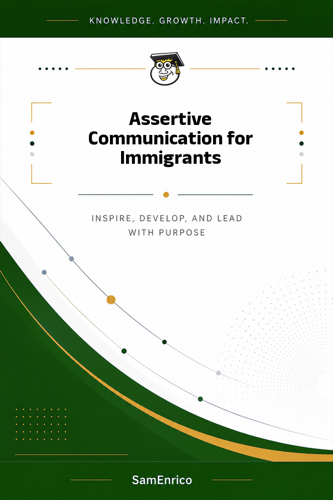
Assertive Communication for Immigrants eBook
Navigate language and cultural barriers to speak u
by Noel Marisha
Navigate language and cultural barriers to speak up confidently.
Formats
Free sample
Chapter 1: The Three Selves...--–- María had always been the funny one. In her Mexican family gatherings, she commanded the table—telling stories, mimicking her uncle’s exaggerated sneeze, landing punchlines with perfect timing. Her cousins called her La Chispa—The Spark. When she moved to Toronto at twenty-eight, that spark didn’t just dim. It vanished.
At her first office potluck, a colleague asked her a simple question: “So, what do you think of the new software update?” María understood every word. She knew exactly what she wanted to say: “It’s clunky, but I’m sure we’ll adapt.” Instead, what came out was a slow, halting, “It is… good. Yes. Good.” She watched her colleague’s eyes glaze over with polite boredom. That night, she sat in her studio apartment and cried.
Not because she missed home—though she did. She cried because she had just met a stranger who looked exactly like her, sounded nothing like her, and seemed to have stolen her personality.The Phenomenon Every Immigrant Knows but Rarely Names María’s experience is not unique. It is not a failure of character, a lack of effort, or evidence that she “should have studied harder.” It is a documented psychological phenomenon that researchers call second language ego—the disorienting experience of feeling like a different person when speaking a different language. For immigrants, this is not a temporary adjustment. It is a daily reality that shapes everything from job interviews to romantic relationships to the simple act of ordering coffee.If you are reading this book, you have likely experienced something similar.
Perhaps you were a respected professional in your home country—a doctor, an engineer, a teacher—but in your new country, you feel like a child struggling to form basic sentences. Perhaps you are witty and warm in your native language but have been told you seem “cold” or “robotic” in English, French, or German. Perhaps you have avoided social gatherings not because you are introverted, but because the effort of translating your personality feels exhausting before you even walk through the door.This chapter is the foundation of everything that follows. Before you can learn the scripts, techniques, and strategies of assertive communication, you must understand why you feel like a different person. Without that understanding, the tools will feel like costumes—external fixes that never quite fit.
With it, you can begin the work of integrating your three selves into a single, confident voice.The Three Personalities: A Framework for Understanding Based on extensive interviews with immigrants across North America and Europe, researchers have identified a recurring pattern: most immigrants report experiencing not one, but three distinct versions of themselves.Personality One: The Native Self This is the person you are when speaking your first language. For most immigrants, this self is characterized by:Automaticity: You do not think about grammar, word order, or vocabulary. The language flows through you rather than being assembled by you.Emotional Range: You can be funny, serious, tender, sarcastic, angry, or loving with precision. You know exactly which word will land a joke and which will start a fight.Social Intuition: You understand subtext, tone, and implication without conscious effort. You know when someone is being polite versus genuine, sarcastic versus sincere.Identity Congruence: You feel like you.
There is no gap between your internal experience and your external expression.For many immigrants, Personality One feels lost, inaccessible, or relegated to phone calls with family and brief visits home. Its absence is often the source of profound grief—not for the country left behind, but for the self left behind with it.Personality Two: The Language Learner Self This is the person you become when speaking your new language in everyday, low-to-moderate stakes situations. This self is characterized by:Effortfulness: Every sentence requires conscious construction. You are aware of grammar, word choice, and pronunciation in real time.Reduced Emotional Range: You can communicate basic needs and facts, but humor, sarcasm, and emotional nuance feel out of reach. Jokes fall flat.
Sarcasm sounds like sincerity. Tenderness sounds like formality.Social Anxiety: You are acutely aware of being evaluated. You worry about making mistakes, sounding stupid, or being misunderstood.Identity Contraction: You feel like a simplified version of yourself—less intelligent, less interesting, less you.Personality Two is where most immigrants live for the first several years in a new country. It is exhausting, humiliating, and isolating. But it is also temporary—or at least, it can be.Personality Three: The Professional or High-Stakes Self This is the person you become when the stakes are highest: job interviews, performance reviews, medical appointments, legal matters, or conflicts with authority figures.
This self is characterized by:Hyper-Rehearsal: You plan and practice conversations in advance, sometimes writing out entire scripts.Emotional Suppression: You avoid expressing anything that might be misunderstood. You stick to facts, dates, and neutral language.Perfectionism: You cannot afford mistakes, so you speak slowly, carefully, and minimally.Identity Masking: You present a competent but flattened version of yourself. You are professional, but not warm. Correct, but not engaging.Personality Three is a survival mechanism. It protects you from humiliation and harm.
But it also prevents genuine connection, professional advancement, and the simple joy of being known.The Gap That Changes Everything The central insight of this chapter—and this book—is that the gap between these three selves is not a measure of your inadequacy. It is a measure of your situation.Consider how you experience emotions in your native language. The word love may carry decades of meaning—the weight of childhood, of first romance, of family obligation. The same word in your new language may feel thin, technical, almost clinical. This is not because you do not feel love.
It is because the word has not yet accumulated meaning through lived experience.Consider how you experience humor. A joke in your native language relies on timing, cultural reference, and shared assumption. Translate that joke directly into your new language, and it becomes a confusing string of words. This is not because you are no longer funny. It is because humor is the last thing to transfer—it requires not just vocabulary, but a shared understanding of what is absurd, what is taboo, and what is unexpected.Consider how you experience conflict.
In your native language, you know exactly how to disagree without destroying a relationship. You know when to be direct and when to hint. You know which arguments are worth having and which are not. In your new language, all of that social knowledge disappears. You may come across as aggressive when you intend to be firm, or passive when you intend to be respectful.
This is not because you lack social skills. It is because social skills are culturally specific, and you are still learning the local rules.This gap between your internal experience and your external expression is the single greatest barrier to assertive communication for immigrants. You know what you want to say. You feel what you want to express. But the bridge between feeling and speaking is under construction.Linguistic Code-Switching vs.
Emotional Resonance To understand this gap more deeply, we must distinguish between two different kinds of language skill: code-switching and…
This is the end of the free sample. Get the eBook to keep going. Buy now
About this book
Details
- Author
- Noel Marisha
- Publisher
- SamEnrico
- Language
- English
- Genre
- Non-Fiction, Self-Help, Immigrant
- Released
- 2026-06-07
- Pages (approx.)
- 136
- Available as
- eBook, Audiobook

Read better in the ZLOADR app
Your eBooks on your phone or tablet. Sign in with your SamEnrico account and start reading.
More by Noel Marisha
 Poor Childhood Self Worth PlanNoel Marisha$11.99
 Test Taking Strategies HandbookNoel Marisha$11.99
 Seated Twist Spine GuideNoel Marisha$11.99
 Food Photography Comparison DisorderNoel Marisha$11.99
 The Colossal Enigma: Decoding the Olmec Heads' Silent SecretsNoel Marisha$11.99
 Citation Rules for Psychology StudentsNoel Marisha$12.99
 Overcoming Promotion ObjectionsNoel Marisha$12.99
 Understanding Nadh Coq Reductase, Deficiency OfNoel Marisha$17.99
 Customer Support (Games)Noel Marisha$11.99
 How to Start a Chippers for Road Surfacing Business (Beginners Guide)Noel Marisha$11.99
You may also like
 Hong Kong Handover 1997Dunn Johnnie$11.99
 Zumba For Postnatal Recovery CourseNeal Christian$11.99
 Zumba for BeginnersLadner Nikia$11.99
 YouTube Comment Mining GuideHumes Pandora$12.99
 Worry Box MeditationCarlin Rudy$11.99
 Workplace Stress MeditationNguyen Lynn$11.99
 Workplace Stress and Sleep RepairHawley Ivory$11.99
 Workplace Perfectionism CureDelaney Jeffry$11.99
 Workplace Injustice Anger GuideWallen Isabelle$11.99
 Work Addiction and Burnout LinkGreenwood Ester$11.99
 Women in Yoga and WellnessBeattie Galina$11.99
 Women in Stand Up ComedyChun Evangeline$11.99