
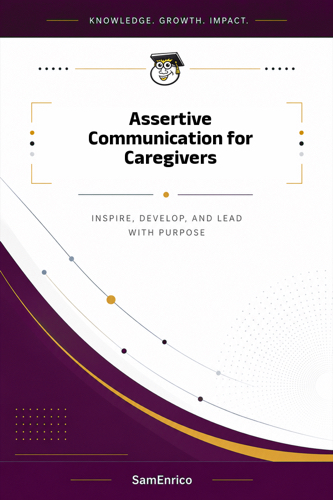
Non-FictionSelf-HelpCaregiving
Assertive Communication for Caregivers eBook
Ask for help and set limits without guilt or resen
Ask for help and set limits without guilt or resentment.
Formats
Free sample
Chapter 1: The Empty Cup--–- The alarm was set for 6:00 AM, but you were already awake. You had been awake since 3:47, when you heard the thump from the other room. Not a fall this time—just a book knocked off the nightstand. But your body had already launched into emergency mode: heart pounding, ears straining, breath held. You lay there in the dark, waiting for the next sound.
It didn't come. Your mother was asleep again. You were not.By 7:00 AM, you had already administered two medications, changed a soiled bedsheet, answered three text messages from your sister (none of which offered actual help), and reheated the same cup of coffee three times without taking a single sip. By 10:00 AM, you had canceled your own doctor's appointment—the one you had been waiting three months for—because the home health aide called in sick and there was no one else.By 2:00 PM, you caught yourself thinking something you would never say out loud: I wish this was over.Then the guilt came. Hot, suffocating, familiar.
How could you think that? After everything she has done for you? After everything she is going through? You are a terrible person. A terrible caregiver.
A terrible daughter.You pushed the thought down, poured another cup of cold coffee, and kept going.This is not a story about a bad caregiver. This is a story about a caregiver who has been handed an impossible load and told that carrying it alone is the only way to be good. This is the story of the empty cup.And it is the story of how you are going to fill it again.The Cultural Lie You Have Been Breathing Like Air There is a silent curriculum that every caregiver absorbs, usually without ever being taught directly. It comes in sideways—through movies where the devoted spouse dies of exhaustion in the final act, through sympathy cards that praise the "angel" who never complained, through relatives who say "I don't know how you do it" as if that is a compliment rather than an indictment.The lie is this: Your worth as a caregiver is directly proportional to how much you suffer.This is the Martyr Equation. It looks like this:More suffering = More virtue.Less suffering = Less love.Once you accept this equation, everything else follows logically—and tragically.
You learn to hide your exhaustion because admitting it would mean admitting you are not virtuous enough. You learn to refuse help because accepting it would reduce your suffering and therefore reduce your worth. You learn to measure your success not by your mother's comfort or your father's safety, but by how depleted you feel at the end of the day.This is not love. This is arithmetic with a missing variable.The missing variable is you.Not the caregiver version of you—the one who administers medications and schedules appointments and changes bedsheets. The real you.
The one who used to laugh at stupid movies. The one who had hobbies that had nothing to do with wound care or pill organizers. The one who existed before this role consumed you.The Martyr Equation requires you to erase that person. This book is going to bring her back.What the Research Actually Says (And Why It Will Surprise You)If the Martyr Equation were correct, the most self-sacrificing caregivers would be the happiest, healthiest, and most effective. They are not.
In fact, study after study shows the opposite.The Caregiver Health Study from the University of California followed more than 1,500 family caregivers over five years. The researchers measured two things: how many hours of care the caregivers provided each week, and how much they reported suppressing their own needs (skipping meals, losing sleep, canceling medical appointments). The finding was stark: The caregivers who suppressed their own needs the most had the highest rates of clinical depression, anxiety disorders, and cardiovascular disease—regardless of how many hours they actually provided care.In other words, it was not the workload that broke them. It was the inability to set limits on that workload.A second study, published in the Journal of the American Geriatrics Society, looked at the quality of care provided. Family members of care receivers were asked to rate their loved one's satisfaction and safety.
The highest ratings did not go to the caregivers who worked the most hours or sacrificed the most sleep. The highest ratings went to caregivers who reported moderate workloads with clear boundaries—caregivers who took breaks, asked for help, and protected their own health.Why? Because a burned-out caregiver makes dangerous mistakes. They forget medications. They miss early warning signs of infection.
They lose patience and say things that damage the relationship. They show up physically but check out emotionally, leaving the care receiver feeling like a burden rather than a loved one.Setting limits is not selfish. It is quality assurance.The Distinction That Will Save Your Life: Selfishness vs. Self-Preservation These two words are not synonyms, but the Martyr Myth has spent your entire caregiving journey trying to convince you they are. Let us separate them permanently.Selfishness is taking resources that belong to others for your own gain, knowing that your gain causes them harm.
Selfishness says: "I will take the last hour of respite care even though you need it more." Selfishness says: "I will stop helping entirely because I am bored." Selfishness is about excess—taking more than your share at the expense of someone else's basic needs.Self-preservation is taking care of your own basic biological and psychological needs so that you can continue to function. Self-preservation says: "I will eat lunch even though you need help with your lunch first." Self-preservation says: "I will sleep six hours tonight instead of four." Self-preservation is about baseline—maintaining the minimum conditions for your own survival.Here is the test that will cut through the guilt every time:Ask yourself: Am I taking something that rightfully belongs to someone else and that they cannot live without? Or am I keeping something that I need to live, which no one else is entitled to?If you are keeping your own sleep, your own meals, your own medical care, your own sanity—that is not selfishness. That is the rent you pay for the privilege of continuing to show up.The Martyr Myth wants you to believe that any attention to your own needs is theft from the care receiver. That is a lie.
Your needs are not in competition with the care receiver's needs. They are in sequence. You must meet your baseline needs first, or you will have nothing left to give.This is not philosophy. This is physiology.The Physiology of the Empty Cup When you skip a meal, your blood glucose drops. Your brain, which runs exclusively on glucose, begins to ration energy.
It shuts down non-essential functions first—things like creativity, patience, impulse control, and emotional regulation. By the time you feel "hangry," your prefrontal cortex (the part of your brain responsible for empathy and long-term planning) is already operating at half capacity.When you lose sleep, your amygdala—the brain's fear and anger center—becomes more reactive. At…
This is the end of the free sample. Get the eBook to keep going. Buy now
About this book
Details
- Author
- Mercado Hulda
- Publisher
- SamEnrico
- Language
- English
- Genre
- Non-Fiction, Self-Help, Caregiving
- Released
- 2026-06-08
- Pages (approx.)
- 127
- Available as
- eBook, Audiobook

Read better in the ZLOADR app
Your eBooks on your phone or tablet. Sign in with your SamEnrico account and start reading.
More by Mercado Hulda
 Foster Care Self Esteem PlanMercado Hulda$11.99
 Academic Burnout Prevention WorkbookMercado Hulda$11.99
 Bridge and Backbend GuideMercado Hulda$11.99
 Financial Comparison on Social MediaMercado Hulda$11.99
 The Emperor’s Poison: The First Forensic Trial of Meiji JapanMercado Hulda$11.99
 How to Start a Calendering Machinery for Textiles Business (Beginners Guide)Mercado Hulda$11.99
 Criminal LawMercado Hulda$11.99
 Citation Rule Video Script CompanionMercado Hulda$12.99
 Promotion Presentation BlueprintMercado Hulda$12.99
 Understanding N SyndromeMercado Hulda$17.99
You may also like
 Hong Kong Handover 1997Dunn Johnnie$11.99
 Zumba For Postnatal Recovery CourseNeal Christian$11.99
 Zumba for BeginnersLadner Nikia$11.99
 YouTube Comment Mining GuideHumes Pandora$12.99
 Worry Box MeditationCarlin Rudy$11.99
 Workplace Stress MeditationNguyen Lynn$11.99
 Workplace Stress and Sleep RepairHawley Ivory$11.99
 Workplace Perfectionism CureDelaney Jeffry$11.99
 Workplace Injustice Anger GuideWallen Isabelle$11.99
 Work Addiction and Burnout LinkGreenwood Ester$11.99
 Women in Yoga and WellnessBeattie Galina$11.99
 Women in Stand Up ComedyChun Evangeline$11.99