
Non-FictionSelf-HelpCareer Advancement
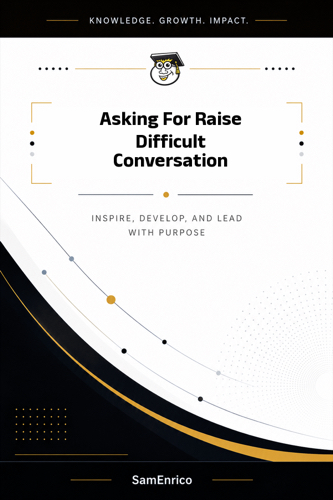
Asking For Raise Difficult Conversation eBook
Negotiates salary increase with confidence and dat
by Carlos Mari
Negotiates salary increase with confidence and data.
Formats
Free sample
Chapter 1: The Gratitude Trap--–- You are standing in the shower, rehearsing words you will never say. The water has gone cold. You have been in there for twenty-two minutes, running through the same mental script: I really think I deserve... No, that sounds entitled. Based on my contributions...
No, that sounds like a threat. I was hoping we could discuss... No, that sounds like a beggar. You turn off the water, dry yourself, and walk to your closet. The conversation never happens.
The raise never gets asked for. Another day, another dollar, another quiet erosion of your worth.This is not a character flaw. It is not laziness, cowardice, or a lack of ambition. It is a design flaw in how you were taught to see yourself and your work. And until you name it, confront it, and dismantle it, no amount of negotiation tactics or salary data will save you from the paralysis that has already cost you—by some estimates—hundreds of thousands of dollars in lifetime earnings.Welcome to The Gratitude Trap.The Silent Epidemic No One Talks About Let us begin with a confession.
Not mine, but one I have heard from over a thousand professionals across every industry, every level, and every demographic. Here it is, in their own words, anonymized but real:"I saved my company $400,000 last year. I haven't asked for a raise in four years. I keep telling myself I'll do it after the next project." – Senior Operations Manager, tech industry"My coworker does half my work and makes $15,000 more than me. I found out at a happy hour.
I smiled, went to the bathroom, and cried. That was eighteen months ago. I still haven't said anything." – Marketing Director, non-profit"I was promoted twice without a salary adjustment. My title changed, my responsibilities tripled, my paycheck stayed the same. When I finally mentioned it to my boss, he said, 'I'm glad you brought this up.' He gave me 3%.
I said thank you." – Product Lead, financial services These are not stories of incompetence or weakness. These are stories of high-performers who have been captured by a psychological mechanism so powerful that it overrides their own financial self-interest. I call it The Gratitude Trap, and it has three distinct components that work together like a silent machine grinding down your earning potential.Component One: The Gratitude Reflex The first component is the most insidious because it wears the mask of virtue. You have been trained—by parents, by teachers, by a culture that prizes humility—to respond to any gift or opportunity with gratitude. A job offer comes: you say thank you.
A promotion arrives: you say thank you. A bonus appears: you say thank you. None of this is wrong. Gratitude is a beautiful thing.But here is where it turns toxic. The Gratitude Reflex convinces you that the current arrangement—your salary, your title, your responsibilities—is a gift rather than an exchange.
You start to believe that you should be thankful for what you have, and that asking for more is not just greedy but ungrateful. You owe them. They took a chance on you. You should prove yourself first. Maybe next year.Let me be brutally clear: your employment is not charity.
It is a transaction. You sell your time, attention, skills, and energy. They pay you money. If either party stops benefiting, the transaction ends. There is no debt of gratitude on either side.
The moment you feel lucky to have your job is the moment you lose all leverage in asking for more.Component Two: The Perfectionism Pivot The second component is the one that hits high-performers hardest. You believe—deep in your bones—that you must be perfect before you can ask. Not good. Not great. Perfect.
No missed deadlines, no unresolved conflicts, no feedback that wasn't addressed. You are waiting for a moment that does not exist.Here is what you are actually waiting for: a version of yourself that has never made a mistake. That person does not exist. And because they do not exist, you will never ask. You will wait for the perfect quarterly review, the perfect project completion, the perfect alignment of budget cycles.
And while you wait, two years become five, five become ten, and you wake up realizing you have left hundreds of thousands of dollars on the table.The Perfectionism Pivot is particularly cruel because it masquerades as professionalism. "I'm just being thorough," you tell yourself. "I want to make sure I have all my data." But thoroughness without action is procrastination dressed in a business suit. The perfect moment is a myth. The only real question is whether you will ask before you are perfect—which means asking while you are still terrified.Component Three: The Comparison Cage The third component is the one that keeps you silent even when you know you are underpaid.
It is the voice that says: Who do you think you are? Other people have it worse. Be grateful you have a job at all.This voice weaponizes comparison against you. It points to the person who was laid off, the person who makes less, the person who has been stuck at the same level for a decade. "See?" the voice says.
"You have no right to complain."But comparison in the other direction—toward the person who makes more, who was promoted faster, who negotiated a signing bonus—is exactly the data you need. The Gratitude Trap trains you to look down, not up. It trains you to feel lucky rather than leveraged. And it trains you to see asking as an act of aggression rather than an act of normal business.The Neuroscience of Why You Cannot Ask Now let us get under the hood. Why does asking for a raise feel physically painful?
Why do your palms sweat, your heart race, your throat close up? This is not weakness. This is biology.Researchers have found that the brain regions activated by social rejection—the anterior cingulate cortex and the insula—are the same regions activated by physical pain. Your brain literally cannot tell the difference between someone saying "no" to your raise request and someone punching you in the stomach. The neural pathways are identical.This is an evolutionary hangover.
For most of human history, social rejection meant expulsion from the tribe, which meant death. Your brain is still wired to treat any potential rejection as a life-or-death threat. When you contemplate asking for a raise, your amygdala (the brain's fear center) fires before your prefrontal cortex (the reasoning center) even gets a word in. You are not being irrational. You are being prehistoric.But here is the crucial insight that changes everything: your brain can be retrained.
The same neuroplasticity that created this fear response can also overwrite it. And the most effective tool for retraining is not meditation, not affirmations, not "confidence hacks." It is data.Why Emotional Pleas Fail and Data Prevails Let me give you two versions of the same request. Read them and notice your own visceral reaction.Version A (Emotional): "I really need a raise. My rent went up, I have student loans, and…
This is the end of the free sample. Get the eBook to keep going. Buy now
About this book
Details
- Author
- Carlos Mari
- Publisher
- SamEnrico
- Language
- English
- Genre
- Non-Fiction, Self-Help, Career Advancement
- Released
- 2026-06-10
- Pages (approx.)
- 131
- Available as
- eBook, Audiobook

Read better in the ZLOADR app
Your eBooks on your phone or tablet. Sign in with your SamEnrico account and start reading.
More by Carlos Mari
 Meth Recovery Exercise Therapy WorkbookCarlos Mari$11.99
 Honey Bee Hive WatchCarlos Mari$11.99
 Parentified Child Liberation WorkbookCarlos Mari$11.99
 Letting Go of Narcissistic AbuseCarlos Mari$11.99
 Pattern Recognition for FinanceCarlos Mari$11.99
 CRE Letter of Intent GuideCarlos Mari$11.99
 Resume Immigration PathwaysCarlos Mari$11.99
 Self Esteem For WomenCarlos Mari$11.99
 The Jade Lords of the Olmec: Africa’s Forgotten Architects of MesoamericaCarlos Mari$11.99
 Golden Handshakes: The FIFA Corruption TakedownCarlos Mari$11.99Golden Handshakes: The FIFA Corruption TakedownCarlos Mari$11.99
 Lost Cities of the Pacific: Decoding the Quantum Secrets of YonaguniCarlos Mari$11.99
You may also like
 Hong Kong Handover 1997Dunn Johnnie$11.99
 Zumba For Postnatal Recovery CourseNeal Christian$11.99
 Zumba for BeginnersLadner Nikia$11.99
 YouTube Comment Mining GuideHumes Pandora$12.99
 Worry Box MeditationCarlin Rudy$11.99
 Workplace Stress MeditationNguyen Lynn$11.99
 Workplace Stress and Sleep RepairHawley Ivory$11.99
 Workplace Perfectionism CureDelaney Jeffry$11.99
 Workplace Injustice Anger GuideWallen Isabelle$11.99
 Work Addiction and Burnout LinkGreenwood Ester$11.99
 Women in Yoga and WellnessBeattie Galina$11.99
 Women in Stand Up ComedyChun Evangeline$11.99