
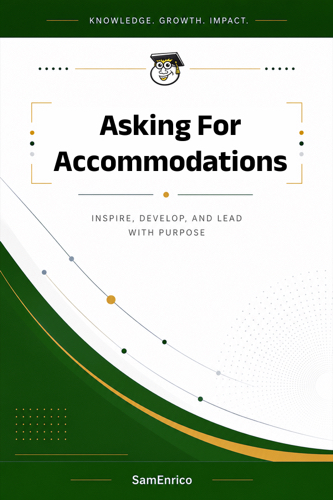
Asking For Accommodations eBook
Request workplace adjustments for disability or he
Request workplace adjustments for disability or health needs.
Formats
Free sample
Chapter 1: The Masking Tax...--–- You are exhausted, and you cannot figure out why.Not the normal tiredness that comes after a long week or a difficult project. Not the sleepy feeling that a good night's rest could fix. This is deeper. This is the exhaustion of waking up every morning and running a cost-benefit analysis on every single movement, every typed word, every meeting invitation, every casual comment in the breakroom. Should I tell them my head is pounding, or do I fake a smile?
Can I stand up during this presentation, or will they think I am being dramatic? If I admit I cannot process verbal instructions right now, will they assume I am incompetent?This is the exhaustion of hiding.And if you feel it, you are not broken. You are not weak. You are not lazy. You are part of the largest, most invisible workforce in the modern economy.
You are one of the millions of people who wake up every day with a body or a brain that does not quite fit the standard-issue expectations of the nine-to-five world. You have learned to camouflage your symptoms, to minimize your needs, to laugh off the pain, to work twice as hard to produce the same result as someone who does not have to manage a chronic condition while also managing a spreadsheet.You have learned to mask. And the cost of that mask is higher than you think.This chapter is about taking that mask off, at least privately, long enough to see your own face. It is about understanding that your exhaustion has a name, that your isolation is by design, and that the first step toward getting what you need at work is not drafting a legal letter or scheduling a meeting with HR. The first step is much simpler and much harder: admitting to yourself that you are not alone.The 1-in-4 Reality: You Are Not the Exception Let us start with a number that should shock you but probably will not, because you have been conditioned to believe the opposite.
Twenty-five percent. One in four working adults has a disability or a chronic health condition. That is not a fringe statistic from an advocacy group with an agenda. That is the data from the Centers for Disease Control, the World Health Organization, and the Bureau of Labor Statistics, all saying roughly the same thing across different methodologies and different countries.One in four.In an office of twenty people, that is five colleagues navigating something invisible. In a company of one thousand, that is two hundred and fifty people.
In the United States workforce alone, that is over forty million people. Forty million people who have diabetes, autoimmune disorders, mental health conditions, ADHD, long COVID, chronic pain, hearing loss, mobility impairments, learning differences, cancer in remission, Crohn's disease, bipolar disorder, anxiety, depression, epilepsy, multiple sclerosis, arthritis, endometriosis, post-traumatic stress, traumatic brain injury, or any of the hundreds of other conditions that make the standard workday a negotiation rather than a given.Here is the part that should truly alarm you: most of them never tell anyone at work.The same studies that give us the one-in-four figure also give us a second number, one that is rarely discussed in diversity reports or corporate inclusion statements. The majority of employees with disabilities or chronic health conditions choose not to disclose. They hide. They mask.
They develop elaborate strategies to appear fully abled, fully healthy, fully in control. They take sick days under fake excuses. They work from home on days when standing is impossible but say nothing about why. They memorize meeting agendas because they know their auditory processing will fail in real time. They arrive early to the office so no one sees them limping from the parking lot.They do this because they have learned, often through painful experience, that disclosure carries risk.
And they are not wrong.The Anatomy of Masking: What You Are Hiding and What It Costs You Masking is not a clinical term, though it has been adopted by psychologists and occupational therapists to describe a very real phenomenon. Masking is the conscious or semi-conscious process of hiding symptoms of a disability or chronic condition to appear neurotypical, able-bodied, or simply "normal" in a workplace setting.For someone with a visible disability—a wheelchair user, a person with a guide dog, someone with an obvious physical difference—masking is not really an option. Their accommodation needs are often visible from the start, which brings its own set of challenges, including staring, invasive questions, and assumptions about competence. But for the vast majority of people with disabilities, the condition is invisible. And invisibility brings a cruel paradox: you have the option to pass as non-disabled, but passing requires constant vigilance.Consider what masking might look like for different people in different roles.A lawyer with lupus knows that stress triggers her flares.
She also knows that her firm expects sixty-hour weeks and weekend email responses. So she hides her fatigue. She smiles through depositions when her joints are screaming. She ducks into the bathroom to take medication that makes her nauseous, then returns to her desk and pretends nothing happened. She has not taken a sick day in three years, not because she has not needed one, but because she used all her sick days during a bad flare and does not want to raise questions.A software engineer with ADHD sits down to code at nine in the morning.
His medication takes an hour to fully kick in, but his team has a ten o'clock standup where everyone reports progress. He spends the first hour of every day pretending to be productive while his brain struggles to focus. He volunteers for the tasks that require hyperfocus—the ones that play to his strengths—but he downplays the fact that he cannot do administrative work without body-doubling or external accountability. He has never told his manager about his diagnosis because the last time he mentioned ADHD at work, a colleague joked about "everyone being a little ADD."A teacher with anxiety disorder loves her students but dreads faculty meetings. The open-ended nature of discussions, the pressure to speak extemporaneously, the casual comments that she will ruminate on for days—all of it sends her nervous system into overdrive.
She prepares scripts for every interaction. She practices her breathing in the bathroom between classes. She has never missed a day of teaching, but she has come home and cried in the car more times than she can count.A retail manager with long COVID used to be the energizer bunny of his store. Now he runs out of gas by two in the afternoon. His brain fog makes inventory tracking a nightmare.
He has started delegating tasks he used to handle himself, not because he is training his team, but because he literally cannot remember the steps. His regional manager has noticed the change and asked if everything is okay. He said yes. He said he is just tired. He said he will shake it off.Every single one of these people is paying the masking tax.Calculating Your Masking…
This is the end of the free sample. Get the eBook to keep going. Buy now
About this book
Details
- Author
- Fries Rebbecca
- Publisher
- SamEnrico
- Language
- English
- Genre
- Non-Fiction, Self-Help, Disability Rights
- Released
- 2026-06-06
- Pages (approx.)
- 148
- Available as
- eBook, Audiobook

Read better in the ZLOADR app
Your eBooks on your phone or tablet. Sign in with your SamEnrico account and start reading.
More by Fries Rebbecca
 Failure Rebranding StrategyFries Rebbecca$11.99
 CFA Exam Prep GuideFries Rebbecca$11.99
 The Mother's Medical FraudFries Rebbecca$11.99
 Shift Work Driving Home SafetyFries Rebbecca$11.99
 Opioid Master GuideFries Rebbecca$11.99
 Cheerleader Hypnosis GuideFries Rebbecca$11.99
 Sleep Metabolic FixFries Rebbecca$11.99
 The Golden Thread: The Silk Road and the Rise of VeniceFries Rebbecca$11.99
 The Fall of the Argentine Shakespeare: The Tragic Rise and Ruin of Enrique CarrerasFries Rebbecca$11.99
 How to Produce Electric Knife Replacement BladesFries Rebbecca$11.99
 Papaya: Green & Ripe Papaya HarvestingFries Rebbecca$11.99
 Alibaba Trade Show vs Amazon Virtual Selling WorkbookFries Rebbecca$12.99
You may also like
 Disability Accommodation AngerHong David$11.99
 Workplace Accommodations Request GuideZarate Deshawn$11.99
 Workplace Anger Accommodation RequestBreen Jame$11.99
 Disability Accommodation Anger HandbookFrierson Franklyn$11.99
 Navigating Disability Accommodation TalksCleary Dian$11.99
 Requesting Reasonable AccommodationYi Annamaria$11.99