
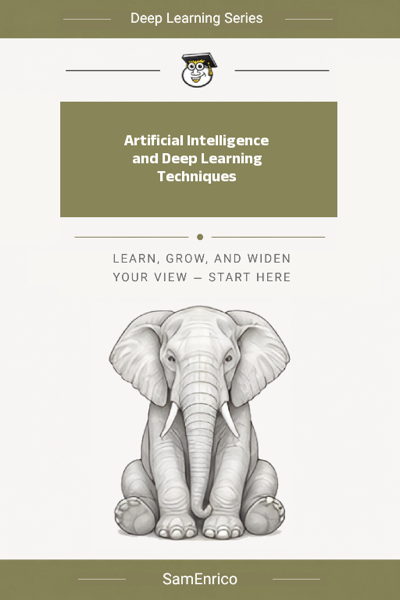
Artificial Intelligence and Deep Learning Techniques eBook
A Coursebook on Artificial Intelligence and Deep L
A Coursebook on Artificial Intelligence and Deep Learning Techniques
Formats
Free sample
Chapter 1: The Intelligence Paradox--–- In the summer of 1956, a small group of mathematicians and cognitive scientists gathered at Dartmouth College with an audacious proposal. They believed they could build machines that thought. Not machines that simply calculated faster than any human, but machines that could learn, reason, understand language, and perhaps even improve themselves. The proposal they wrote contained a phrase that would echo through the next seven decades: "Every aspect of learning or any other feature of intelligence can in principle be so precisely described that a machine can be made to simulate it."They were not wrong. But they were also not right – at least, not on the timeline they imagined.
The Dartmouth workshop marked the birth of artificial intelligence as a field, but it also inaugurated a peculiar pattern that would repeat itself every fifteen to twenty years: a wave of extravagant promises, followed by a brutal crash of disappointment, followed by a quiet renaissance. This pattern – this paradox of simultaneous triumph and failure – is the single most important fact about AI that no algorithm will teach you.If you picked up this book, you likely have heard that deep learning is transforming the world. You may have seen Chat GPT write a poem, watched Alpha Fold predict protein structures, or read about self-driving cars navigating city streets. You are here to learn how these systems work – the mathematics, the code, the architectures. That is all coming.
But before you write a single line of Python, you need to understand why AI has failed spectacularly twice before succeeding so dramatically today. You need to understand what is genuinely new about the current era, what is merely a better version of old ideas, and what remains stubbornly impossible.This chapter is not an introduction in the conventional sense. It will not apologize for math or promise that AI is easy. Instead, it will arm you with a mental map of the entire AI landscape – its past, its present pipeline, and the skills you need to navigate the chapters ahead. By the time you finish the hands-on lab at the end, you will have a working Python environment, a running notebook, and – more importantly – a clear answer to the question: "What am I actually building in this book, and why does it matter?"1.1 Three Kinds of Intelligence – And Why the Difference Matters Let us begin with a deceptively simple question: What do we mean when we say a machine is "intelligent"?The answer matters because almost every argument about AI – whether enthusiastic or terrified – collapses if we do not distinguish between three fundamentally different categories.
In academic circles, these are called Narrow AI, General AI, and Superintelligence. In practice, they are better understood as the specialist, the generalist, and the god.Narrow AI (Weak AI or Applied AI) describes systems that perform a single task extremely well – often better than any human – but cannot transfer their abilities to any other domain. The chess engine that defeats world champions cannot drive a car. The spam filter that protects your inbox cannot write a sonnet. The facial recognition system that unlocks your phone cannot diagnose diseases.
Every single system you will build in this book – from the simple perceptron in Chapter 4 to the generative adversarial network in Chapter 9 – is Narrow AI.This is not a limitation to be mourned. Narrow AI is extraordinarily useful precisely because it is specialized. A radiologist does not need an AI that can also compose music; she needs an AI that can detect tumors with higher sensitivity than the human eye. An autonomous vehicle does not need to discuss philosophy; it needs to distinguish a plastic bag from a child. The power of deep learning lies in its ability to approximate any function, given enough data and compute – but that function is always a narrow mapping from inputs to outputs.General AI (Strong AI or Human-Level AI) refers to a system that can perform any intellectual task that a human being can.
It would learn to play chess, then apply that learning to master Go without retraining. It would understand a novel situation, reason about it, adapt its behavior, and explain its reasoning in natural language. As of 2026, no such system exists – despite confident claims from some quarters that large language models are "sparks of AGI."The distinction between Narrow and General AI is not merely quantitative (more tasks) but qualitative (transfer learning across fundamentally different domains). A human who learns to ride a bicycle can apply concepts of balance to ice skating. A narrow AI trained on chess has no representation of balance at all.
This gap – the inability to abstract and transfer knowledge across domains – remains the single greatest unsolved problem in artificial intelligence.Superintelligence describes an intellect that vastly exceeds the best human minds in every domain, including scientific creativity, strategic planning, and social manipulation. This is the stuff of speculative fiction – and genuine concern among a subset of AI researchers. The alignment problem, which we will explore in Chapter 12, asks: if we build a superintelligence, how do we ensure its goals align with human welfare? That question is important, but it is not relevant to anyone reading this chapter. You cannot accidentally build a superintelligence, any more than you can accidentally build a nuclear reactor while learning to change a lightbulb.Why does this taxonomy matter for a coursebook on deep learning techniques?
Because the field is plagued by category errors. A journalist reads a paper about a narrow AI that can generate convincing text, then writes a headline declaring that machines have become sentient. A policymaker hears that AI systems exhibit bias, then concludes that all AI is inherently untrustworthy. An executive learns that GPT-4 can write code, then cancels the company's software engineering internship program. All of these are mistakes that stem from confusing the specialist with the generalist.Throughout this book, you will build narrow AI systems.
They will be impressive within their specific domains – a classifier that distinguishes cats from dogs with 99% accuracy, a generator that creates plausible synthetic faces, a reinforcement learning agent that masters a video game. But you will also learn to recognize their limitations: they have no understanding, no consciousness, no common sense, no goals beyond the loss function you provide. That recognition is not pessimism; it is professionalism.1.2 A Brief History of Overpromising and Underdelivering (Then Finally Getting It Right)The history of artificial intelligence is often told as a triumphal march from the Dartmouth workshop to Chat GPT. That narrative is false. A more accurate history looks like a series of steep climbs followed by avalanches, followed by new climbers scaling different faces of the same mountain.The First Wave: Symbolic AI (1956–1974)The original AI researchers believed that intelligence could be reduced to symbol manipulation.
If you could encode the rules of logic, you could encode reasoning. If you could represent knowledge as facts and relationships (for example, "Socrates is a man" and "all men are mortal"), then a machine could derive new knowledge ("Socrates is mortal") using logical inference.This approach, called symbolic AI or "Good Old-Fashioned AI" (GOFAI), produced some early successes. The Logic Theorist (1956) proved 38 of the…
This is the end of the free sample. Get the eBook to keep going. Buy now
About this book
Details
- Author
- Porterfield Hollis
- Publisher
- SamEnrico
- Language
- English
- Genre
- Non-Fiction, Informative, Educational
- Released
- 2026-06-02
- Pages (approx.)
- 155
- Available as
- eBook, Audiobook

Read better in the ZLOADR app
Your eBooks on your phone or tablet. Sign in with your SamEnrico account and start reading.
More by Porterfield Hollis
 Press Release For AnniversariesPorterfield Hollis$11.99
 Wrist Pain Meditation GuidePorterfield Hollis$11.99
 Weightlifting Platform Hypnosis GuidePorterfield Hollis$11.99
 The Envelope System for ShoppersPorterfield Hollis$11.99
 Polish Family Communist EraPorterfield Hollis$11.99
 Following Up Without AnnoyingPorterfield Hollis$11.99
 Financial Mindfulness MethodPorterfield Hollis$11.99
 Experiencing the Mind BreathPorterfield Hollis$11.99
 Leaves on Stream VisualizationPorterfield Hollis$11.99
 Anohni: The Voice That Shattered SilencePorterfield Hollis$11.99
 Whispers of the Hollow Earth: The Lost Civilization Beneath Our FeetPorterfield Hollis$11.99
 Travel Influencer Wanderlust EnvyPorterfield Hollis$12.99