
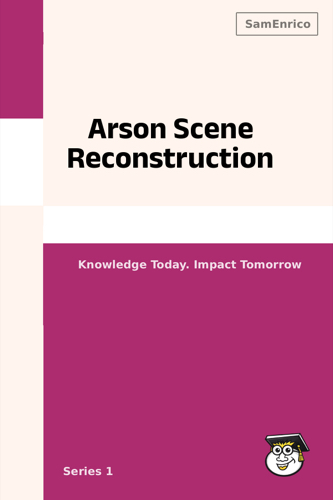
Arson Scene Reconstruction eBook
Determine fire origin and spread using burn patter
Determine fire origin and spread using burn patterns, accelerant detection, and structural collapse.
Formats
Free sample
Chapter 1: Beyond the Flame--The fire investigator’s greatest enemy is not the arsonist. It is certainty.Marcus Vale learned this lesson twenty years into his career, standing in the ruins of a church that had burned on Christmas Eve. The congregation had gathered outside in the snow, watching their sanctuary collapse. Children cried. An elderly deacon pressed a photograph of the stained-glass window into Vale’s hand—a window that had been handcrafted in 1927, now reduced to green and blue glass shards scattered across the parking lot like frozen tears.Vale had found the origin quickly.
Under a pew near the back wall, a space heater sat tilted against a wooden leg. The carpet beneath it was deeply charred. The electrical cord showed arcing. The V-pattern on the wall pointed directly to that spot. Open and shut.
Accidental fire. He wrote his report, testified at the insurance hearing, and moved on to the next case.Eighteen months later, a man was arrested for setting fire to a different church forty miles away. During interrogation, he confessed to eleven church fires over three years—including the Christmas Eve fire Vale had investigated. The space heater, he explained, was a prop. He had poured gasoline under the pew, ignited it with a lighter on a long stick, then tipped the heater over as he fled.
He had counted on investigators seeing the heater and stopping there.Vale had stopped there. He had been certain. And certainty had blinded him to the pour pattern hidden beneath the char, to the unusual burn depth on the pew leg, to the fact that the heater was unplugged—a detail he noted in his report but failed to weigh properly. The heater could not have been the ignition source if it was unplugged. And yet Vale had written “space heater” as the cause without ever confirming that the heater was energized at the time of the fire.That case changed everything for Vale.
He stopped using the word “obvious” in his reports. He started treating every accidental finding as provisional. He became a reconstructionist, not merely an origin-and-cause investigator. And he began teaching others the lesson that nearly cost an innocent man his freedom: you do not know what you think you know until you have tested it against every scrap of evidence.This book is written for investigators who want to avoid Marcus Vale’s mistake. It is written for prosecutors who need to understand what their expert witnesses can and cannot say.
It is written for defense attorneys who must recognize when an investigation has stopped too soon. And it is written for students of fire science who will inherit a field still recovering from decades of junk science and wrongful convictions.Arson scene reconstruction is not a set of tricks or rules of thumb. It is a disciplined application of the scientific method to the most destructive force on earth. It requires patience, humility, and a willingness to be wrong. And it demands that you begin every investigation not with a conclusion but with a question: What actually happened here?The Architecture of This Book Before we dive into fire dynamics, burn patterns, and laboratory analysis, let me explain how this book is structured and how to get the most from it.Arson Scene Reconstruction is divided into three parts, mirroring the logical flow of a reconstruction investigation.Part I: The Scientific Canvas (Chapters 1-3) establishes the foundational knowledge you need before you ever step onto a scene.
Chapter 1 (this chapter) introduces the reconstruction mindset, the scientific method, and the tools for weighing competing hypotheses. Chapter 2 teaches fire dynamics—the physics of how fires start, grow, spread, and decay. Chapter 3 provides a visual lexicon of burn patterns, teaching you to read the archive of damage left behind.Part II: The Search for Truth (Chapters 4-7) moves from theory to practice. Chapter 4 presents a systematic exterior-interior sweep protocol. Chapter 5 focuses on accelerant detection and mapping.
Chapter 6 covers evidence collection and laboratory analysis. Chapter 7 provides methods for evaluating electrical and mechanical ignition sources.Part III: The Collapse and the Criminal (Chapters 8-12) addresses advanced synthesis. Chapter 8 treats structural collapse as a timeline recorder. Chapter 9 connects physical evidence to the behavioral blueprint of the fire-setter. Chapter 10 introduces computational fire modeling.
Chapter 11 applies reconstruction principles to fatal fires. Chapter 12 prepares you for the courtroom crucible, where your conclusions will be tested under oath.Each chapter includes case studies drawn from real investigations, with names and identifying details changed to protect the innocent and the convicted alike. Each chapter concludes with key takeaways and practical exercises. Some chapters include decision trees and matrices—use them. They are not decoration; they are tools designed to prevent the cognitive biases that have sent innocent people to prison.Defining Reconstruction: More Than Origin and Cause Let me be precise about terms, because precision matters in this field.Origin and cause investigation answers two questions:Origin: Where did the fire start?
(e.g., “the kitchen stove, left rear burner”)Cause: What ignited it? (e.g., “a pan of cooking oil overheated and ignited”)These are necessary findings. They are not sufficient for reconstruction. An origin-and-cause investigator can determine that a fire started in a bedroom from a cigarette and close the case. A reconstructionist asks what happened next—and why.Arson scene reconstruction answers a broader set of questions that together create a narrative timeline of the fire event:What was the fire’s growth rate from ignition to flashover?How and when did ventilation change (window breakage, door openings, roof collapse)?In what sequence did structural elements fail, and what does that sequence reveal about fire travel?Where were occupants or victims during the fire, and did they move before death?What behavioral evidence (trailers, multiple origins, timing devices) indicates human intent?Could the physical damage have been produced by an accidental cause, or only by an incendiary one?Does the evidence support a single hypothesis, or are multiple explanations equally plausible?Think of origin-and-cause as determining the first frame of a film and the spark that started it.
Reconstruction restores every frame between ignition and extinction. It answers how the fire spread, when it reached critical points, why certain areas burned more severely than others, and what the fire’s behavior reveals about human action before, during, and after the flames.This distinction has profound practical consequences. An origin-and-cause investigator might stop after finding a frayed electrical cord in the living room and a char pattern consistent with that cord. A reconstructionist asks: Why did the fire spread so quickly to the bedroom when the door was closed? Why is there a clean burn pattern on the floor beneath the window when the window was closed at ignition?
Why did the sofa burn from the bottom up rather than the top down? These questions often reveal anomalies that origin-and-cause alone would miss—anomalies that point to incendiary fires or, just as importantly, that rule out arson in cases where an innocent person has been accused.The Scientific Method at the Fire Scene NFPA 921, the Guide for Fire and Explosion Investigations, is unambiguous: fire investigation must follow the scientific method. But what…
This is the end of the free sample. Get the eBook to keep going. Buy now
About this book
Details
- Author
- Kirkwood Celesta
- Publisher
- SamEnrico
- Language
- English
- Genre
- Non-Fiction, True Crime
- Released
- 2026-06-12
- Pages (approx.)
- 160
- Available as
- eBook, Audiobook

Read better in the ZLOADR app
Your eBooks on your phone or tablet. Sign in with your SamEnrico account and start reading.
More by Kirkwood Celesta
 Semiconductor Talent HotspotsKirkwood Celesta$11.99
 Number Rhyme Peg System MasteryKirkwood Celesta$11.99
 Mentor Imposter ConnectionKirkwood Celesta$11.99
 Hybrid Work SchedulingKirkwood Celesta$11.99
 The Startup CFO for HireKirkwood Celesta$11.99
 Using Others Recorded HypnosisKirkwood Celesta$11.99
 Focus For HR ProfessionalsKirkwood Celesta$11.99
 The Guerrilla Filmmakers of Sarajevo: Making Art Under SiegeKirkwood Celesta$11.99
 Chiron: The Centaur Who Taught Gods and HeroesKirkwood Celesta$11.99
 How to Produce a Drag HarrowKirkwood Celesta$11.99
 College Essay Brainstorming HandbookKirkwood Celesta$12.99
 Research Proposal Timeline WorkbookKirkwood Celesta$12.99
You may also like
 Hong Kong Handover 1997Dunn Johnnie$11.99
 Zumba For Postnatal Recovery CourseNeal Christian$11.99
 Zumba for BeginnersLadner Nikia$11.99
 YouTube Comment Mining GuideHumes Pandora$12.99
 Worry Box MeditationCarlin Rudy$11.99
 Workplace Stress MeditationNguyen Lynn$11.99
 Workplace Stress and Sleep RepairHawley Ivory$11.99
 Workplace Perfectionism CureDelaney Jeffry$11.99
 Workplace Injustice Anger GuideWallen Isabelle$11.99
 Work Addiction and Burnout LinkGreenwood Ester$11.99
 Women in Yoga and WellnessBeattie Galina$11.99
 Women in Stand Up ComedyChun Evangeline$11.99