
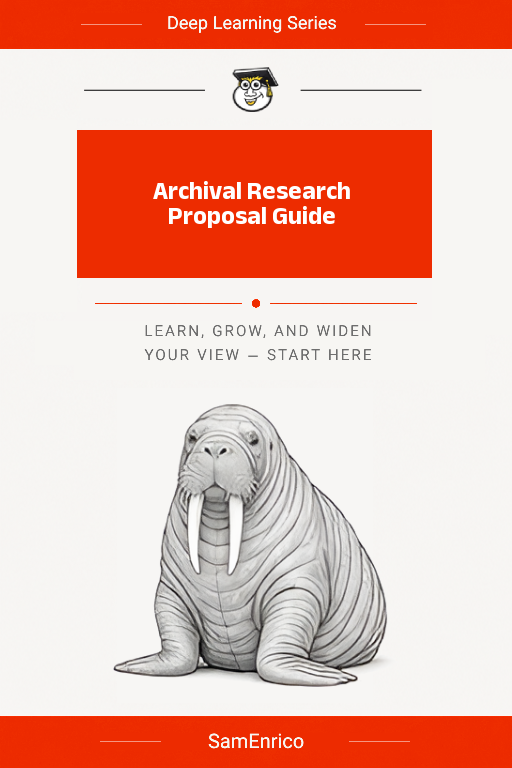
researchStudent's ShortcutArchival
Archival Research Proposal Guide
Propose research using existing archives, datasets
Propose research using existing archives, datasets, or historical records. Describe access protocols, document provenance, and coding schemes for secondary data.
Formats
About this book
Free sample
Chapter 1: The Black Box--–- You are about to propose a project on materials you have never seen. You do not know if the relevant documents exist. You do not know if they are legible, complete, or even open to researchers. You do not know if the archivist will like you, if the reading room has working outlets, or if the one box you desperately need will be offsite for the entire month of your visit. And yet, by the time you finish this book, you will write a proposal that convinces a committee, a funding body, and a repository gatekeeper that your project is not only feasible but essential.This is the Black Box Problem.
It is the central paradox of archival research, and it separates the archival proposal from every other genre of academic proposal writing. A chemist proposing a lab experiment can describe the equipment, the reagents, and the procedures in advance because those elements are stable and knowable. An ethnographer proposing fieldwork can describe the community, the setting, and the anticipated modes of participation because those elements, while dynamic, are accessible for preliminary observation. But you—the archival researcher—must write a detailed, credible, and fundable plan for a project whose primary evidence is locked in boxes you cannot open, folders you cannot touch, and records you cannot read until you arrive.This chapter does not pretend to solve the Black Box Problem. That would be dishonest.
Instead, this chapter teaches you how to write around it, through it, and in spite of it. You will learn how to translate uncertainty into methodological transparency. You will learn how archival sedimentation—the messy, haphazard way that records accumulate over time—becomes an asset rather than a liability in your proposal. You will learn to write for two audiences simultaneously: the academic committee that demands theoretical contribution and the institutional gatekeepers who demand preservation protocols. And you will learn when to call your document a "proposal" versus a "prospectus," a distinction that matters enormously for funding but that most guidebooks ignore entirely.By the end of this chapter, you will have…
This is the end of the free sample. Get the eBook to keep going. Buy now
Contents
- Chapter 1
- Chapter 2
- Chapter 3
- Chapter 4
- Chapter 5
- Chapter 6
- Chapter 7
- Chapter 8
- Chapter 9
- Chapter 10
- Chapter 11
- Chapter 12
Details
- Author
- Cantrell Christene
- Publisher
- SamEnrico
- Language
- English
- Genre
- research, Student's Shortcut, Archival
- Released
- 2026-05-30
- Pages (approx.)
- 150
- Available as
- eBook, Audiobook

Read better in the ZLOADR app
Your eBooks on your phone or tablet. Sign in with your SamEnrico account and start reading.
More by Cantrell Christene
 Harvard Extension School Student SupportCantrell Christene$11.99
 The Highway Proximity GuideCantrell Christene$11.99
 High Stakes NegotiationCantrell Christene$11.99
 Burnout Prevention for RetailCantrell Christene$11.99
 The Last Supper of Sergio Morales: A Death Row Meal in Mexico's Justice SystemCantrell Christene$11.99
 How to Become a Glazier ApprenticeCantrell Christene$11.99
 Rocky Mountain Douglas-fir HarvestingCantrell Christene$11.99
 How to Produce Bicycle Handlebar Grips and DecorCantrell Christene$11.99
You may also like
 Scientific Research On TM GuideMartens Nathanial$11.99
 Research Proposal Methodology Section MasteryPauley Debroah$11.99
 Research Proposal Appendix CompilationRaines Tyisha$11.99
 Academic Researcher Distraction GuideFord Virgil$11.99
 TM Research and ScienceCovert Nicki$11.99
 Social Anxiety Research ReviewRoberge Cole$11.99
 Research Proposal Significance Section GuideBock Tory$12.99
 Research Proposal Reviewer PsychologyLugo Tawanda$11.99
 Research Proposal Research Questions DesignLara Robbi$11.99
 Research Proposal References and CitationsPatten Shanice$11.99
 Research Proposal Mixed Methods DesignCameron Omega$11.99
 Research Proposal Data Management PlanAnderson Roberto$12.99