
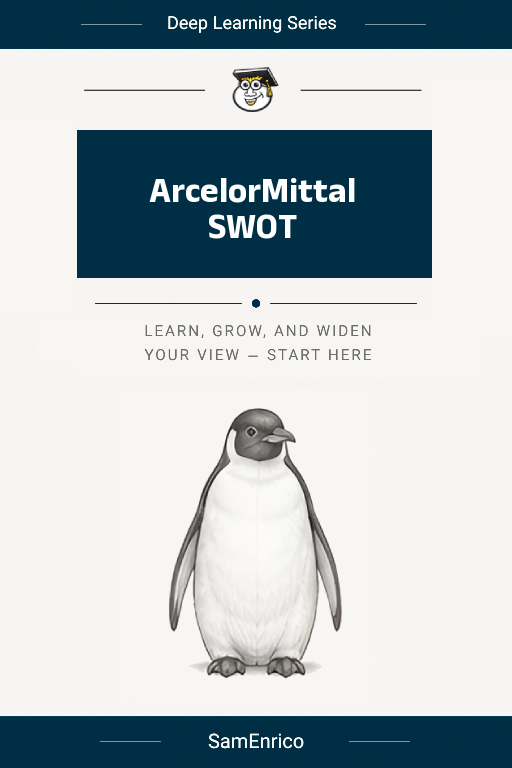
Non-FictionStrategic AtlasSteel
ArcelorMittal SWOT eBook
Analyze global steel leadership, emerging market e
Analyze global steel leadership, emerging market exposure, decarbonization capex, and trade tariffs.
Formats
Free sample
Chapter 1: The Crown of Rust...--–- The call came at 4:47 AM Luxembourg time. Aditya Mittal, then Chief Executive Officer of Arcelor Mittal, was already awake. He had been reviewing the monthly rolling forecasts for the European division, a ritual that had become increasingly grim since he took over from his father in 2021. On the other end of the line was the company’s head of European government affairs, her voice taut with the particular strain that precedes bad news delivered too early in the morning.“The German economic ministry has rejected the Hamburg hydrogen subsidy application,” she said. “They are citing budget constraints following the constitutional court ruling on the climate fund.
The entire €4 billion package is frozen indefinitely.”Aditya set down his pen. The Hamburg plant was supposed to be the flagship of Arcelor Mittal’s green transformation—the first large-scale direct reduced iron facility in Western Europe powered by green hydrogen, capable of producing steel with near-zero emissions. The company had spent three years and €150 million on engineering studies, permitting, and pilot projects. Now, with a single phone call, the timeline had collapsed.He asked the obvious question. “What about Dunkirk?
What about Gijón?”“The French and Spanish ministries are waiting to see how Germany plays out. They don’t want to move alone. If Berlin won’t lead, Paris won’t follow. I’m sorry, Aditya. We’re looking at a minimum eighteen-month delay across all three sites.”Eighteen months.
That was the polite way of saying that the €27 billion decarbonization pipeline—already the most expensive environmental retrofit in industrial history—would miss the 2026–2028 window that made financial sense. By the time the subsidies might reappear, carbon prices could have shifted, Chinese dumping could have intensified, and shareholder patience could have evaporated.Aditya looked out the window at the darkened Luxembourg City skyline. Below, in the company’s treasury department, analysts were already running the numbers on what this would mean for the 2026 earnings call. The preliminary models showed a €500 million hit to free cash flow over two years—money that had been set aside for green hydrogen infrastructure but would now sit idle, or worse, be diverted to share buybacks to keep the stock price from collapsing.This book is not about that phone call. That phone call is merely the door through which we enter a much larger story.This is a story about the world’s largest steel company—a company that produces more metal than the entire output of the United States—standing at the intersection of three existential forces.
The first is China, which has mastered the art of subsidizing its own producers while dumping excess steel onto global markets, depressing prices and destroying margins wherever it goes. The second is carbon, a regulatory revolution that promises to remake the economics of heavy industry but demands a staggering €27 billion in upfront investment that the company does not have and cannot borrow without sacrificing its investment-grade credit rating. The third is capital, the relentless pressure from shareholders who want dividends and buybacks today, not the promise of green steel premiums a decade from now.These three forces are not independent. They interact, collide, and amplify one another. Chinese dumping reduces the cash flow available for decarbonization.
Carbon costs make European plants uncompetitive against Chinese imports. Capital markets punish the company for holding too much debt, which constrains its ability to retrofit its own facilities. It is a perfect storm, and Arcelor Mittal is sailing directly into it.But this book is not about Arcelor Mittal. Not really.This is a book about what happens to any mature industry when the old rules of globalization break. The steel industry is merely the stage; the actors are the universal forces of power, money, and survival.
The lessons here apply equally to chemicals, cement, aluminum, automotive parts, and any other industrial sector built on the assumptions of cheap energy, open trade, and stable climate policy. Those assumptions are gone. What replaces them is the subject of every chapter that follows.To understand where Arcelor Mittal stands today—and more importantly, where it might go—we must begin in a boardroom in Rotterdam, in the autumn of 2005. That is where the modern era of global steel truly began.The Hostile Heir: How One Man Rebuilt an Industry Lakshmi Mittal was not supposed to win. In October 2005, when his company—then called Mittal Steel—launched a €18.6 billion hostile takeover bid for Arcelor, the European business establishment dismissed him as an upstart from a developing country who did not understand the rules of European capitalism.
Arcelor’s management called the bid “vulgar” and “financially irresponsible.” The French government, which held symbolic stakes in several Arcelor subsidiaries, declared the takeover a threat to national industrial sovereignty. The Luxembourg and Spanish governments joined the chorus of protest. For six months, it looked as though the old world would repel the invader.Lakshmi Mittal had heard this before. He was born in 1950 in Sadulpur, a small town in the Rajasthan desert, into a family that ran a small steel trading business. His father, Mohan Mittal, had started with nothing and built a modest operation.
Lakshmi left India in the 1970s to manage a steel mill in Indonesia, then acquired a bankrupt plant in Trinidad and Tobago, then bought a struggling mill in Mexico, then another in Kazakhstan, then another in Canada. He had a gift for seeing value where others saw only rust and ruin. Where Western financiers saw obsolete blast furnaces and militant unions, Lakshmi saw underutilized capacity that could be integrated into a global network.By 2005, his company—Mittal Steel—had become the world’s largest steel producer by acquiring distressed assets on every continent except Antarctica. The takeover of Arcelor was the final piece: the acquisition that would transform a collection of turnaround stories into a genuine global champion, with the scale to set prices and the vertical integration to control costs.The defense mounted by Arcelor was ferocious. Management struck a deal with a Russian rival, Severstal, to create a competing merger that would block Mittal’s bid.
European politicians lined up to denounce the Indian outsider. A Luxembourg court issued injunctions. The French finance minister called the bid “hostile to the values of European capitalism.” But Lakshmi understood something that his detractors did not: steel is a commodity, and commodities are won by cost, not sentiment. He raised his bid. He courted Arcelor’s largest shareholders directly, bypassing management.
He offered generous termination packages to Arcelor executives who would stay, and nothing to those who would not. One by one, the holdouts capitulated.In June 2006, Arcelor’s board finally accepted a sweetened €38 billion offer. The new company would be called Arcelor Mittal, with Lakshmi as Chairman and CEO. The French newspaper Le Figaro ran the headline: “Industrial Rape.” But on the London Stock Exchange, Arcelor Mittal shares rose 12% on the first day of trading.The lesson of the 2006 takeover was simple: scale wins. Lakshmi had proven that a disciplined acquirer could consolidate a fragmented global industry, capture synergies, and force even the most resistant governments to accept the logic of the market.
For the next fifteen years, that lesson guided Arcelor Mittal’s strategy. The company invested in upstream iron ore mines to…
This is the end of the free sample. Get the eBook to keep going. Buy now
About this book
Details
- Author
- Ruffin Magali
- Publisher
- SamEnrico
- Language
- English
- Genre
- Non-Fiction, Strategic Atlas, Steel
- Released
- 2026-06-01
- Pages (approx.)
- 147
- Available as
- eBook, Audiobook

Read better in the ZLOADR app
Your eBooks on your phone or tablet. Sign in with your SamEnrico account and start reading.
More by Ruffin Magali
 Hydration For Senior Memory GuideRuffin Magali$11.99
 Walking Meditation For Insomnia HandbookRuffin Magali$11.99
 Secret Drinking Recovery GuideRuffin Magali$11.99
 Forgiveness After Political DividesRuffin Magali$11.99
 The Body Scan for Back Pain GuideRuffin Magali$11.99
 The Silent War: The Battle of the Beagle Channel (1977)Ruffin Magali$11.99
 Understanding Notalgia ParestheticaRuffin Magali$17.99
 Selling AssociateRuffin Magali$11.99
 How to Start a Orthopedic and Prosthetic Devices Business (Beginners Guide)Ruffin Magali$11.99
 German University Admissions ExplainedRuffin Magali$12.99
You may also like
 Hong Kong Handover 1997Dunn Johnnie$11.99
 Zumba For Postnatal Recovery CourseNeal Christian$11.99
 Zumba for BeginnersLadner Nikia$11.99
 YouTube Comment Mining GuideHumes Pandora$12.99
 Worry Box MeditationCarlin Rudy$11.99
 Workplace Stress MeditationNguyen Lynn$11.99
 Workplace Stress and Sleep RepairHawley Ivory$11.99
 Workplace Perfectionism CureDelaney Jeffry$11.99
 Workplace Injustice Anger GuideWallen Isabelle$11.99
 Work Addiction and Burnout LinkGreenwood Ester$11.99
 Women in Yoga and WellnessBeattie Galina$11.99
 Women in Stand Up ComedyChun Evangeline$11.99