
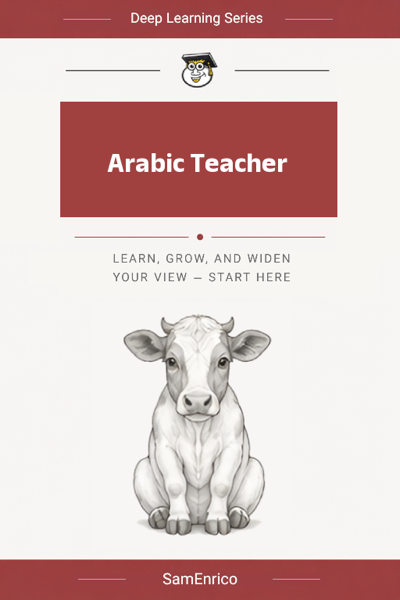
Non-FictionInformativeEducational
Arabic Teacher Audiobook
A Coursebook on Arabic Teacher
by Lawson Naomi
A Coursebook on Arabic Teacher
Formats
Free sample
Chapter 1: The Fluency Trap--“I speak Arabic fluently. Of course I can teach it.”This is the single most dangerous sentence in Arabic language education. It has echoed through faculty meetings, hiring interviews, and university corridors for decades. It sounds reasonable. It sounds confident.
It is almost always wrong.The assumption that native or fluent speakers automatically make effective teachers confuses two entirely different things: knowing a language and knowing how to teach a language. These are as distinct as being able to bake a cake and being able to run a bakery. One requires skill with ingredients. The other requires skill with people, systems, curriculum, psychology, and troubleshooting—plus the ingredients.This chapter exists because thousands of Arabic classes around the world are failing not due to bad textbooks, low budgets, or unmotivated students. They are failing because the person at the front of the room has never been asked a simple, uncomfortable question: “What makes you a teacher, not just a speaker?”We will answer that question here.
We will dismantle the fluency trap, rebuild what it means to be an Arabic teacher, and give you tools to assess your own readiness—honestly, rigorously, and without ego. By the end of this chapter, you will know whether you are ready to teach, what you need to develop, and how to measure your progress against international standards that actually matter.The Three Roles You Were Never Told About Most Arabic teachers enter the classroom with one role in mind: language expert. They believe their job is to know Arabic better than the students and to dispense that knowledge. This is not teaching. This is lecturing with good intentions.Effective Arabic teaching requires three distinct roles, and you must move between them fluidly, sometimes within a single minute of classroom time.Role One: Language Model The language model is not simply someone who speaks Arabic correctly.
A language model is someone who speaks Arabic observably, consistently, and transparently. Students need to hear you produce sounds, construct sentences, hesitate, self-correct, code-switch, and use fillers like يعني and خلص. They need to see language as a living process, not a perfect product.Being a good model means three things. First, your pronunciation of critical phonemes—‘ayn, ghayn, qaf, the emphatics—must be accurate enough that students can mimic you without developing bad habits. Second, your grammar, especially in Fusha, must be reliable.
Students will fossilize your errors. If you consistently drop case endings or confuse verb forms, they will too. Third, you…
This is the end of the free sample. Get the Audiobook to keep going. Buy now
About this book
Details
- Author
- Lawson Naomi
- Publisher
- SamEnrico
- Language
- English
- Genre
- Non-Fiction, Informative, Educational
- Released
- 2026-05-06
- Pages (approx.)
- 142
- Available as
- eBook, Audiobook

Listen in the VoxFlicks app
Audiobooks and audio dramas wherever you go. Sign in with your SamEnrico account and press play.
More by Lawson Naomi
 Mental Health At Work PrimerLawson Naomi$11.99
 Senior Real Estate Agent GuideLawson Naomi$11.99
 Anger After InjusticeLawson Naomi$11.99
 Self Hypnosis for Injury RehabLawson Naomi$11.99
 Loneliness and Addiction RecoveryLawson Naomi$11.99
 The Last Dance of the RedwoodsLawson Naomi$11.99
 The Forgotten Cartographer: Jean-Baptiste Régis and the Mapping of the MekongLawson Naomi$11.99
 Schengen Short Stay RulesLawson Naomi$12.99
 FinCEN BOI Portal GuideLawson Naomi$12.99
 Understanding Diencephalic SyndromeLawson Naomi$17.99
 How to Start a Hobby in Keep A JournalLawson Naomi$11.99
You may also like
 Hong Kong Handover 1997Dunn Johnnie$11.99
 Zumba For Postnatal Recovery CourseNeal Christian$11.99
 Zumba for BeginnersLadner Nikia$11.99
 YouTube Comment Mining GuideHumes Pandora$12.99
 Worry Box MeditationCarlin Rudy$11.99
 Workplace Stress MeditationNguyen Lynn$11.99
 Workplace Stress and Sleep RepairHawley Ivory$11.99
 Workplace Perfectionism CureDelaney Jeffry$11.99
 Workplace Injustice Anger GuideWallen Isabelle$11.99
 Work Addiction and Burnout LinkGreenwood Ester$11.99
 Women in Yoga and WellnessBeattie Galina$11.99
 Women in Stand Up ComedyChun Evangeline$11.99