
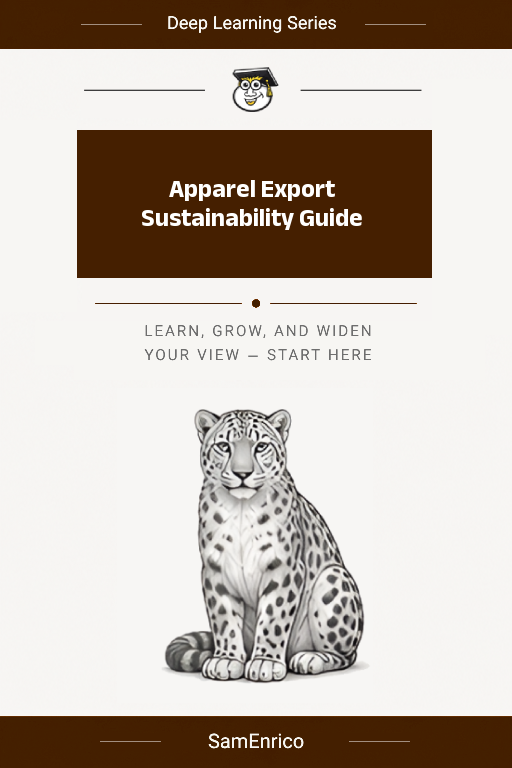
Non-FictionBusiness BriefApparel Compliance
Apparel Export Sustainability Guide
Compares GOTS, Oeko-Tex, Bluesign, and B Corp cert
Compares GOTS, Oeko-Tex, Bluesign, and B Corp certifications for textile and apparel exports to sustainability-conscious markets.
Formats
About this book
Free sample
Chapter 1: The License to Sell–- On a humid Tuesday morning in Dhaka, Mohammad Ashraf, the third-generation owner of a mid-sized garment factory, received an email that would cost his company $2.4 million. The message from his largest European buyer, a German children's wear brand he had supplied for eleven years, was polite, professional, and utterly devastating. After the upcoming season, they would not be renewing his contract. The reason was not quality—his defect rate was below two percent. Not delivery times—he had never missed a shipment.
Not price—he was already leaner than most competitors. The reason was a single missing document. He did not have GOTS certification for his organic cotton line. His competitor forty kilometers away did.This is not a story about sustainability. It is a story about market access, about the invisible barriers that now separate factories that ship containers from factories that watch them pass by.
For most of the history of apparel exports, the rules of the game were simple: price, quality, delivery time, and perhaps a social audit to satisfy the buyers' corporate social responsibility departments. Those days are over. In their place, a new architecture of trade has emerged, one where a piece of paper certifying chemical safety or organic fiber content carries as much weight as a letter of credit. Welcome to the era of mandatory sustainability.The Fragmentation Crisis: Four Hundred Labels and No Time to Understand Them Let us begin with a simple question: How many ecolabels exist for textiles and apparel? The answer, depending on which database you consult, ranges from 187 to more than 400.
The Global Ecolabelling Network identifies over 450 active ecolabels across all product categories. The Textile Exchange, which specializes in fiber-specific standards, tracks more than sixty textile-focused certifications alone. And every year, new labels appear, promising to fill gaps that existing labels supposedly left uncovered.For an exporter sitting in Karachi, Ho Chi Minh City, or Addis Ababa, this proliferation creates a nightmare of confusion. Your buyer in Stockholm asks for GOTS. Your buyer in New York asks for Oeko-Tex and B Corp.
Your buyer in Tokyo asks for Bluesign and a Higg Index score. Each certification comes with its own application process…
This is the end of the free sample. Get the eBook to keep going. Buy now
Contents
- Chapter 1
- Chapter 2
- Chapter 3
- Chapter 4
- Chapter 5
- Chapter 6
- Chapter 7
- Chapter 8
- Chapter 9
- Chapter 10
- Chapter 11
- Chapter 12
Details
- Author
- Pinckney Rubin
- Publisher
- SamEnrico
- Language
- English
- Genre
- Non-Fiction, Business Brief, Apparel Compliance
- Released
- 2026-05-29
- Pages (approx.)
- 147
- Available as
- eBook, Audiobook

Read better in the ZLOADR app
Your eBooks on your phone or tablet. Sign in with your SamEnrico account and start reading.
More by Pinckney Rubin
 API Security Breach ReviewPinckney Rubin$11.99
 Creator Equipment on a BudgetPinckney Rubin$11.99
 Alcohol Detox for ProfessionalsPinckney Rubin$11.99
 The Binge Eating and Depression GuidePinckney Rubin$11.99
 Perfectionism Imposter LinkPinckney Rubin$11.99
 The Clockmaker's Legacy: Harrison and the Quest for LongitudePinckney Rubin$11.99
 Understanding Primary AmenorrheaPinckney Rubin$17.99
 How to Become a Composition-weatherboard ApplierPinckney Rubin$11.99
 Search Console Speed ReportPinckney Rubin$12.99
 Construction Painters SupervisorPinckney Rubin$11.99
You may also like
 Hong Kong Handover 1997Dunn Johnnie$11.99
 Zumba For Postnatal Recovery CourseNeal Christian$11.99
 Zumba for BeginnersLadner Nikia$11.99
 YouTube Comment Mining GuideHumes Pandora$12.99
 Worry Box MeditationCarlin Rudy$11.99
 Workplace Stress MeditationNguyen Lynn$11.99
 Workplace Stress and Sleep RepairHawley Ivory$11.99
 Workplace Perfectionism CureDelaney Jeffry$11.99
 Workplace Injustice Anger GuideWallen Isabelle$11.99
 Work Addiction and Burnout LinkGreenwood Ester$11.99
 Women in Yoga and WellnessBeattie Galina$11.99
 Women in Stand Up ComedyChun Evangeline$11.99