
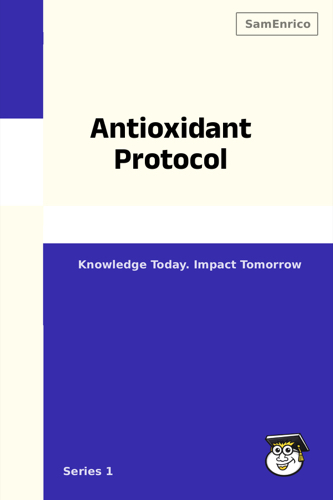
Antioxidant Protocol eBook
Teaches using vitamins C, E, and CoQ10 to reduce o
Teaches using vitamins C, E, and CoQ10 to reduce oxidative damage.
Formats
Free sample
Chapter 1: The Rusting Inside--You are rusting. Not the dramatic, orange-flaking rust of a forgotten bicycle in a coastal rain. But the quiet, invisible rust of electrons being stolen from your cells billions of times per second. This is oxidative stress, and it is the single most underappreciated driver of why you feel tired at 3:00 PM, why your skin is losing its bounce, why your memory occasionally slips, and why—statistically—something inside you will eventually fail in a way that carries a name like heart disease, diabetes, or Alzheimer's.This is not fear-mongering. This is biochemistry.Every moment you are alive, your body burns fuel.
You eat food. Your mitochondria—tiny power plants inside nearly every cell—combine that fuel with oxygen to create energy. This process is called cellular respiration, and it is the miracle that keeps you warm, thinking, breathing, and moving. But like every fire, every engine, every combustion reaction, it produces exhaust. That exhaust is a class of molecules called free radicals—unstable, electron-hungry predators that tear through your cellular neighborhood, stealing electrons from whatever they touch.When a free radical steals an electron from a fatty membrane, that membrane becomes leaky and fragile.
When it steals from a protein, that protein stops folding correctly and loses its function. When it steals from your DNA, it creates a mutation—a typo in the operating instructions of your cell. Most of the time, your cells repair this damage. But not always. And over decades, the cumulative cost of unrepaired oxidative damage is what we call aging.This chapter will teach you to see oxidative stress not as an abstract scientific concept but as a daily, measurable reality.
You will learn the five major sources of free radicals in modern life, the difference between helpful and harmful oxidation, and how to calculate your personal Oxidation Score—a number that will serve as your baseline before starting the Antioxidant Protocol.The City Under Siege: An Analogy You Will Not Forget Imagine your body is a sprawling, ancient city. There are walls, buildings, libraries filled with blueprints, power plants, and communication towers. Every day, vandals roam the streets. These vandals are free radicals. They are not evil—they are simply desperate.
They lack an electron, and they will rip one from anything—a brick in the wall, a beam in the library, a wire in the power plant—to complete themselves.Your city employs repair crews: the antioxidants. These crews carry spare electrons and rush to patch the holes the vandals make. When the city is young and well-supplied, the repair crews outnumber the vandals. The damage is fixed before breakfast.But as you age, and as modern life accelerates, the vandals multiply. Air pollution adds thousands per breath.
A processed meal of fried food and sugar syrup adds millions. A night of broken sleep doubles their ranks by morning. Eventually, the vandals outnumber the repair crews. Holes are left unfixed. Walls crumble.
The library's blueprints develop typos. The power plant runs less efficiently. The city is not dead—but it is rusting from the inside.This is oxidative stress. Not the presence of free radicals—you will always have free radicals, and you actually need them for immune function and cellular signaling. The problem is the imbalance: vandals exceeding repair crews.And here is the truth most books will not tell you: You cannot eliminate free radicals.
You cannot live a zero-oxidation life. Breathing alone guarantees that. But you can restore the balance. You can train your repair crews, supply them with better tools, and reduce the number of new vandals arriving each day. That is exactly what this book will teach you.The Two Faces of Oxidation: Good vs.
Bad Before you declare war on every free radical in your body, you need to understand a crucial distinction. Not all oxidative stress is harmful. In fact, some of it is essential for your survival.Physiological oxidative stress (good) occurs in small, controlled bursts. When you exercise, your muscles produce free radicals deliberately. These free radicals act as signals, telling your cells to build more mitochondria, produce more antioxidant enzymes, and become more resilient.
This is called hormesis—the same principle by which a vaccine (a small dose of a pathogen) strengthens your immune system. Without this good oxidative stress, you would never adapt, never grow stronger, never recover from exercise.Pathological oxidative stress (bad) is chronic, overwhelming, and uncontrolled. It is not a signal—it is a demolition. It occurs when free radical production outpaces your body's ability to neutralize them, hour after hour, day after day. This is the kind that ages your skin, oxidizes your LDL cholesterol (the true first step of heart disease), damages your neurons, and fuels every major degenerative disease.The goal of the Antioxidant Protocol is not to eliminate oxidative stress.
The goal is to eliminate pathological oxidative stress while preserving physiological oxidative stress. That means you will not be popping antioxidants like candy before every workout. You will learn, in Chapter 11, exactly when to intervene and when to let your body adapt on its own.The Five Horsemen of Modern Oxidation Why is oxidative stress so much worse today than it was for your grandparents? Not because your body has changed—your biochemistry is nearly identical to that of a human from 10,000 years ago. The world around you has changed.
Here are the five major accelerants of free radical production in modern life, each backed by decades of peer-reviewed research.1. Air Pollution: The Invisible Assault Every breath you take in a city, near a highway, or on a hazy day delivers a cocktail of particulate matter (PM2.5), nitrogen dioxide, and volatile organic compounds directly into your lungs. These particles are not inert. They trigger an inflammatory cascade that floods your bloodstream with free radicals. A 2019 study in The Lancet estimated that air pollution contributes to 1.8 million excess deaths per year globally, primarily through oxidative stress-mediated cardiovascular disease.
The solution is not to move to a mountaintop (though that would help). It is to support your body's detoxification pathways with specific antioxidants—which you will learn in Chapter 11.2. Ultra-Processed Foods and Oxidized Oils The average Western diet is a free radical factory. Industrial seed oils (soybean, canola, corn, grapeseed) are extracted at high temperatures, causing them to oxidize before they ever reach your plate. When you eat these oils, you are ingesting pre-formed lipid peroxides—free radicals ready to attack your cell membranes from the inside.
Added sugars and high-fructose corn syrup promote glycation, a process that generates reactive oxygen species (ROS) and creates advanced glycation end products (AGEs) that stiffen your tissues. The Rainbow Diet in Chapter 9 will show you exactly what to remove and what to add.3. Chronic Psychological Stress When you are stressed—and modern life ensures you are almost always at least mildly stressed—your body releases cortisol and adrenaline. These hormones prepare you for fight or flight. But when the stress never ends (traffic, emails, news cycles, financial worries), your metabolism remains in a perpetual state of high alert.
Your mitochondria work overtime, and like any engine running too hot for too long, they leak free radicals. Chronic stress…
This is the end of the free sample. Get the eBook to keep going. Buy now
About this book
Details
- Author
- Pinson Cristobal
- Publisher
- SamEnrico
- Language
- English
- Genre
- Non-Fiction, Health & Wellness, Nutrition
- Released
- 2026-06-06
- Pages (approx.)
- 147
- Available as
- eBook, Audiobook

Read better in the ZLOADR app
Your eBooks on your phone or tablet. Sign in with your SamEnrico account and start reading.
More by Pinson Cristobal
 Assertiveness and AngerPinson Cristobal$11.99
 PGT After Loss GuidePinson Cristobal$11.99
 Crooked Teeth Childhood ShamePinson Cristobal$11.99
 Cocaine Baby SyndromePinson Cristobal$11.99
 Study Sleep Memory ConnectionPinson Cristobal$11.99
 Franchising Your Local Brand Across Borders Cultural TrainingPinson Cristobal$11.99
 Small Talk for College StudentsPinson Cristobal$11.99
 The Library of Alexandria: Beacon of the Ancient WestPinson Cristobal$11.99
 The Battle of Mohi: The Mongols Crush the Last European Kingdom (1241)Pinson Cristobal$11.99
 How to Start a offshore Support Vessel Business (Beginners Guide)Pinson Cristobal$11.99
 How to Produce SpreadersPinson Cristobal$11.99
 Mastering The Art of Bare-knuckle Boxing (London Prize Ring Rules)Pinson Cristobal$11.99
You may also like
 Vitamin D For Winter DepressionHardesty Anissa$11.99
 Thiamine ProtocolWorden Teodora$11.99
 The Nutrigenomics HandbookHurst Deedra$11.99
 The DNA Test for Caffeine MetabolismKeane Lacy$11.99
 Lactose Free Calcium Sources GuideSipes Stefania$11.99
 Genetic Testing for Lactose IntoleranceMattson Maris$11.99
 Dysthymia And Vitamin DeficienciesChurchill Celine$11.99
 Bipolar Nutrition GuideBeall Criselda$11.99
 Bean A Day LongevityMartin Celia$11.99
 Blue Zone Fish IntakeGrant Cassandra$11.99
 Plant Based Longevity Diet HandbookMontalvo Chu$11.99
 Low Glycemic Diet Resistance GuideRoark Parker$11.99