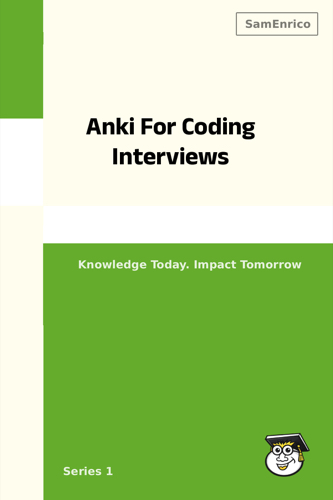
Anki For Coding Interviews eBook
Teaches memorizing algorithms, data structures, an
by Turner Cesar
Teaches memorizing algorithms, data structures, and syntax rules.
Formats
Free sample
Chapter 1: The Leet Code Graveyard--–- The email arrived at 11:47 PM on a Tuesday. Three weeks earlier, Marcus had been certain he was ready. He had solved 437 Leet Code problems—more than the celebrated "Blind 75" and "Neet Code 150" combined. He had watched every MIT algorithms lecture. He had read Cracking the Coding Interview cover to cover, twice, and annotated the margins.
He had even completed two mock interviews with senior engineers from FAANG companies, both of whom told him he was "well-prepared."The email was a standard rejection template: "After careful consideration... not moving forward... encourage you to apply again in 12 months... best of luck in your search." No specific feedback. No explanation of what went wrong.Marcus closed his laptop and stared at the ceiling.
He had flown to Mountain View at his own expense. He had studied for four months while working full-time. He had skipped weekends with friends. And now, the only evidence of his effort was a polite form letter and a deepening sense that he had wasted his time.What happened during the interview was something he could not explain to himself, let alone to a recruiter. The first technical screen went fine—a simple array problem he solved in fifteen minutes.
The second round was a graph traversal. He knew BFS. He had implemented BFS dozens of times. But under pressure, with an engineer watching his every keystroke on the shared screen, his mind went blank. Not "I need a moment to think" blank.
The kind of blank where the concept of a queue felt foreign. He wrote something—he could not remember what—and the interviewer nodded politely and moved on. By the third round, he was second-guessing his variable names.The post-mortem he conducted on himself was brutal. He had solved a graph problem just like this one two weeks before the interview. He remembered solving it.
He remembered the satisfaction of seeing all green checkmarks. But he could not, for the life of him, recall the exact implementation details under pressure.Marcus is not a fictional composite. He is a real engineer whose story appears in countless online forums, Blind posts, and Reddit threads. He is also, in a sense, every coding interview candidate who has ever left a whiteboard with the sinking realization that they knew the answer yesterday but could not produce it today.This book exists because of Marcus and the thousands of engineers like him. It exists because the traditional approach to coding interview preparation—solving hundreds of problems, reading solutions, watching videos—suffers from a fundamental flaw that no amount of effort can overcome.
The flaw is not in your intelligence, your work ethic, or your ability to understand algorithms. The flaw is in how human memory works. And until you understand that flaw, you will continue to grind problems into the Leet Code graveyard, only to forget them when they matter most.The Ebbinghaus Discovery That Changes Everything In 1885, a German psychologist named Hermann Ebbinghaus published a monograph titled Memory: A Contribution to Experimental Psychology. It was the first rigorous study of how humans forget information over time. Ebbinghaus was his own test subject.
He memorized lists of nonsense syllables—meaningless combinations like "ZOF" and "WUX"—and tested himself at various intervals to measure how much he retained.His findings, now known as the Ebbinghaus Forgetting Curve, were startling and have been replicated hundreds of times in the century since. The curve shows that within one hour of learning new information, humans forget approximately 50 percent of it. Within 24 hours, forgetting rises to 70 percent. Within one week, without review, retention drops below 20 percent.Let that sink in. When you solve a Leet Code problem on Monday—understanding the algorithm, writing clean code, passing all test cases—by Tuesday you may have lost half of that understanding.
By the following Monday, you may retain less than one-fifth of what you thought you had mastered.Ebbinghaus also discovered the solution. The forgetting curve is not fixed. Each time you actively retrieve information from memory—not passively re-read it, but actively recall it—the curve becomes shallower. The next forgetting period is slower. With strategic, timed retrieval, the curve can be flattened to near-horizontal, meaning information can be retained for months or years with minimal decay.This discovery, more than any other, is the scientific foundation of this book.
The question is not whether you can learn coding interview material. The question is whether you can engineer your forgetting curve to retain it.Marcus, like most candidates, never considered this question. He assumed that solving a problem once meant he understood it forever. He treated memory as a binary state: either you know something or you do not. But memory is not binary.
Memory is a decaying signal, and without active intervention, it decays rapidly.The Illusion of Competence Why do traditional study methods fail so spectacularly for coding interviews? The answer lies in a cognitive bias called the illusion of competence. This is the tendency to mistake recognition for recall.When you read a solution in Cracking the Coding Interview, you experience a feeling of understanding. The code makes sense. The explanation is clear.
Your brain registers familiarity, and familiarity feels like knowledge. But familiarity is not the same as the ability to produce that solution from scratch, under time pressure, on a whiteboard, without any hints or references.The illusion of competence is particularly dangerous for coding interviews because the medium of study—reading, watching videos, reviewing notes—is the same medium in which solutions are presented. You see a solution. You think, "Yes, I understand that." You close the book. A week later, when faced with a variation of the same problem, you cannot produce the solution.
But because you recognize it when you see it again, you tell yourself, "Oh, I knew that. I just needed a reminder."This is not knowledge. This is recognition masking as knowledge.Consider a simple experiment you can perform right now. Think of the binary search algorithm. You have likely implemented it dozens of times.
Now, without looking at any reference, write the complete binary search code on a piece of paper. Include the correct boundary conditions. Handle the case where the target is not in the array. Write it in the language you use most frequently.If you are like most engineers, you will make at least one mistake. You might use the wrong comparison operator ( < instead of
This is the end of the free sample. Get the eBook to keep going. Buy now
About this book
Details
- Author
- Turner Cesar
- Publisher
- SamEnrico
- Language
- English
- Genre
- Non-Fiction, Self-Help, Computer Science
- Released
- 2026-06-05
- Pages (approx.)
- 142
- Available as
- eBook, Audiobook

Read better in the ZLOADR app
Your eBooks on your phone or tablet. Sign in with your SamEnrico account and start reading.
More by Turner Cesar
 Influencer Marketing ImpactTurner Cesar$11.99
 Hair Dye Trace EvidenceTurner Cesar$11.99
 The Keto Micronutrient GuideTurner Cesar$11.99
 The AED Maintenance GuideTurner Cesar$11.99
 Workaholic Vacation GuideTurner Cesar$11.99
 SIDS Family Support GuideTurner Cesar$11.99
 Sékou Touré Guinea IndependenceTurner Cesar$11.99
 The Republic of Genius: Florence, Venice, and the Birth of the Modern MindTurner Cesar$11.99
 The Iron Curtain of the Sands: Al-Ahly vs. Zamalek - Egypt's Eternal Football RivalryTurner Cesar$11.99
 Amazon Product Variation GuideTurner Cesar$12.99
 Datadog Scrum for Observability StartupsTurner Cesar$12.99
 How to Produce Scale Model AccessoriesTurner Cesar$11.99