
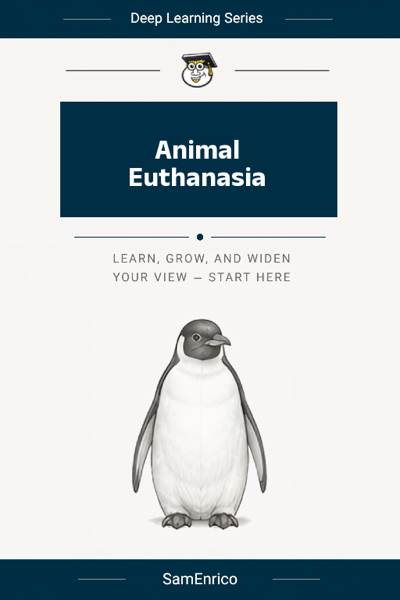
Non-FictionInformativeEducational
Animal Euthanasia eBook
A Coursebook on Animal Euthanasia
A Coursebook on Animal Euthanasia
Formats
Free sample
Chapter 1: The Mercy Paradox...--–- The veterinary technician’s hands trembled as she held the syringe. Not from cold, not from inexperience—she had performed this procedure over a thousand times. The trembling came from somewhere deeper, somewhere the textbooks never reached. The dog on the table was a thirteen-year-old Labrador retriever named Gus. His owner, a retired schoolteacher named Eleanor, had driven four hours through a snowstorm to reach this clinic because her local veterinarian had refused to perform euthanasia for “convenience reasons.” Gus had terminal bone cancer.
His left front leg had become a swollen, hairless column of pain. He had stopped eating three days ago. Last night, he had cried—not a whimper, but a full-throated howl that Eleanor said sounded like a wounded animal, which of course he was. And yet, as the technician looked into Gus’s brown eyes—still warm, still aware, still wagging his tail slightly when Eleanor spoke—she felt the question that haunts every euthanasia provider: Who am I to end this life?This is the mercy paradox. The very act designed to relieve suffering creates a profound moral and emotional burden for everyone involved.
We call euthanasia a “good death,” but the path to that goodness is paved with uncertainty, grief, and the weight of playing god in miniature. Veterinary professionals enter the field because they love animals. They leave—or worse, they harm themselves—because they cannot reconcile the love with the lethal injection. Pet owners seek euthanasia because they cannot bear to watch their companions suffer. They spend their remaining days wondering: Did I do it too soon?
Too late? Did he know? Did he forgive me?This book exists because the mercy paradox demands resolution. Not through simplistic answers—there are none—but through a framework that integrates clinical excellence, ethical clarity, and emotional honesty. Chapter 1 establishes the foundational tension that animates every subsequent page: how to provide a good death without losing your own humanity in the process.The Historical Roots of the Paradox To understand where we are, we must understand where we came from.
The human-animal relationship has never been static, and the history of animal euthanasia is really a history of how societies have drawn and redrawn the line between acceptable and unacceptable suffering.In ancient agricultural societies, animals were tools. A plow ox that could no longer pull was not euthanized; it was slaughtered for meat and leather. The concept of mercy killing for animals barely existed because animals were not seen as beings capable of experiencing a life worth living or a death worth avoiding. Aristotle, the great systematizer of Greek thought, argued that animals existed for the sake of humans—plants for animals, animals for humans. This instrumental view dominated Western thought for nearly two thousand years.The first crack in this edifice appeared during the Enlightenment.
Jeremy Bentham, the founder of utilitarianism, asked not “Can they reason?” or “Can they talk?” but “Can they suffer?” That question—simple, devastating, irreversible—shifted the moral ground. If animals can suffer, then causing unnecessary suffering is wrong. And if causing unnecessary suffering is wrong, then allowing unavoidable suffering to continue without intervention might also be wrong.But euthanasia as a deliberate, medicalized practice for animals did not emerge until the late nineteenth century, and even then, it was controversial. The American Veterinary Medical Association (AVMA) did not publish its first euthanasia guidelines until 1963. Before that, the methods ranged from the brutal to the bizarre: drowning, poisoning, electrocution, shooting, even strangulation.
The idea that an animal deserved a painless, dignified death was radical. The idea that a veterinarian, rather than a farmer or a dog catcher, should be the one to provide it was even more radical.The shift accelerated in the 1970s and 1980s, parallel to the rise of the companion animal as a family member. As pets moved from the barn to the bedroom, the expectations around their deaths changed. An old farm dog put down with a shotgun behind the barn became unthinkable. The same death, dressed in clinical white and preceded by sedation and followed by grief counseling, became not just acceptable but expected.Today, we live in the aftermath of that shift.
Approximately 10 million companion animals are euthanized annually in the United States alone—roughly half in veterinary clinics, half in shelters. The majority of these deaths are mercy-driven responses to terminal illness, intractable pain, or untreatable aggression. A minority—perhaps 10-15%—are what the profession delicately calls “convenience euthanasias”: animals killed because the owner is moving, cannot afford treatment, or simply no longer wants the pet.This last category reveals the ongoing fault line in the mercy paradox. If euthanasia is defined as a good death motivated by mercy, then convenience euthanasia is not euthanasia at all. But the same syringe, the same drug, the same gesture delivers both.
The veterinarian cannot know with certainty which motivation drives which owner. The owner may not know themselves. And the animal, of course, knows nothing of motives—only the warm presence of a human hand and then, if all goes well, nothing at all.Defining Euthanasia: Words Matter Before we proceed further, we must establish definitions that will govern the rest of this book. Precision here is not pedantry; it is the foundation of ethical practice.Euthanasia comes from the Greek eu (good, well) and thanatos (death). A good death.
But what makes a death good? Three criteria, drawn from the AVMA guidelines and supported by every major veterinary ethics text:First, the death must be painless and distress-free. The animal should experience no more than momentary discomfort (e.g., the pinch of a needle) followed by rapid unconsciousness and then death. Agonal movements—reflexive gasping or limb paddling after death—do not indicate consciousness or pain, but they must not be confused with signs of awareness.Second, the death must be intentional and deliberate. Accidental death, even if painless, is not euthanasia.
Suicide—when an animal could consent, which they cannot—is not euthanasia. Euthanasia requires a conscious decision by a moral agent (the veterinarian, with the owner’s consent) that death is the best available outcome for this animal at this time.Third, the death must be mercy-driven. This is the most contested criterion. Mercy means the primary motivation is the relief of suffering. If the primary motivation is economic convenience, owner inconvenience, or space in a shelter, the death may be justifiable on other grounds (practical, economic, public health) but it is not euthanasia in the ethical sense.This third criterion creates real-world difficulties, which we will confront directly in Chapter 8.
A shelter that euthanizes healthy, adoptable animals because it has run out of kennel space is not providing euthanasia; it is performing population control. A veterinarian who euthanizes a healthy cat because the owner is moving to a no-pets apartment is not providing euthanasia; they are providing a service that many would call killing. Calling these acts “euthanasia” does not make them so, and using the same word for mercy-driven and convenience-driven deaths blurs the moral line that professionals depend on to protect their own psychological health.Throughout this book, unless otherwise specified, “euthanasia” refers…
This is the end of the free sample. Get the eBook to keep going. Buy now
About this book
Details
- Author
- Barbee Antionette
- Publisher
- SamEnrico
- Language
- English
- Genre
- Non-Fiction, Informative, Educational
- Released
- 2026-06-02
- Pages (approx.)
- 145
- Available as
- eBook, Audiobook

Read better in the ZLOADR app
Your eBooks on your phone or tablet. Sign in with your SamEnrico account and start reading.
More by Barbee Antionette
 Aromatherapy for FocusBarbee Antionette$11.99
 Senator Cloakroom NegotiationBarbee Antionette$11.99
 Self Hypnosis Sports InjuryBarbee Antionette$11.99
 Recordkeeping for Importers GuideBarbee Antionette$11.99
 Meth Recovery Financial Repair ManualBarbee Antionette$11.99
 The Rubber Revolution: How a Visionary Chemist Transformed Southeast AsiaBarbee Antionette$11.99
 Frozen Echoes: The Last Broadcast of the Titanic's Wireless RoomBarbee Antionette$11.99
 Understanding Convulsions Benign Familial Neonatal Dominant FormBarbee Antionette$17.99
 TikTok Ad Review ProcessBarbee Antionette$12.99
 Venture Debt Maturity GuideBarbee Antionette$12.99
 How to Start a Day Care for Disabled Children (non-charitable) Business (Beginners Guide)Barbee Antionette$11.99
You may also like
 Hong Kong Handover 1997Dunn Johnnie$11.99
 Zumba For Postnatal Recovery CourseNeal Christian$11.99
 Zumba for BeginnersLadner Nikia$11.99
 YouTube Comment Mining GuideHumes Pandora$12.99
 Worry Box MeditationCarlin Rudy$11.99
 Workplace Stress MeditationNguyen Lynn$11.99
 Workplace Stress and Sleep RepairHawley Ivory$11.99
 Workplace Perfectionism CureDelaney Jeffry$11.99
 Workplace Injustice Anger GuideWallen Isabelle$11.99
 Work Addiction and Burnout LinkGreenwood Ester$11.99
 Women in Yoga and WellnessBeattie Galina$11.99
 Women in Stand Up ComedyChun Evangeline$11.99