
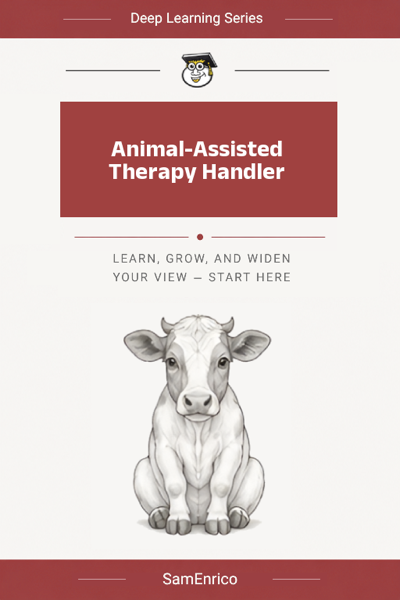
Non-FictionInformativeEducational
Animal-Assisted Therapy Handler eBook
A Coursebook on Animal-Assisted Therapy Handler
by Foss Joselyn
A Coursebook on Animal-Assisted Therapy Handler
Formats
Free sample
Chapter 1: The Silent Witness--–- The first time I witnessed a child speak after months of silence, it was not to a therapist, a parent, or a teacher. It was to a golden retriever named Sunny. The child, a seven-year-old girl with selective mutism, had not uttered a single word in her school or clinic for nearly eleven months. She sat on the floor, her back against a worn beanbag chair, her hands buried in the deep gold fur of Sunny’s neck. The dog lay perfectly still, her head resting on her paws, her eyes half-closed in calm contentment.
The girl leaned forward and whispered, “Good dog.” Three decibels above a breath. Two words. And in that moment, everything I thought I knew about healing changed.That moment was not magic. It was not luck. It was the mammalian brain doing exactly what evolution designed it to do in the presence of a non-judgmental, predictable, warm-bodied other.
But it took me years to understand the science behind what I had witnessed. And it took me even longer to understand that Sunny was not the therapist. I was. Sunny was something else entirely: a silent witness, a co-regulator, a bridge across a chasm that no amount of verbal encouragement could span. This book is about becoming the handler of that silent witness.
It is about the rigorous, ethical, evidence-informed practice of Animal-Assisted Therapy (AAT)—not as a feel-good add-on, but as a clinical intervention requiring precision, documentation, and deep respect for the animal who volunteers to work alongside you.Before you train a single behavior, before you step into a hospital or a school or a counseling office, you must understand what AAT actually is, where it came from, and—most critically—whether you are legally and ethically permitted to practice it. This chapter establishes the foundational vocabulary, historical context, and professional boundaries that will govern every page of this coursebook. By the end, you will know the difference between therapy, activity, and education; you will understand how a chance encounter in a psychiatrist’s office in the 1960s birthed an entire field; and you will be able to state, clearly and without hesitation, whether you are a clinician delivering AAT or a volunteer delivering AAA. That distinction, as you will see, is not semantic. It is the difference between practice and violation.What This Chapter Covers This first chapter is organized into five core sections.
First, we establish the essential definitions that distinguish Animal-Assisted Therapy from Animal-Assisted Activities and Animal-Assisted Education. Second, we travel through the historical milestones that transformed a fringe idea into an evidence-based profession. Third, we introduce the handler’s three primary roles—facilitator, protector, and interpreter—which will recur throughout this book. Fourth, we build a working vocabulary of key terms, including goal-directed interventions, treatment objectives, target behaviors, and session pacing. Finally, and most importantly for the reader’s professional safety, we clarify the licensure requirements that determine who can legally deliver AAT versus AAA or AAE.
This final section resolves a confusion that has led to ethical violations, legal disputes, and harm to both clients and animals.Throughout this chapter, and indeed throughout this book, we will use case examples drawn from real practice (with identifying details changed). We will also provide frequent cross-references to later chapters where concepts are developed further. If you are the kind of reader who wants to jump ahead, feel free—but understand that the chapters are designed to build upon one another. The handler who skips foundations is like a carpenter who skips learning to read a tape measure. You might still build something.
It will not stand.Section 1: The Critical Distinctions – AAT, AAA, and AAEIn popular culture, any interaction between a human and an animal is often called “therapy.” A dog visits a nursing home: therapy. A child reads to a rabbit at the library: therapy. A horse helps a veteran with PTSD: definitely therapy. But clinical precision requires that we distinguish between activities that are therapeutic in a general sense and those that constitute formal Animal-Assisted Therapy. The difference is not about the animal.
It is about the human leading the session.Animal-Assisted Therapy (AAT)Animal-Assisted Therapy is defined as a goal-directed, structured intervention in which an animal who meets specific criteria is an integral part of the clinical treatment process. AAT is delivered by a licensed professional (such as a clinical social worker, marriage and family therapist, occupational therapist, physical therapist, speech-language pathologist, psychologist, or psychiatrist) within the scope of that professional’s practice. The intervention is documented in the client’s treatment record, includes measurable objectives, and is evaluated for effectiveness over time.In plain language: if you are not a licensed clinician, you cannot legally call what you do “Animal-Assisted Therapy.” You can call it many other things—Animal-Assisted Activities, Animal-Assisted Education, therapy dog visiting, reading with Rover—but the word “therapy” in a clinical context is legally restricted in most jurisdictions. This is not elitism. It is accountability.
Therapy implies a duty of care, a standard of documentation, and a liability framework that volunteers and paraprofessionals are not trained to carry.Example of AAT: A licensed occupational therapist works with a child with fine motor delays. The goal, written in the child’s IEP, states: “Using a soft brush, the child will groom the therapy rabbit for three continuous minutes without prompting, across three of four sessions.” The therapist structures the activity, measures the time, documents the outcome, and adjusts the treatment plan accordingly. The rabbit is present as a therapeutic tool, but the therapist is the clinical decision-maker.Animal-Assisted Activities (AAA)Animal-Assisted Activities are casual, visitation-based interactions that provide comfort, social engagement, or recreational benefit but are not targeted toward specific clinical goals. AAA is delivered by trained volunteers who are not required to hold clinical licenses. The animal is typically certified by a national organization such as Pet Partners or Therapy Dogs International.
No documentation beyond a visit log is required, and no client-specific treatment objectives are written.Example of AAA: A volunteer handler brings a therapy dog to a nursing home once a week. Residents pet the dog, talk to the handler, and experience improved mood. No individual goals are set for any resident. The handler does not write progress notes or coordinate with medical staff (though they may share general observations). This is valuable, evidence-supported work—but it is not therapy.Animal-Assisted Education (AAE)Animal-Assisted Education falls between AAT and AAA.
It uses animal interactions to achieve educational or developmental objectives in school settings. AAE may be delivered by teachers, school counselors, or trained volunteers under the supervision of an educator. The goals are academic or social-emotional (e.g., improved reading fluency, increased attendance, reduced classroom disruptions) rather than clinical. However, when a school psychologist delivers AAE to address a diagnosed condition (e.g., anxiety disorder), that session becomes AAT.Example of AAE: A classroom teacher brings a trained rabbit into the classroom during silent reading time. Students who struggle with reading aloud take turns reading to the rabbit.
The teacher measures reading fluency weekly. No clinical diagnosis is required, and no treatment plan is written. The rabbit is…
This is the end of the free sample. Get the eBook to keep going. Buy now
About this book
Details
- Author
- Foss Joselyn
- Publisher
- SamEnrico
- Language
- English
- Genre
- Non-Fiction, Informative, Educational
- Released
- 2026-05-04
- Pages (approx.)
- 160
- Available as
- eBook, Audiobook

Read better in the ZLOADR app
Your eBooks on your phone or tablet. Sign in with your SamEnrico account and start reading.
More by Foss Joselyn
 Sales Rejection ResilienceFoss Joselyn$11.99
 Racist Workplace Anger GuideFoss Joselyn$11.99
 The Destiny 2 Time Sink GuideFoss Joselyn$11.99
 Performance Trance StateFoss Joselyn$11.99
 The Courtroom Nonverbal GuideFoss Joselyn$11.99
 Charlemagne's Crown: A Renaissance of LightFoss Joselyn$11.99
 Social Media Image AI GuideFoss Joselyn$12.99
 Biotech R&D Capital GuideFoss Joselyn$12.99
 Understanding Microphthalmia With Limb AnomaliesFoss Joselyn$17.99
 How to Start a Bungs Made of Wood Business (Beginners Guide)Foss Joselyn$11.99
You may also like
 Hong Kong Handover 1997Dunn Johnnie$11.99
 Zumba For Postnatal Recovery CourseNeal Christian$11.99
 Zumba for BeginnersLadner Nikia$11.99
 YouTube Comment Mining GuideHumes Pandora$12.99
 Worry Box MeditationCarlin Rudy$11.99
 Workplace Stress MeditationNguyen Lynn$11.99
 Workplace Stress and Sleep RepairHawley Ivory$11.99
 Workplace Perfectionism CureDelaney Jeffry$11.99
 Workplace Injustice Anger GuideWallen Isabelle$11.99
 Work Addiction and Burnout LinkGreenwood Ester$11.99
 Women in Yoga and WellnessBeattie Galina$11.99
 Women in Stand Up ComedyChun Evangeline$11.99