
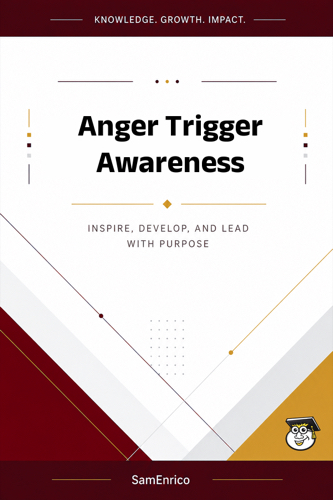
Non-FictionSelf-HelpSelf Awareness
Anger Trigger Awareness eBook
Identifies personal anger triggers to prevent esca
by Mattos Keiko
Identifies personal anger triggers to prevent escalation.
Formats
Free sample
Chapter 1: The Six-Second Lie--–- The explosion came without warning. That is what everyone believes. One moment you are fine, perhaps a little tired, a little annoyed by something small—a dish left in the sink, a comment that landed wrong, a driver who cut you off. The next moment, your vision narrows, your chest tightens, and words or actions erupt from you as if fired from a cannon. Afterward, you are left standing in the wreckage, wondering what just happened.
Where did that come from? Why couldn't you stop it? And the answer you tell yourself, the answer most people have been told their entire lives, is this: I have an anger problem. My temper gets the best of me. I just snapped.That story is a lie.
Not a malicious lie, but a dangerous one. Anger does not come without warning. You do not "just snap." What you experience as a sudden explosion is actually the end of a process—a predictable, measurable, physiological and psychological sequence that began anywhere from three to sixty seconds earlier. The reason you feel blindsided is not because the anger appeared from nowhere. It is because you were not looking in the right place at the right time.This chapter will introduce you to the single most important concept in this entire book: the Six-Second Lie.
It is the false belief that anger happens to you instantly, like a lightning strike, and therefore cannot be stopped. In truth, you have a window of approximately six seconds between the moment a trigger lands on your nervous system and the moment your brain becomes flooded with adrenaline and cortisol to the point where rational thinking becomes nearly impossible. Those six seconds are everything. They are the difference between a life ruled by reactive explosions and a life in which you remain the one holding the steering wheel.Most people try to manage their anger at the wrong time. They attempt to calm themselves down when they are already at a seven or eight on a ten-point rage scale—when their heart rate has already crossed the threshold of one hundred beats per minute, when their prefrontal cortex (the part of the brain responsible for reasoning and impulse control) has already been partially shut down by the amygdala's threat detection system.
Trying to "use your words" or "take a deep breath" at that stage is like trying to stop a freight train by standing on the tracks with your hand out. It is not that those techniques are useless. It is that they are applied too late.What you will learn in this chapter—and what this entire book will train you to do—is to shift your intervention point from the end of the anger cycle to the very beginning. You will learn to recognize the trigger, not the explosion. You will learn to feel the body's first warning signals three seconds before your conscious mind even registers the word "anger." And you will learn to intercept the sequence before it gains momentum.This is not about suppressing anger.
Suppression does not work; it only stores pressure for a later, larger explosion. This is about awareness applied at the right moment. Think of it this way: a small fire can be extinguished with a glass of water. The same fire, after sixty seconds, might require a fire extinguisher. After three minutes, it might consume an entire house.
Your anger works exactly the same way. The question is not whether you get angry. The question is how early you catch it.By the end of this chapter, you will understand the true anatomy of an anger explosion. You will learn the corrected five-stage Anger Escalation Cycle that will serve as the backbone for everything that follows. You will understand the six-second window in precise, practical terms.
And you will take your first small but essential step: learning to simply notice the earliest moment of a shift in your mood, without trying to change it, without judging yourself for it. That single skill—early noticing—is the foundation upon which every other technique in this book is built.Let us begin by dismantling the lie.The Anatomy of a Lie: Why "I Just Snapped" Is Never True For a moment, imagine you are watching a video recording of someone else's anger explosion. Perhaps it is a driver screaming at another driver through a car window. Perhaps it is a parent yelling at a child over a spilled drink. Perhaps it is a partner slamming a door after a comment that landed badly.
Watch the video carefully. If you slow it down, frame by frame, you will see that the explosion is not a single event. It is the final frame of a sequence.Now imagine that same person, five minutes before the explosion. They might have been tired. They might have been hungry.
They might have been carrying stress from work, or worry about money, or the lingering weight of a poor night's sleep. Their nervous system was already primed, already closer to the edge than they realized. Then something happened—something small, something that on another day might have rolled off their back. A car merged without a signal. A partner sighed in a particular way.
A child asked a question for the tenth time. That small event was the trigger. But the trigger alone did not cause the explosion. What happened next was a cascade.Within milliseconds of the trigger, the person's body began to change. Their breathing became shallower.
Their jaw tightened. Their shoulders rose. Their heart rate increased. They did not consciously choose any of these changes; their autonomic nervous system was doing what it evolved to do—preparing for a threat. This is the body's first signal, and it happens approximately three seconds before the person consciously thinks, "I am angry."Then came the thought.
Not a calm, considered thought, but a hot thought—a rapid, automatic interpretation of what the trigger meant. "He did that on purpose." "She is so disrespectful." "This always happens to me." That hot thought, often barely conscious, turned a neutral event into a personal attack. The body, already primed, responded to the thought with even more adrenaline. The urge to act—to shout, to slam, to hit, to punish—became overwhelming. And finally, the action.
The explosion.This entire sequence, from trigger to action, takes approximately six seconds in a person with a healthy nervous system. In a person who is already stressed, tired, or hungry, it can take even less time. But it never takes zero time. There is always a gap. There is always a window.
And in that window lies your freedom.The lie of "I just snapped" is seductive because it absolves you of responsibility. If anger is a bolt from the blue, you cannot be expected to stop it. But the evidence from neuroscience, cognitive psychology, and anger research is unanimous: anger is a process, not an event. It has predictable stages. And any process can be interrupted if you know where and when to look.The Corrected Anger Escalation Cycle: A Five-Stage Model Most books on anger management present a cycle…
This is the end of the free sample. Get the eBook to keep going. Buy now
About this book
Details
- Author
- Mattos Keiko
- Publisher
- SamEnrico
- Language
- English
- Genre
- Non-Fiction, Self-Help, Self Awareness
- Released
- 2026-06-10
- Pages (approx.)
- 157
- Available as
- eBook, Audiobook

Read better in the ZLOADR app
Your eBooks on your phone or tablet. Sign in with your SamEnrico account and start reading.
More by Mattos Keiko
 Quit Smoking for SchizophreniaMattos Keiko$11.99
 Sleep Deprivation EffectMattos Keiko$11.99
 Rapid Peg System Recall CourseMattos Keiko$11.99
 Low Carb Portion Control MasteryMattos Keiko$11.99
 Medical Trauma Nightmare GuideMattos Keiko$11.99
 Grandparent Grief GuideMattos Keiko$11.99
 Scholarships In Dubai HandbookMattos Keiko$11.99
 The Aswang's Hungry Shadows: A Filipino Feast of FearMattos Keiko$11.99
 The Ghosts of Whitechapel: DNA and the Ripper’s ShadowMattos Keiko$11.99
 How to Produce Special Effects ControllersMattos Keiko$11.99
 S Corporation Succession RulesMattos Keiko$12.99
 Africa Domain Renewal Price CheckMattos Keiko$12.99
You may also like
 Hong Kong Handover 1997Dunn Johnnie$11.99
 Zumba For Postnatal Recovery CourseNeal Christian$11.99
 Zumba for BeginnersLadner Nikia$11.99
 YouTube Comment Mining GuideHumes Pandora$12.99
 Worry Box MeditationCarlin Rudy$11.99
 Workplace Stress MeditationNguyen Lynn$11.99
 Workplace Stress and Sleep RepairHawley Ivory$11.99
 Workplace Perfectionism CureDelaney Jeffry$11.99
 Workplace Injustice Anger GuideWallen Isabelle$11.99
 Work Addiction and Burnout LinkGreenwood Ester$11.99
 Women in Yoga and WellnessBeattie Galina$11.99
 Women in Stand Up ComedyChun Evangeline$11.99