
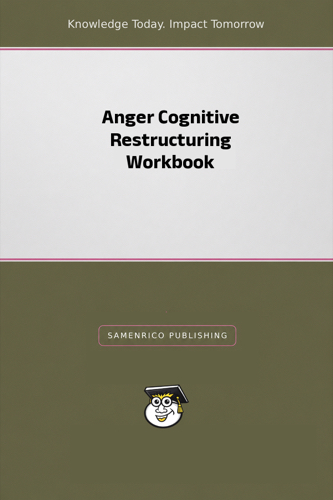
Anger Cognitive Restructuring Workbook eBook
Structured exercises for independent practice.
by Slagle Golda
Structured exercises for independent practice.
Formats
Free sample
Chapter 1: The Security Footage...--–- You are about to discover something that will change every argument you have for the rest of your life. It is not a breathing technique. It is not a counting-to-ten trick. It is not learning to "let things go" or "choose your battles." It is simpler, harder, and more powerful than all of those combined. Here it is: The person who made you angry did not make you angry.Read that sentence again.
Let it land. The person who cut you off in traffic did not make you angry. The coworker who took credit for your work did not make you angry. The partner who forgot your birthday did not make you angry. The child who spilled juice on your clean floor did not make you angry.If you feel defensive reading that—if your brain is already generating counterexamples, already thinking "But you don't understand what they did"—that defensiveness is the very mechanism this chapter will dismantle.
The belief that events cause anger is the single biggest obstacle to change. It is also, according to decades of cognitive behavioral research, flat wrong.This chapter introduces the foundational skill of this entire workbook: stimulus discrimination. That is a clinical term for a simple ability—the ability to separate what actually happened from what you told yourself about what happened. Without this skill, no other tool in this book will work. With it, everything else becomes possible.The Great Misunderstanding Every anger management workbook on the shelf begins with the same implicit promise: "We will teach you to control your anger." But control is the wrong goal.
Control implies that anger is a force outside yourself, a beast to be subdued, a pressure cooker to be managed until the steam releases. That framing is why most anger logs fail.Consider the standard anger log. It asks questions like: "What triggered your anger?" "How did you react?" "What was the outcome?" These seem reasonable. But they contain a hidden assumption: that the trigger (the event) and the anger (the response) are directly connected. The log asks you to describe what happened, then describe how you felt, as if the second followed inevitably from the first.This is the Trigger → Anger model.
It looks like this:Someone does something → You feel angry This model is seductive because it matches subjective experience. When you are furious, it does not feel like you had a choice. It feels like the anger happened to you. It feels like the other person reached into your chest and pulled a lever marked "Rage." But subjective experience is not objective reality. And the Trigger → Anger model is a lie your brain tells you to avoid responsibility.The actual model, supported by every major cognitive-behavioral and rational-emotive framework, looks like this:Someone does something → You have an automatic interpretation → You feel angry That middle step—the interpretation—is where your power lives.
It is also where your brain hides. The interpretation happens so fast (milliseconds) that you never see it. You go straight from event to emotion, skipping over the thought that bridged them. This skipping is called cognitive fusion—the merging of thought with reality. You believe your interpretation is reality rather than a version of reality.The Three Coffee Scenario Let us make this concrete with a single event that produces three completely different emotional outcomes.The Event (identical for all three scenarios): You are sitting at your desk at work.
A coworker walks by and says, "Did you finish that report?" then keeps walking.Scenario A: Rage Your interpretation: "She asked because she thinks I'm lazy. She's checking up on me. She's implying I can't be trusted. She should mind her own business."Your emotional outcome: Rage (8/10). You spend the next hour fuming.Scenario B: Indifference Your interpretation: "She probably just needs the report for her own work.
She's not accusing me of anything. It's a neutral question."Your emotional outcome: Indifference (1/10). You answer "Almost done" and continue working.Scenario C: Amusement Your interpretation: "She has no idea I finished it yesterday. This is going to be fun. I'll wait until the meeting and surprise everyone."Your emotional outcome: Amusement (2/10).
You feel a small thrill of secret competence.Same event. Three interpretations. Three completely different emotional outcomes. The event did not change. The only variable was the interpretation running through your head in the half-second after the question was asked.This is not philosophy.
This is clinical psychology. Albert Ellis, founder of Rational Emotive Behavior Therapy (REBT), called this the A-B-C model: Activating event → Belief (interpretation) → Consequence (emotional and behavioral). Decades of research have confirmed that the Belief is the only modifiable link in the chain. You cannot change the Activating event (it already happened). You cannot directly change the Consequence (emotions are not switchable).
But you can change the Belief.Why Your Brain Hides the Interpretation If the interpretation is so important, why do you never see it? Three reasons.First: Speed. The interpretation happens in the brain's limbic system before the prefrontal cortex (your rational brain) has even registered the event. By the time you are consciously aware of feeling angry, the interpretation has already done its work and disappeared. You are left with the emotion, not the thought that caused it.Second: Repetition.
The more often you have the same interpretation in response to the same type of trigger, the more automatic it becomes. Neural pathways that fire together wire together. After enough repetitions, the interpretation feels instantaneous because it is. It has become a habit, not a choice.Third: Self-protection. Blaming the event protects your ego.
If the anger is caused by what they did, you are not responsible. You are a victim of their behavior. This is emotionally comfortable in the short term. It is also the guarantee that you will keep having the same anger episodes forever, because you are waiting for the world to change instead of changing your interpretation.The goal of this chapter is to make the invisible visible. To slow down the half-second between trigger and interpretation.
To pull the interpretation out of the shadows and put it on paper where you can see it, examine it, and eventually—in later chapters—rewrite it.The Instant Replay Worksheet Most anger logs ask you to write in the first person: "I was angry because..." This is a mistake. First-person narrative reinforces the Trigger → Anger illusion. It keeps you fused with your interpretation.This workbook uses a different method: the third-person security camera.The Instant Replay Worksheet asks you to describe a recent anger episode as if you were watching a security tape of yourself. You are not the person in the footage. You are an observer.
This small shift in perspective—from participant to witness—creates enough psychological distance to see the interpretation that your brain automatically supplied.The worksheet has three columns. They must be completed in order. No skipping.Column 1: The Security Footage (Trigger)Here you write only what a security camera would capture. No thoughts. No feelings.
No interpretations. No mind-reading. No adjectives about intent. No evaluations of fairness. Just observable facts.Acceptable entries: time, place, date, exact words…
This is the end of the free sample. Get the eBook to keep going. Buy now
About this book
Details
- Author
- Slagle Golda
- Publisher
- SamEnrico
- Language
- English
- Genre
- Non-Fiction, Self-Help, Workbook
- Released
- 2026-06-06
- Pages (approx.)
- 153
- Available as
- eBook, Audiobook

Read better in the ZLOADR app
Your eBooks on your phone or tablet. Sign in with your SamEnrico account and start reading.
More by Slagle Golda
 MDD in BIPOC CommunitiesSlagle Golda$11.99
 PLEASE Skill for EmotionSlagle Golda$11.99
 Parent Zone Out TimeSlagle Golda$11.99
 Self Esteem For Disabled WorkersSlagle Golda$11.99
 Plant Based Master GuideSlagle Golda$11.99
 Medically Supervised Barbiturate WithdrawalSlagle Golda$11.99
 Blue Zone Dairy And Eggs GuideSlagle Golda$11.99
 The Sound Architects: How Black Engineers Revolutionized MusicSlagle Golda$11.99
 The Hollow Hill’s Secret: The Boy Who Spoke to the SidheSlagle Golda$11.99
 Service Providers Guide to Wrought Iron FabricationSlagle Golda$11.99
 A Collector's Handbook to the Hansa 3500 PrivatSlagle Golda$11.99
 How to Produce Hydraulic Stop LeakSlagle Golda$11.99
You may also like
 Hong Kong Handover 1997Dunn Johnnie$11.99
 Zumba For Postnatal Recovery CourseNeal Christian$11.99
 Zumba for BeginnersLadner Nikia$11.99
 YouTube Comment Mining GuideHumes Pandora$12.99
 Worry Box MeditationCarlin Rudy$11.99
 Workplace Stress MeditationNguyen Lynn$11.99
 Workplace Stress and Sleep RepairHawley Ivory$11.99
 Workplace Perfectionism CureDelaney Jeffry$11.99
 Workplace Injustice Anger GuideWallen Isabelle$11.99
 Work Addiction and Burnout LinkGreenwood Ester$11.99
 Women in Yoga and WellnessBeattie Galina$11.99
 Women in Stand Up ComedyChun Evangeline$11.99