
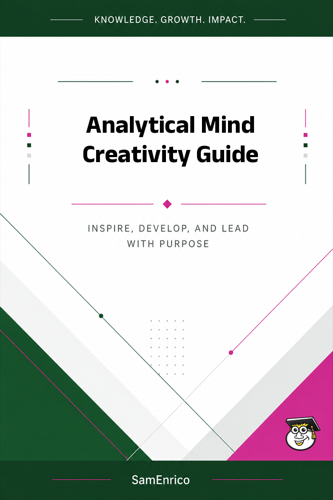
Analytical Mind Creativity Guide eBook
Cultivate imagination within logical frameworks us
by Coe Goldie
Cultivate imagination within logical frameworks using this practical workbook for data thinkers.
Formats
Free sample
Chapter 1: The Analyst Who Couldn't Imagine--–- Sarah had been a data analyst for twelve years. She could slice a dataset faster than anyone on her team. She could spot outliers, build predictive models, and explain p-values to executives who glazed over at the word "regression." Her performance reviews were glowing—except for one line that appeared every single year, in slightly different wording, like a ghost haunting her career: "Sarah is a strong technical contributor but would benefit from more creative thinking in her approach to problems."The first time she read that line, she dismissed it. She was an analyst. Creativity was for designers, marketers, and people who wrote poetry.
The second time, it stung. The third time, she went to her manager and asked, point-blank, "What does 'creative thinking' even mean? I solve problems. I find answers. Isn't that enough?"Her manager, a well-meaning woman named Priya, sighed and said something Sarah would never forget: "You always find the right answer, Sarah.
But you never find the surprising one. You never find the answer that nobody else saw coming. And that's what we need to grow."Sarah walked out of that meeting and sat at her desk, staring at her spreadsheet, her hands frozen on the keyboard. She had no idea how to be surprising. She had no idea how to find an answer nobody else saw coming.
Her entire professional identity was built on being correct, rigorous, and reliable. And now she was being told that correct, rigorous, and reliable was not enough.This book is for Sarah. It is for every data thinker who has been told—directly or indirectly—that they are "not creative." It is for the analysts, engineers, scientists, programmers, and finance professionals who have internalized the false belief that their logical minds are somehow incompatible with imagination. It is for everyone who has ever thought, "I am not a creative person," and meant it as a statement of fact rather than a confession of fear.You are about to discover that you have been lied to. Not maliciously, but systematically.
The culture of analytical work has taught you that precision and play are opposites, that skepticism and curiosity cannot coexist, that the quantitative mind must starve the imaginative one. This is a false dichotomy—a cultural fiction, not a biological reality. And in this chapter, we are going to dismantle it.The False Dichotomy That Ruins Careers Let us name the enemy. The false dichotomy between logic and creativity is the belief that you must choose: be analytical OR be imaginative. Be rigorous OR be playful.
Be data-driven OR be intuitive. This dichotomy is embedded in our educational systems (art vs. science), our workplace structures (analysts in one department, creatives in another), and even our language ("left-brained" vs. "right-brained," a neurological myth that refuses to die).Here is the truth: the most innovative breakthroughs in human history emerged from minds that were both rigorously analytical and wildly imaginative.Consider the discovery of the structure of DNA. James Watson and Francis Crick were trained as biologists, but their breakthrough came from an act of analogical reasoning—seeing the double helix as a spiral staircase, a zipper, a twisting ladder.
That was imagination. But they also had the analytical rigor to build models, test hypotheses, and reject configurations that did not fit the X-ray diffraction data. They did not choose between logic and creativity. They used both, in sequence, as tools for different phases of the same problem.Consider the development of modern computing. Alan Turing was a mathematician and logician.
His work on the Entscheidungsproblem was pure formal reasoning. But the idea of a universal machine—a device that could compute anything that was computable—was a leap of imagination that no amount of pure logic would have produced. He had to imagine a machine that did not yet exist, then work backward to make it real.Consider the field of epidemiology. John Snow did not just analyze cholera data. He had to imagine that a disease could be spread through water, not air—a radical hypothesis that contradicted everything his peers believed.
Then he tested that hypothesis with data, mapping cases around the Broad Street pump. Imagination first, then validation.These examples share a pattern. The false dichotomy collapses as soon as you look closely at how actual breakthroughs happen. Great thinkers do not choose between logic and creativity. They move between them, using each at the right time, in the right proportion, for the right purpose.
The false dichotomy is not about process phases (which we will learn to separate in Chapter 2). It is about identities—the mistaken belief that analytical people cannot be creative at all. That is what we are dismantling here.How Analytical Habits Become Creativity Killers If the false dichotomy is the enemy, the habits of analytical thinking are its foot soldiers. The very strengths that make you effective as a data thinker—pattern recognition, efficiency seeking, risk aversion, precision—can become traps that narrow your perception and suppress novel possibilities. Let me name three of these traps.Trap 1: Pattern Recognition Without Pattern Breaking Your brain is a pattern-matching machine.
This is a gift. It allows you to see trends, make predictions, and navigate a complex world without processing every detail consciously. But when you become an expert in a domain, your patterns become automatic. You stop seeing alternatives because you stop looking. The expert's curse is that the patterns that made you effective now make you blind.A data analyst who has built the same type of dashboard for five years will see every new problem as a variation of the old one.
A programmer who has solved similar bugs a hundred times will reach for the same solution without considering others. A financial modeler will default to the same assumptions because they have always worked before. Pattern recognition without pattern breaking is not wisdom. It is a rut.Trap 2: Efficiency Seeking That Kills Exploration Analytical work rewards efficiency. The fastest correct answer wins.
The leanest model deploys first. The shortest path between problem and solution is celebrated. But efficiency is the enemy of exploration. Exploration requires inefficiency—trying paths that lead nowhere, asking questions that have no immediate payoff, spending time on ideas that might fail.When you optimize for efficiency, you optimize for the known. You reach for the tool you already understand, the method you have already validated, the answer you have already found.
Creativity requires the opposite: a willingness to be inefficient, to wander, to spend time on things that might not work.Trap 3: Risk Aversion That Avoids Failure Analytical work punishes failure. A wrong answer, a flawed model, an incorrect prediction—these are costly. You learn to avoid them. You learn to stay within your zone of certainty. You learn to only propose solutions you are confident will work.
But creativity requires failure. Every novel idea is a hypothesis that might be wrong. The only way to never fail is to never try anything new.These traps are not character flaws. They are the inevitable shadow side of your analytical strengths. The same mind that makes you excellent at your job…
This is the end of the free sample. Get the eBook to keep going. Buy now
About this book
Details
- Author
- Coe Goldie
- Publisher
- SamEnrico
- Language
- English
- Genre
- Non-Fiction, Self-Help, Analytical Creativity
- Released
- 2026-06-06
- Pages (approx.)
- 124
- Available as
- eBook, Audiobook

Read better in the ZLOADR app
Your eBooks on your phone or tablet. Sign in with your SamEnrico account and start reading.
More by Coe Goldie
 Submarine War Memorial DedicationCoe Goldie$11.99
 GOS and Fructan GuideCoe Goldie$11.99
 Anger for Government WorkersCoe Goldie$11.99
 The Plant Based Blue Zone DietCoe Goldie$11.99
 The Southern Cross and the Stars: New Zealand’s Quest for KnowledgeCoe Goldie$11.99
 Payroll AI Automation GuideCoe Goldie$12.99
 Catalog Management EfficiencyCoe Goldie$12.99
 How to Become a Sheet-mill SupervisorCoe Goldie$11.99
 Understanding Steele–Richardson–olszewski Syndrome, AtypicalCoe Goldie$17.99
 Brussels Sprout HarvestingCoe Goldie$11.99