
Non-FictionSelf-HelpAnalogical Thinking
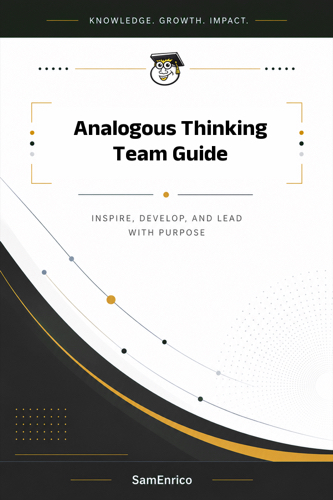
Analogous Thinking Team Guide eBook
Borrows solutions from unrelated fields.
by Epps Collin
Borrows solutions from unrelated fields.
Formats
Free sample
Chapter 1: Beyond Familiar Shores–- Every Monday morning, in conference rooms across the world, teams gather to solve problems using a method that guarantees they will never discover anything truly new. They review what worked last quarter. They examine what competitors launched last month. They assign tasks based on internal best practices. This is the ritual of the adjacent possible—the seemingly logical habit of searching for solutions one step away from what you already know—and it is the single most powerful force keeping teams trapped in incremental thinking.The adjacent possible is a concept borrowed from evolutionary biology, where it describes the set of genetic mutations that are just one step away from an organism's current form.
In team settings, it describes something far more limiting: the gravitational pull of your own industry, your own past successes, and your own familiar failures. If a competitor used a referral program, you build a better referral program. If last year's product launch succeeded through email marketing, this year's campaign will optimize email open rates. The logic feels flawless. Build on what works.
Iterate incrementally. Avoid catastrophic failure. And yet, this logic produces exactly what it promises: incremental improvement. Not breakthroughs. Not category-defining innovations.
Not solutions that make competitors scratch their heads and ask, "Where did that come from?"This book is built on a counterintuitive premise that will unsettle you, then liberate you: the most valuable solutions to your team's toughest problems live in domains that have nothing to do with your industry. Not one step away. Not two steps away. Often, they live in worlds you would never think to visit—the pit lane of a Formula One race, the decision-making rules of a slime mold, the rehearsal habits of a jazz quartet, or the supply lines of a medieval army. This practice has many names—analogical thinking, cross-domain transfer, biomimicry, lateral thinking—but at its heart, it is the deliberate, structured act of borrowing solutions from unrelated fields.Before we can teach you how to do this, however, we must confront a paradox that trips up even the smartest teams.
The paradox is this: the most powerful analogies are often the most distant, yet teams instinctively reject distance because it feels risky, impractical, and vaguely embarrassing. Your brain is wired to prefer the familiar. When someone suggests, "What if we solved our customer retention problem like a beehive manages foraging?" your first instinct is to laugh, dismiss, or say, "That's interesting, but we're not bees." That instinct is not a sign of intelligence. It is the enemy of innovation. And overcoming it is the first and most essential skill this book will teach you.The Hospital That Learned From Race Cars Let us begin with a story that demonstrates everything this chapter needs to teach.
In 2012, a large teaching hospital in Pittsburgh found itself trapped in a stubborn, life-threatening problem. Patient handoffs between surgical teams and intensive care units were failing. Information lost during the fifteen-minute gap between the operating room and the ICU was causing an unacceptable rate of complications. Nearly thirty percent of post-surgical errors traced back to communication breakdowns during handoffs. The hospital's quality improvement team did what most teams do.
They studied other hospitals. They benchmarked against peer institutions. They attended conferences on patient safety. In other words, they searched the adjacent possible—healthcare solutions for healthcare problems.After eighteen months of effort, error rates had improved by only four percent.Then someone on the team attended a Formula One race. Not as part of a work assignment.
Not as a benchmarking trip. Simply as a fan. What she noticed changed everything. A Formula One pit crew performs a tire change and refueling in under three seconds. Three seconds.
And they do it with near-perfect reliability across hundreds of races, under conditions of extreme time pressure, noise, and physical danger. The question that occurred to her was not "How is a pit crew like a hospital?" That question would have produced only surface-level observations. Instead, she asked something far more powerful: "What problem is a pit crew solving that looks structurally identical to my problem?"The answer emerged with stunning clarity. A pit crew solves a problem of high-stakes, time-pressured, role-dense information transfer. So does a surgical handoff.
The surface details could not be more different—tires and fuel versus patient charts and vital signs. The tools, vocabulary, and physical environment share nothing in common. But the structural problem was identical: how do you move a complex, life-critical set of responsibilities from one team to another with zero information loss and near-zero time?The hospital team studied pit crew protocols in detail. They discovered three mechanisms that proved transferable. First, pit crews use a structured call-and-response system where every action is verbalized and confirmed before the next action begins.
The tire changer does not assume the fuel hose is detached; they wait for the confirmation call. Second, pit crews use role redundancy with a spotter. Each technician focuses exclusively on their role while a separate spotter monitors the whole system, watching for failures that individuals cannot see from their position. Third, pit crews use a handoff protocol that includes what they call the "silent second"—a moment when the outgoing team physically steps back from the car and the incoming team verbally confirms readiness before any hand touches the vehicle.The hospital adapted these principles to their context. They created a fifteen-second "silent handoff" where the surgical team steps back from the patient's bedside, the ICU team does a quick verbal confirmation of three critical data points, and only then does the physical transfer of the patient occur.
They designated a rotating spotter role—a nurse not involved in direct transfer whose only job is to watch for missed steps. They implemented call-and-response for the three most frequently missed data elements.Error rates dropped by forty-two percent in six months. The intervention cost nothing but training time. No new technology was purchased. No consultants were hired.
The solution came from a domain so distant from healthcare that no competitor had ever considered it, and that distance was precisely why it worked.This is the power of analogous thinking. The pit crew did not come from healthcare. It came from motorsports. And that distance was not an obstacle to overcome—it was the source of novelty. No healthcare conference had ever recommended a pit crew protocol.
No competing hospital was using one. The adjacent possible would never have produced this insight because the adjacent possible is blind to anything outside its own neighborhood.Why Your Brain Fights Distance To understand why teams resist distant analogies, we need to understand how human brains evolved to solve problems. The brain is not a general-purpose reasoning engine. It is a collection of specialized heuristics shaped by millions of years of survival pressures. One of those heuristics is called local search, and it is extraordinarily effective under most conditions.Imagine you are a hunter-gatherer searching for berries.
You found berries near that large oak tree yesterday. Where should you look today? The rational answer is: near that large oak tree, and then slightly beyond it. You search locally because…
This is the end of the free sample. Get the eBook to keep going. Buy now
About this book
Details
- Author
- Epps Collin
- Publisher
- SamEnrico
- Language
- English
- Genre
- Non-Fiction, Self-Help, Analogical Thinking
- Released
- 2026-06-10
- Pages (approx.)
- 152
- Available as
- eBook, Audiobook

Read better in the ZLOADR app
Your eBooks on your phone or tablet. Sign in with your SamEnrico account and start reading.
More by Epps Collin
 Letterboxd Film BuffEpps Collin$11.99
 NVC for MenEpps Collin$11.99
 Persuasive Proposal Design GuideEpps Collin$11.99
 Team Interruption TrainingEpps Collin$11.99
 The Posture Stress ConnectionEpps Collin$11.99
 The Medical EmergencyEpps Collin$11.99
 Metabolic Health NappingEpps Collin$11.99
 Blue Zone Resilience FactorsEpps Collin$11.99
 The Lost Sculptors of Ife: Masters of the Bronze RenaissanceEpps Collin$11.99
 The Siege of Chaco Canyon: Ancient Warriors of the SouthwestEpps Collin$11.99
 The Last Dance of the Blue Angels: A Legacy of Precision and PerilEpps Collin$11.99
 How to Start a Manometers (non-electronic) Business (Beginners Guide)Epps Collin$11.99
You may also like
 Hong Kong Handover 1997Dunn Johnnie$11.99
 Zumba For Postnatal Recovery CourseNeal Christian$11.99
 Zumba for BeginnersLadner Nikia$11.99
 YouTube Comment Mining GuideHumes Pandora$12.99
 Worry Box MeditationCarlin Rudy$11.99
 Workplace Stress MeditationNguyen Lynn$11.99
 Workplace Stress and Sleep RepairHawley Ivory$11.99
 Workplace Perfectionism CureDelaney Jeffry$11.99
 Workplace Injustice Anger GuideWallen Isabelle$11.99
 Work Addiction and Burnout LinkGreenwood Ester$11.99
 Women in Yoga and WellnessBeattie Galina$11.99
 Women in Stand Up ComedyChun Evangeline$11.99