
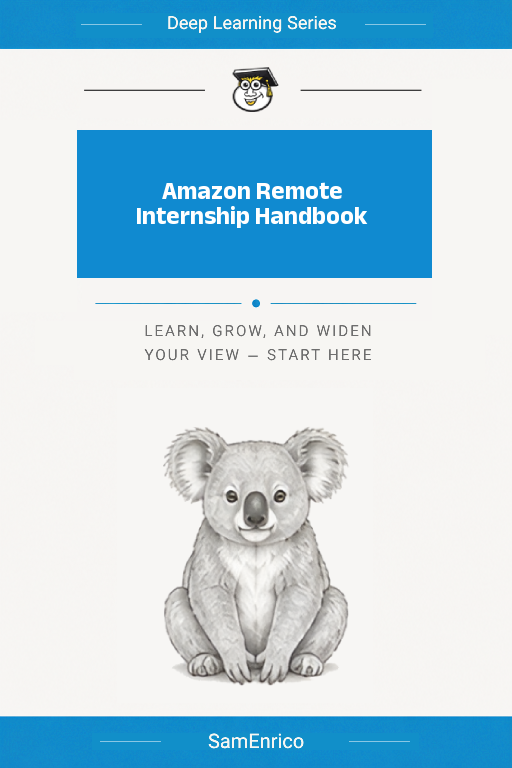
Non-FictionVirtual Work ExperienceE-commerce Guide
Amazon Remote Internship Handbook eBook
Secure a virtual internship at Amazon globally. Ma
Secure a virtual internship at Amazon globally. Master leadership principles, remote onboarding, and cross-timezone work.
Formats
Free sample
Chapter 1: The Remote Loophole--–- When Andy Jassy announced in February 2024 that Amazon corporate employees would return to the office five days a week, the internet erupted. Headlines screamed that remote work was dead at Amazon. Tech recruiters declared the end of distributed work at the world’s largest employer. Thousands of employees updated their Linked In profiles to “open for work.” And thousands of students—students like you, reading this sentence—made a quiet assumption: There goes my chance to intern at Amazon without relocating.That assumption was wrong. Not slightly wrong.
Completely, categorically, dangerously wrong.What the headlines didn’t tell you is that Amazon’s RTO (Return to Office) mandate contained exceptions so large you could drive a Prime delivery truck through them. Interns were never the target. Global teams were never the target. AWS technical roles, Alexa engineering teams, and Advertising product groups—some of Amazon’s fastest-growing divisions—have operated as distributed organizations for years, long before COVID made remote work a household term. The mandate applied to corporate employees in specific hub locations working on specific teams.
If you’re not a full-time corporate employee sitting in Seattle, Arlington, or New York, the rules are different. Sometimes dramatically so.This chapter dismantles everything you think you know about Amazon and remote work. You’ll learn why Amazon actually needs remote interns, which orgs are most likely to hire you virtually, and how to spot the difference between a truly remote-friendly internship and a “remote in name only” posting that will require relocation by Week 3. More importantly, you’ll learn the single question that separates successful remote applicants from the thousands who self-reject before they ever click “apply.”The Great Misunderstanding: Who the RTO Mandate Actually Targets Let’s start with the text Amazon’s leadership actually published. In that February 2024 memo, Andy Jassy wrote: “We’ve decided to return to operating as we were before the onset of COVID, with corporate employees working from the office five days per week.” The key phrase is “corporate employees working from the office.” Interns are not corporate employees.
They are seasonal, fixed-term trainees. The policies that apply to a Senior Product Manager with ten years of tenure do not automatically apply to a summer intern who hasn’t graduated college.But the loophole runs deeper than semantics. Amazon’s internal guidance—documents that never reach the press—divides the workforce into three categories for RTO purposes. Category One is “Hub-Based Corporate Employees”: these are the people who must be in office five days a week. Category Two is “Field and Operations Employees”: warehouse workers, delivery drivers, data center technicians, and other roles that were never remote to begin with.
Category Three is “Distributed and Global Teams”: groups whose members are spread across multiple countries, time zones, and legal entities. For Category Three, the RTO mandate functionally does not apply because there is no single office to return to.As an intern, you will almost never fall into Category One. You might fall into Category Two if you apply for a role in Amazon Logistics or Fulfillment Centers (but those are rarely remote). Your target is Category Three: distributed, global teams that have always worked across borders and therefore cannot be forced into a single building.Why Amazon Needs Remote Interns (Even If They Won't Advertise It)Here’s the counterintuitive truth that changes everything: Amazon doesn’t offer remote internships because it’s generous or progressive. Amazon offers remote internships because it’s desperate for talent in specific, hard-to-fill roles.Consider the math.
In 2024, Amazon received over 2.5 million applications for fewer than 10,000 internship positions globally. That’s a 0.4% acceptance rate—more selective than Harvard, Stanford, or MIT. With those numbers, why would Amazon bother accommodating a student in Brazil who wants to work with a team in Seattle? Wouldn’t they just hire someone local?The answer reveals how little most people understand about Amazon’s talent strategy. For every ten open internship positions on a global team like AWS Support or Alexa Devices, the hiring manager faces a specific problem: the qualified candidates are not evenly distributed.
A team in Seattle might need a Portuguese speaker for a customer segment in São Paulo. A team in Berlin might need someone familiar with Japanese regulatory compliance. A team in Bangalore might need a student who can overlap with US Eastern Time for four hours each day.In each of these cases, the “perfect candidate” doesn’t live near an Amazon office. They live in a different country, a different time zone, a different legal jurisdiction. Amazon could try to relocate them—and sometimes does—but relocation takes months, costs tens of thousands of dollars, and requires visa sponsorship that may be impossible for a three-month internship.
The alternative is to make the internship remote.So here’s the truth that most guidebooks won’t tell you: Amazon’s remote internships are not a concession to work-life balance or digital nomad culture. They are a tactical solution to a geographic mismatch between talent and team. And that means the remote internships that exist are not random. They cluster in specific orgs, specific roles, and specific situations. Your job is to identify those clusters and aim directly for them.The Orgs Where Remote Coordination Is the Norm Not all Amazon teams are created equal when it comes to remote work.
Some orgs have been distributed since their founding. Others are fighting every day to bring people back to a physical desk. Here are the orgs where your chances of landing a genuinely remote internship are highest.Amazon Web Services (AWS)AWS is the most distributed org at Amazon, and it’s not close. The cloud business operates data centers on every continent except Antarctica. Support teams are organized around “follow the sun” rotations, with engineers in Sydney handing off to Mumbai, then to Dublin, then to Virginia, then back to Sydney.
Security teams monitor global traffic 24/7 from wherever they happen to live. Solutions Architects regularly work with customers in different time zones.For interns, AWS offers several remote-friendly paths. The AWS Virtual Internship program (which we cover in detail in Chapter 12) is explicitly designed for remote participation. AWS Support internships often accept remote candidates because the work is entirely ticket-based and asynchronous. And AWS AI teams—working on machine learning models that require continuous training across global compute clusters—have been distributed since their inception.Alexa and Devices The Alexa team has a unique problem: the voice assistant is used in 80+ countries, but the engineering teams are concentrated in a handful of locations (Seattle, Berlin, Bangalore, Tokyo).
To build features that work for Japanese users, a Berlin engineer often needs input from someone familiar with Japanese culture. To debug a Spanish-language issue, a Seattle team might need a native speaker who lives in Spain.These mismatches create remote internship opportunities. Look for Alexa roles with “International Expansion,” “Localization,” “Language Engineering,” or “Cross-Platform” in the title. These teams are explicitly chartered to work across borders and are therefore more comfortable with remote participants.Amazon Advertising Advertising is one of Amazon’s fastest-growing businesses—and one of the most globally distributed. Advertisers in London…
This is the end of the free sample. Get the eBook to keep going. Buy now
About this book
Details
- Author
- Packer Simona
- Publisher
- SamEnrico
- Language
- English
- Genre
- Non-Fiction, Virtual Work Experience, E-commerce Guide
- Released
- 2026-05-29
- Pages (approx.)
- 142
- Available as
- eBook, Audiobook

Read better in the ZLOADR app
Your eBooks on your phone or tablet. Sign in with your SamEnrico account and start reading.
More by Packer Simona
 Political News Anger Triggers GuidePacker Simona$11.99
 The Caregiver Humor Survival GuidePacker Simona$11.99
 Mindful Walking Step by StepPacker Simona$11.99
 Fertility and Vitamins GuidePacker Simona$11.99
 Nightmare Processing for Abuse SurvivorsPacker Simona$11.99
 The Architect of the Universe: Vishwakarma’s Celestial BlueprintPacker Simona$11.99
 How to Become a Laundry Worker IPacker Simona$11.99
 Stryker SWOT GuidePacker Simona$12.99
 Understanding Ofd Syndrome Type 8Packer Simona$17.99
 Commercial CoordinatorPacker Simona$11.99
You may also like
 Hong Kong Handover 1997Dunn Johnnie$11.99
 Zumba For Postnatal Recovery CourseNeal Christian$11.99
 Zumba for BeginnersLadner Nikia$11.99
 YouTube Comment Mining GuideHumes Pandora$12.99
 Worry Box MeditationCarlin Rudy$11.99
 Workplace Stress MeditationNguyen Lynn$11.99
 Workplace Stress and Sleep RepairHawley Ivory$11.99
 Workplace Perfectionism CureDelaney Jeffry$11.99
 Workplace Injustice Anger GuideWallen Isabelle$11.99
 Work Addiction and Burnout LinkGreenwood Ester$11.99
 Women in Yoga and WellnessBeattie Galina$11.99
 Women in Stand Up ComedyChun Evangeline$11.99