
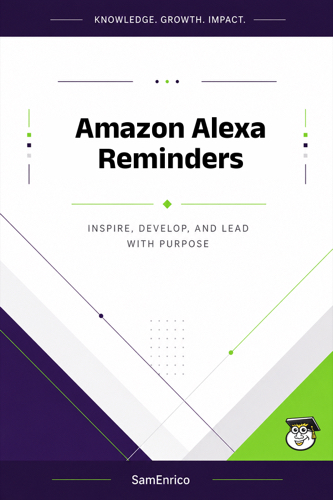
Non-FictionSelf-Help / Smart Home
Amazon Alexa Reminders Audiobook
undefined
by Doherty Raye
undefined
Formats
Free sample
Chapter 1: The Memory Thief...--You have already forgotten something today.Not a decade-old childhood memory or the name of an actor in a movie you saw last year. Something recent. Something important. Within the last three hours, your brain has discarded a task, an idea, or a commitment that you fully intended to act upon. You might remember what it was by the end of this chapter.
More likely, you will not.This is not a personal failing. It is not a sign of aging, distraction, or laziness. It is, quite simply, how your brain was designed to work — and the modern world has turned that design into a liability.For most of human history, forgetting a task had low stakes. If a hunter-gatherer forgot to sharpen a spear, they could sharpen it tomorrow. If a medieval farmer forgot to water a specific row of crops, the other rows would still grow.
But today, you are expected to remember passwords, meeting times, permission slip deadlines, medication schedules, bill due dates, grocery lists, birthday gifts, car maintenance intervals, and the name of that person you met at the conference — all while simultaneously cooking dinner, answering emails, and listening to a child describe their school day. Your brain is running Windows 95 software on 2025 hardware requirements. Something has to give.That something is your prospective memory — the cognitive ability to remember to perform a planned action at a future time. And it is failing you constantly, often without your awareness.The Hidden Epidemic of Forgetting Psychologists have studied prospective memory for decades, but only recently have they quantified its real-world cost. A landmark study from the University of Notre Dame tracked participants for two weeks and asked them to log every forgotten task.
The results were staggering: the average adult forgets between three and five tasks per day. Over a year, that is more than 1,400 forgotten obligations. Some are trivial — forgetting to buy toothpaste, missing a non-urgent email reply. Others carry serious consequences: late fees, missed medical appointments, strained relationships with people who interpret forgetfulness as disrespect.Here is what makes prospective memory different from retrospective memory (remembering facts from the past). When you forget where you put your keys, you know you have forgotten.
There is an uncomfortable feeling of loss, a moment of searching. But when you forget to call your mother on her birthday, you do not feel the forgetting…
This is the end of the free sample. Get the Audiobook to keep going. Buy now
About this book
Details
- Author
- Doherty Raye
- Publisher
- SamEnrico
- Language
- English
- Genre
- Non-Fiction, Self-Help / Smart Home
- Released
- 2026-06-06
- Pages (approx.)
- 141
- Available as
- eBook, Audiobook

Listen in the VoxFlicks app
Audiobooks and audio dramas wherever you go. Sign in with your SamEnrico account and press play.
More by Doherty Raye
 Zumba with DisabilitiesDoherty Raye$11.99
 Overdose Death Of ChildDoherty Raye$11.99
 The Nap Ergonomics GuideDoherty Raye$11.99
 Small Talk for Expat CommunitiesDoherty Raye$11.99
 Assertiveness For The Hearing ImpairedDoherty Raye$11.99
 Bipolar And PregnancyDoherty Raye$11.99
 Pomodoro Study MethodDoherty Raye$11.99
 Bipolar Ketogenic Diet GuideDoherty Raye$11.99
 The Great Unraveling: How the 'Free Britney' Movement Changed the Music IndustryDoherty Raye$11.99
 The Battle of the Aegean: Salamis' Shadow Over the Mediterranean (480 BC)Doherty Raye$11.99
 The American AFL Dream: How Aussie Rules Football Took Root in the U.S.Doherty Raye$11.99
 The Mineral Guide to JacobsiteDoherty Raye$11.99
You may also like
 Hong Kong Handover 1997Dunn Johnnie$11.99
 Zumba For Postnatal Recovery CourseNeal Christian$11.99
 Zumba for BeginnersLadner Nikia$11.99
 YouTube Comment Mining GuideHumes Pandora$12.99
 Worry Box MeditationCarlin Rudy$11.99
 Workplace Stress MeditationNguyen Lynn$11.99
 Workplace Stress and Sleep RepairHawley Ivory$11.99
 Workplace Perfectionism CureDelaney Jeffry$11.99
 Workplace Injustice Anger GuideWallen Isabelle$11.99
 Work Addiction and Burnout LinkGreenwood Ester$11.99
 Women in Yoga and WellnessBeattie Galina$11.99
 Women in Stand Up ComedyChun Evangeline$11.99