
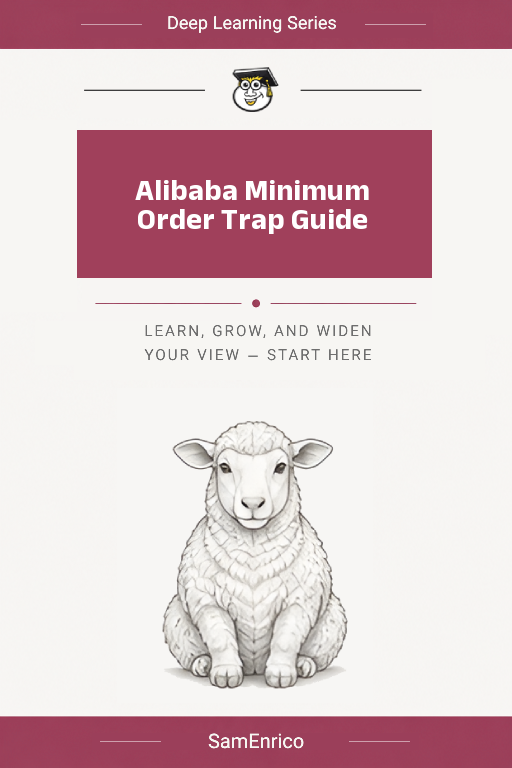
Alibaba Minimum Order Trap Guide eBook
Negotiate MOQ reductions and sample orders before
by Jacobs Tommy
Negotiate MOQ reductions and sample orders before bulk buying, learning supplier management for profitable resale on Amazon or Jumia.
Formats
Free sample
Chapter 1: The $47,000 Lie--The first time I saw an MOQ on Alibaba, I thought it was a rule.I was 24 years old, had just quit a perfectly boring marketing job, and had $12,000 saved up from two years of eating rice and beans. I had found what I believed was the perfect product—a portable phone charger shaped like a vintage cassette tape. Nostalgic. Useful. Cheap to ship.
I had done the Tik Tok research, the Google Trends analysis, the Amazon competitor audit. Everything pointed to yes.Then I messaged the supplier."Dear friend, MOQ is 2,000 pieces. Price $4.50 per unit. Thank you."I stared at the screen. Two thousand units meant 9,000justfortheproduct,plusshipping,plus Amazonfees,plusstorage.Thatleftme9,000 just for the product, plus shipping, plus Amazon fees, plus storage.
That left me 9,000justfortheproduct,plusshipping,plus Amazonfees,plusstorage.Thatleftme3,000 for everything else. I did not have $3,000 for everything else. I had rent, ramen, and the quiet panic of a man who had just told his father he was "starting a business."But here is what I did not know then: the MOQ was not a rule. It was a test. And I failed it completely.Instead of negotiating, instead of asking for samples, instead of doing literally anything intelligent, I did what most beginners do.
I closed the laptop, felt sorry for myself, and moved on to the next product. Then the next. Then the next. Each time, the same wall. MOQ 1,000.
MOQ 3,000. MOQ 500 if you buy two colors. I started to believe that Alibaba was only for rich people, that importing was a rich person's game, that I had somehow missed the memo where you needed fifty thousand dollars just to play.I was wrong. But I did not discover that until after I lost $47,000.The Day I Learned What MOQ Really Means Let me tell you about my friend Kevin. Kevin is the reason this book exists, and also the reason I have a small ulcer that flares up whenever I see a container ship.Kevin started his Amazon business six months after I gave up on mine.
He had less money than I did—$8,000 total. He found a similar product, similar MOQ, similar wall. But unlike me, Kevin did not close his laptop. He sent a follow-up email. Not a desperate one.
A professional one. He wrote:"Thank you for the MOQ of 2,000. I understand your setup costs. However, I am a new seller testing this category. Can you do 200 units at a 15% premium?
I will pay for the sample today and place the trail order within 7 days if quality passes."The supplier said yes.Kevin received his 200 units six weeks later. He listed them on Amazon, ran 30adayin PPC,andsoldoutin12days.Hereordered500unitsata530 a day in PPC, and sold out in 12 days. He reordered 500 units at a 5% premium. Sold out again. His third order was 2,000 units at the original 30adayin PPC,andsoldoutin12days.Hereordered500unitsata54.50 price.
Within eight months, Kevin had a seven-figure product line. He now owns a house, a dog named Bezos, and the kind of quiet confidence that comes from knowing you beat the system.I, meanwhile, had spent those same eight months jumping from product to product, afraid of MOQs, convinced the system was rigged against small sellers. I was wrong. The system was not rigged. I just did not know how to play.The difference between Kevin and me was not money.
It was not intelligence. It was not luck. It was one email. One sentence. One refusal to accept that the first number a supplier gives you is the final number.That is the lie of the MOQ.
The lie is that it is fixed. The lie is that you must buy thousands of units or go home. The lie is that Alibaba is only for big players with big bank accounts. None of that is true. But the lie persists because it benefits two groups of people: lazy suppliers who do not want to deal with small buyers, and lazy gurus who want you to believe you need to "go big or go home" so you will buy their expensive courses about raising capital.I wrote this book because I eventually figured out what Kevin knew intuitively.
I have now sourced over 200 products from Alibaba and 1688. I have negotiated MOQs from 5,000 units down to 50. I have made every mistake you can make—wrong colors, wrong sizes, wrong certifications, wrong suppliers, wrong freight forwarders, wrong everything. And I have distilled every lesson into this book.The first lesson, the most important lesson, the lesson that will determine whether you succeed or fail, is this: the MOQ is not a rule. It is the beginning of a conversation.Why 90% of New Importers Never Place a Second Order Let me be precise about the numbers, because vague statistics are the weapon of lazy gurus.
According to Alibaba's internal 2023 seller survey of 5,247 small businesses (defined as first-time importers with less than $50,000 in annual revenue), approximately 68% never place a second order. Nearly seven out of ten. That is not a typo.Why? The survey asked. The top three reasons were:Inventory death (41%) – They ordered the MOQ, the product did not sell, and they ran out of money to try again.Quality failure (23%) – The sample was good, but the bulk order was garbage, and they had no recourse.Cash flow paralysis (19%) – They could not afford the MOQ in the first place, so they never ordered at all.Notice what is missing from that list.
"The supplier was mean." "The product was bad." "The market was saturated." Those are excuses. The real killers are inventory mismanagement, quality control failures, and a fundamental misunderstanding of how MOQ negotiation actually works.Let me tell you about Maria, who represents the 41%. Maria found a beautiful ceramic coffee mug with a built-in tea infuser. The supplier's MOQ was 1,000 units at 3.50each.Mariahad3.50 each. Maria had 3.50each.Mariahad5,000.
She did the math: 3,500formugs,3,500 for mugs, 3,500formugs,1,000 for sea freight, $500 for Amazon fees and PPC. Tight, but possible. She ordered.The mugs arrived. They were beautiful. She listed them.
And they sold. Slowly. Very slowly. After 90 days, Maria had sold 180 mugs. She had 820 mugs in an Amazon warehouse, accruing storage fees.
She had no money left for PPC. The algorithm stopped showing her listing. Sales dropped to near zero. Maria had become the owner of 820 coffee mugs and a broken business.What went wrong? Maria did not fail because the product was bad.
The product was good. She failed because she ordered 1,000 units when her sales velocity could only support 200. She confused "minimum order quantity" with "smart order quantity." They are not the same thing. They are not even close.The Math That Will Save You Thousands of Dollars Let me show you the math that would have saved Maria. I want you to memorize this formula.
Write it on a sticky note. Tape it to your monitor.Smart Order Quantity = (Available Cash × 0.3) / Landing Cost Per Unit Let me break that down.Available Cash is the money you have set aside specifically for this product launch. Not your rent money. Not your emergency fund. Not your "I might buy a new laptop" money.
The cash you are willing to lose completely if this product fails. For Maria, that was $5,000.Multiply by 0.3. Why…
This is the end of the free sample. Get the eBook to keep going. Buy now
About this book
Details
- Author
- Jacobs Tommy
- Publisher
- SamEnrico
- Language
- English
- Genre
- Non-Fiction, Business Brief
- Released
- 2026-05-30
- Pages (approx.)
- 125
- Available as
- eBook, Audiobook

Read better in the ZLOADR app
Your eBooks on your phone or tablet. Sign in with your SamEnrico account and start reading.
More by Jacobs Tommy
 Romance Scam PreventionJacobs Tommy$11.99
 Credit Card Freeze MethodJacobs Tommy$11.99
 The Baby Blues vs PPD GuideJacobs Tommy$11.99
 Emotional Intelligence for AutismJacobs Tommy$11.99
 Restless Leg Syndrome in MenopauseJacobs Tommy$11.99
 OKRs Complete Implementation GuideJacobs Tommy$11.99
 Migraine Aura GuideJacobs Tommy$11.99
 Facial Expressions DecodedJacobs Tommy$11.99
 The Wyvern’s Gambit: A Dragon’s Double GameJacobs Tommy$11.99
 The Secret Race of Cairo: How a Forgotten Athlete Defied the British EmpireJacobs Tommy$11.99
 How to Produce Cricket BallsJacobs Tommy$11.99
 Financial Imprint CourseJacobs Tommy$12.99
You may also like
 Hong Kong Handover 1997Dunn Johnnie$11.99
 Zumba For Postnatal Recovery CourseNeal Christian$11.99
 Zumba for BeginnersLadner Nikia$11.99
 YouTube Comment Mining GuideHumes Pandora$12.99
 Worry Box MeditationCarlin Rudy$11.99
 Workplace Stress MeditationNguyen Lynn$11.99
 Workplace Stress and Sleep RepairHawley Ivory$11.99
 Workplace Perfectionism CureDelaney Jeffry$11.99
 Workplace Injustice Anger GuideWallen Isabelle$11.99
 Work Addiction and Burnout LinkGreenwood Ester$11.99
 Women in Yoga and WellnessBeattie Galina$11.99
 Women in Stand Up ComedyChun Evangeline$11.99