
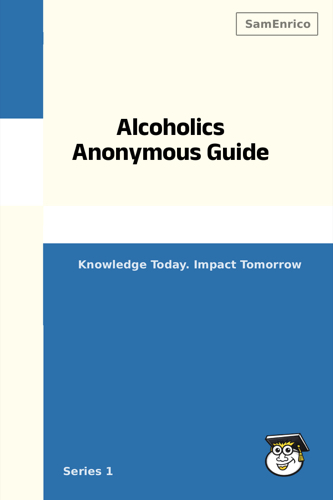
Non-FictionSelf-HelpTwelve Step
Alcoholics Anonymous Guide eBook
Navigates 12-step meetings, sponsorship, and step
by Knox Ericka
Navigates 12-step meetings, sponsorship, and step work.
Formats
Free sample
Chapter 1: The Spiral Staircase...–- You are holding this book for one of three reasons. Either you have just poured a drink you swore you would not pour, or you are sitting in a church basement parking lot too terrified to open the car door, or someone who loves you has placed this book on your nightstand with a desperate, unspoken hope. None of those three entry points require you to believe in God. None require you to call yourself an alcoholic in public. And none require you to understand what a "moral inventory" is or why you would ever need one.
What they do require is something far simpler and far more difficult: a crack of willingness so small that a single photon of light could fit through it. That is enough. That has always been enough.The Fear That Has a Name Let us name the elephant in the room before it sits on your chest. The word "God" appears in the 12 Steps. Specifically, it appears in Step 2 ("came to believe that a Power greater than ourselves could restore us to sanity"), Step 3 ("made a decision to turn our will and our lives over to the care of God as we understood Him"), Step 5 ("admitted to God, to ourselves, and to another human being"), Step 6 ("were entirely ready to have God remove"), Step 7 ("humbly asked Him to remove"), and Step 11 ("prayer and meditation to God").
That is six out of twelve steps. If you are an atheist, an agnostic, a survivor of religious trauma, or simply a person who finds organized religion somewhere between boring and repulsive, you have just counted those six mentions and felt your stomach drop. You are not alone. Approximately one third of A.A. members in major urban areas identify as atheist or agnostic.
The difference between those who stay and those who leave is not belief. The difference is whether someone explained to them, in the first week, what "God as you understood Him" actually means in practice.Here is the secret that the 1930s language obscures: "God" in the 12 Steps is not a noun. It is a verb disguised as a noun. It means "something that is not you, that you are willing to trust, for long enough to stop trying to manage the unmanageable." That something can be the A.A. group itself (many members joke that G-O-D stands for Group Of Drunks).
It can be the natural order of cause and effect. It can be the laws of physics. It can be the future version of yourself who has not yet destroyed their liver. It can be a doorknob, if you can sincerely believe that a doorknob is more powerful than you are when it comes to stopping drinking. The point is not the object of the belief.
The point is the act of believing that you are not the highest authority in the universe. Because if you are the highest authority, you have already proven, repeatedly, that your authority cannot keep you sober. That is not an insult. That is data.The Twelve Steps Are Not Twelve Commandments Here is the second thing that terrifies newcomers: the word "Steps" sounds linear. It sounds like a ladder.
Step 1, then Step 2, then Step 3, and so on until Step 12, at which point you graduate and receive your sober certificate and never have to think about drinking again. That is not how addiction works, and that is not how the steps work. The steps are a spiral. You will do Step 1 hundreds of times. Every time a craving hits and you do not drink, you have just done Step 1 again.
Every time you think "I can handle one beer" and then catch yourself, you have done Step 1 again. The spiral does not go up in a straight line. It circles back over the same terrain at higher and higher altitudes. You will see the same fears, the same resentments, the same character defects on different floors of the same building. That is not failure.
That is the architecture of recovery.Let us lay out the twelve steps in plain language before we cluster them into manageable groups. Step 1: "We admitted we were powerless over alcohol—that our lives had become unmanageable." Translation: Willpower alone does not work for me, and I can prove it with the evidence of my own life. Step 2: "Came to believe that a Power greater than ourselves could restore us to sanity." Translation: Since my willpower failed, I am willing to try trusting something outside myself, even if that something is just the collective experience of people in this room. Step 3: "Made a decision to turn our will and our lives over to the care of God as we understood Him." Translation: I am going to stop trying to control everything and instead ask for help, using whatever understanding of "help" makes sense to me. Step 4: "Made a searching and fearless moral inventory of ourselves." Translation: I am going to write down, on paper, the patterns of harm I have caused and the resentments I carry, without editing or sparing myself.
Step 5: "Admitted to God, to ourselves, and to another human being the exact nature of our wrongs." Translation: I am going to read that inventory aloud to one trusted person, because shame dies when it is spoken. Step 6: "Were entirely ready to have God remove all these defects of character." Translation: I am going to stop defending the parts of me that cause harm, even if they once protected me. Step 7: "Humbly asked Him to remove our shortcomings." Translation: I am going to practice asking for help with my character defects, not because I deserve help but because humility is the opposite of grandiosity. Step 8: "Made a list of all persons we had harmed, and became willing to make amends to them all." Translation: I am going to name everyone I owe a repair to, without deciding in advance who "deserves" my amends. Step 9: "Made direct amends to such people wherever possible, except when to do so would injure them or others." Translation: I am going to clean my side of the street, not to get forgiveness but to stop carrying the weight of unpaid debts.
Step 10: "Continued to take personal inventory and when we were wrong promptly admitted it." Translation: I am going to check in with myself every night, catch my mistakes in real time, and apologize within hours instead of years. Step 11: "Sought through prayer and meditation to improve our conscious contact with God as we understood Him, praying only for knowledge of His will for us and the power to carry that out." Translation: I am going to practice sitting in silence, listening instead of demanding, and asking only to know what to do next—not for specific outcomes. Step 12: "Having had a spiritual awakening as the result of these steps, we tried to carry this message to alcoholics, and to practice these principles in all our affairs." Translation: I am going to tell my story to the next person, not to fix them but to keep my own recovery alive, and I am going to apply these principles to my…
This is the end of the free sample. Get the eBook to keep going. Buy now
About this book
Details
- Author
- Knox Ericka
- Publisher
- SamEnrico
- Language
- English
- Genre
- Non-Fiction, Self-Help, Twelve Step
- Released
- 2026-06-06
- Pages (approx.)
- 116
- Available as
- eBook, Audiobook

Read better in the ZLOADR app
Your eBooks on your phone or tablet. Sign in with your SamEnrico account and start reading.
More by Knox Ericka
 Cross Border Transaction GuideKnox Ericka$11.99
 Yoga Asanas for DoshasKnox Ericka$11.99
 Sugar Detox for Diabetics Type 2Knox Ericka$11.99
 Anchoring Emotional StateKnox Ericka$11.99
 From the Crime Scene to the StandKnox Ericka$11.99
 Cardiovascular Risk MenKnox Ericka$11.99
 Bupropion XL GuideKnox Ericka$11.99
 The Beast of the Backwoods: Canada's Werewolf Hysteria of 1862Knox Ericka$11.99
 Ra and the Serpent's Shadow: A Norse Saga of the Sun God's FallKnox Ericka$11.99
 How to Produce Textile Craft MachinesKnox Ericka$11.99
 Service Providers Guide to Glass & Mirror InstallationKnox Ericka$11.99
 How to Produce Horse LeadsKnox Ericka$11.99
You may also like
 Hong Kong Handover 1997Dunn Johnnie$11.99
 Zumba For Postnatal Recovery CourseNeal Christian$11.99
 Zumba for BeginnersLadner Nikia$11.99
 YouTube Comment Mining GuideHumes Pandora$12.99
 Worry Box MeditationCarlin Rudy$11.99
 Workplace Stress MeditationNguyen Lynn$11.99
 Workplace Stress and Sleep RepairHawley Ivory$11.99
 Workplace Perfectionism CureDelaney Jeffry$11.99
 Workplace Injustice Anger GuideWallen Isabelle$11.99
 Work Addiction and Burnout LinkGreenwood Ester$11.99
 Women in Yoga and WellnessBeattie Galina$11.99
 Women in Stand Up ComedyChun Evangeline$11.99