
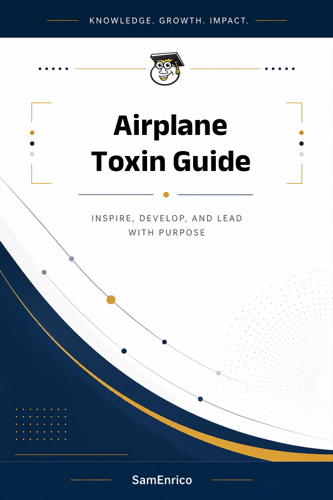
Airplane Toxin Guide
Reduces exposure to recirculated air, cleaning che
Reduces exposure to recirculated air, cleaning chemicals, and EMF at altitude.
Formats
About this book
Free sample
Chapter 1: The Breathing Illusion--–- The first lie you are told on an airplane happens before you even fasten your seatbelt. It is not spoken by the flight attendant, nor printed in the safety card. It is delivered by the gentle hiss of air from the overhead nozzle—a sound that most passengers interpret as reassurance. Fresh air, you think. They are pumping in fresh air.
This assumption, innocent as it seems, is the single most dangerous misconception about commercial aviation. Because the air you are breathing at 35,000 feet is not fresh. It was never meant to be. And what is actually in that invisible stream—the blend of engine exhaust byproducts, aerosolized neurotoxins, and chemically reactive gases—has been quietly reshaping the health of frequent flyers and crew members for decades, all while the aviation industry maintained that the cabin environment was perfectly safe.The story of contaminated cabin air begins not with a dramatic accident, but with an engineering compromise made in the 1950s. When jet engines became powerful enough to lift pressurized aluminum tubes to stratospheric altitudes, aircraft designers faced a fundamental problem: how to supply breathable air to a sealed cabin without carrying heavy oxygen tanks.
The elegant, cost-effective solution was to “bleed” compressed air directly from the engine compressor stages—hence the term bleed air. This air is hot (over 400 degrees Fahrenheit), dry (less than 15% relative humidity), and travels through a series of ducts, heat exchangers, and valves before being cooled and mixed with recirculated cabin air. It is a marvel of engineering efficiency, and it has been standard on every commercial jet from the Boeing 707 to the Airbus A380.But there is a catch, and it is not a small one. The engine compressors from which bleed air is drawn share seals and bearing compartments with engine oil. Those oils are not simple lubricants.
Modern jet engine oils are complex chemical formulations designed to withstand extreme temperatures and pressures. They contain synthetic esters, antioxidants, anti-wear additives, and—most critically—a class of compounds called tricresyl phosphates, or TCP. TCP is an organophosphate, a chemical family that…
This is the end of the free sample. Get the eBook to keep going. Buy now
Contents
- Chapter 1
- Chapter 2
- Chapter 3
- Chapter 4
- Chapter 5
- Chapter 6
- Chapter 7
- Chapter 8
- Chapter 9
- Chapter 10
- Chapter 11
- Chapter 12
Details
- Author
- Bollinger Colby
- Publisher
- SamEnrico
- Language
- English
- Genre
- Non-Fiction, Health & Wellness / Air Travel
- Released
- 2026-06-07
- Pages (approx.)
- 152
- Available as
- eBook, Audiobook

Read better in the ZLOADR app
Your eBooks on your phone or tablet. Sign in with your SamEnrico account and start reading.
More by Bollinger Colby
 Foot Care for Active SeniorsBollinger Colby$11.99
 Substance Induced AngerBollinger Colby$11.99
 Post Hypnotic Suggestion for FocusBollinger Colby$11.99
 Silk & Splendor: The Medici Fashion RevolutionBollinger Colby$11.99
 How to Become a BabbitterBollinger Colby$11.99
 SEM ManagerBollinger Colby$11.99
 How to Produce a Clamshell BucketBollinger Colby$11.99