
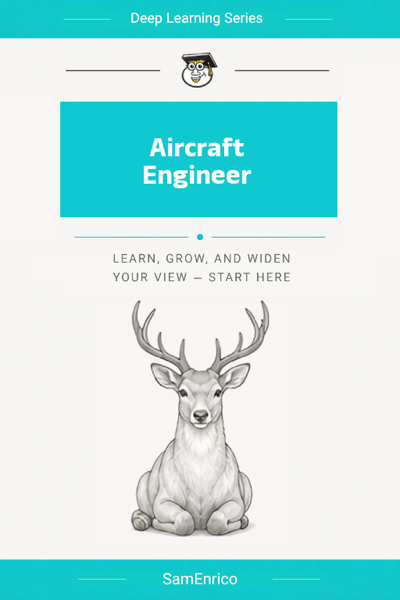
Non-FictionInformativeEducational
Aircraft Engineer Audiobook
A Coursebook on Aircraft Engineer
A Coursebook on Aircraft Engineer
Formats
Free sample
Chapter 1: The Engineer’s Labyrinth--– The hangar at Seattle-Tacoma International Airport was cavernous and cold, smelling of jet fuel, hydraulic fluid, and rust. A young engineer named Elena Vasquez stood before the carcass of a Boeing 737 that had been grounded for forty-seven days. Her task was simple on paper: sign off on a fuselage repair. In reality, every signature felt like a handshake with fate. She traced her finger along a hairline crack in the lap joint, invisible to the untrained eye, and wondered how many people would board this aircraft tomorrow.
One mistake, one overlooked detail, one moment of complacency, and the chain of responsibility would snap. That chain, she knew, began with her. This is the world of the aircraft engineer—a labyrinth of technical knowledge, ethical traps, and life-or-death decisions hidden beneath layers of aluminum, composite, and regulation.1.1 The Five Pillars of Aircraft Engineering Aircraft engineering is not a single profession but a constellation of specialized disciplines, each critical to keeping metal and composites aloft. While the public often imagines a lone mechanic in coveralls, the reality is far more complex. Modern aviation relies on five distinct engineering pillars, and understanding their boundaries is the first step toward mastering the trade.Design Engineers create the shape and architecture of the aircraft.
They work in aerodynamic optimization, structural layout, and systems integration. Using computational fluid dynamics and finite element analysis, they determine where every rivet goes, how every wire routes, and why the wing sweeps back at thirty degrees. Their decisions define the aircraft’s soul.Stress Engineers calculate the invisible forces that try to tear the aircraft apart. They analyze load paths, fatigue life, and failure modes. When a wing flexes upward during turbulence, the stress engineer has already predicted that deflection to within millimeters.
Their world is numbers—tension, compression, shear, and torsion—and their tools include classical hand calculations and complex software like NASTRAN. Without them, the design engineer’s beautiful shapes would shatter on the first flight.Propulsion Engineers focus on the heart of the aircraft: the engines. Whether a piston-driven Lycoming or a high-bypass turbofan, every powerplant is a study in controlled explosions. Propulsion engineers handle thermodynamics, blade aerodynamics, combustion efficiency, and thrust reverse mechanisms. They know why a turbine blade spins at 12,000 RPM without melting—and what happens when it doesn’t.Maintenance Engineers work where the rubber meets the runway.
They interpret inspection data, plan heavy checks, troubleshoot system faults, and ensure that every repair meets airworthiness standards. Unlike design…
This is the end of the free sample. Get the Audiobook to keep going. Buy now
About this book
Details
- Author
- Mundy Bernardo
- Publisher
- SamEnrico
- Language
- English
- Genre
- Non-Fiction, Informative, Educational
- Released
- 2026-05-06
- Pages (approx.)
- 159
- Available as
- eBook, Audiobook

Listen in the VoxFlicks app
Audiobooks and audio dramas wherever you go. Sign in with your SamEnrico account and press play.
More by Mundy Bernardo
 MBSR For Financial Anxiety WorkbookMundy Bernardo$11.99
 Burnout Prevention for Accountants HandbookMundy Bernardo$11.99
 Workplace Stress for AccountantsMundy Bernardo$11.99
 Ezekiel Visionary ProphetMundy Bernardo$11.99
 The Self Esteem for New Mothers GuideMundy Bernardo$11.99
 The Dragon’s Bride: A Flame-Bound HeartMundy Bernardo$11.99
 Understanding Kocher–debré–semelaigne SyndromeMundy Bernardo$17.99
 Documentation Auto Writer ManualMundy Bernardo$12.99
 SaaS in Retail GuideMundy Bernardo$12.99
 How to Start a Hobby in Shooting rifles - pistols - and shotgunsMundy Bernardo$11.99
You may also like
 Hong Kong Handover 1997Dunn Johnnie$11.99
 Zumba For Postnatal Recovery CourseNeal Christian$11.99
 Zumba for BeginnersLadner Nikia$11.99
 YouTube Comment Mining GuideHumes Pandora$12.99
 Worry Box MeditationCarlin Rudy$11.99
 Workplace Stress MeditationNguyen Lynn$11.99
 Workplace Stress and Sleep RepairHawley Ivory$11.99
 Workplace Perfectionism CureDelaney Jeffry$11.99
 Workplace Injustice Anger GuideWallen Isabelle$11.99
 Work Addiction and Burnout LinkGreenwood Ester$11.99
 Women in Yoga and WellnessBeattie Galina$11.99
 Women in Stand Up ComedyChun Evangeline$11.99