
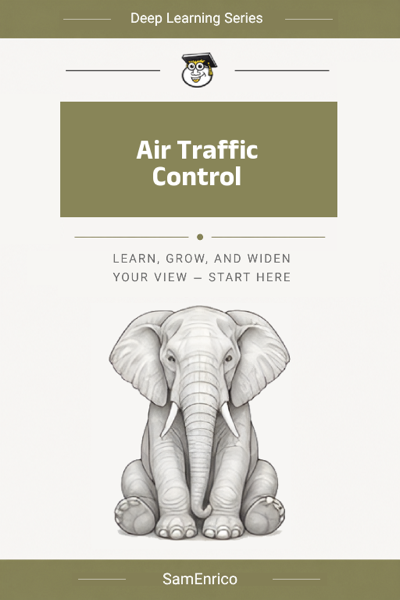
Non-FictionInformativeEducational
Air Traffic Control eBook
A Coursebook on Air Traffic Control
by Kunz Dorsey
A Coursebook on Air Traffic Control
Formats
Free sample
Chapter 1: The Invisible Scaffolding--– Every day, approximately 100,000 flights take off and land somewhere in the world. That is nearly seventy aircraft movements per minute, twenty-four hours a day, three hundred sixty-five days a year. If you stood at the center of a major airport like Hartsfield-Jackson Atlanta or London Heathrow, you would see a jet landing or departing roughly every ninety seconds. The human eye cannot process that density. The human ear would be overwhelmed by the roar.
Yet somewhere, in a windowless room or a glass-walled tower, a group of men and women track every single one of those aircraft. They know where each plane is, where it is going, how high it will fly, and when it will arrive. They speak in clipped, rapid sentences that sound like code to the untrained ear. They make decisions in seconds that affect the lives of hundreds of people. And almost no one outside their profession understands what they actually do.This is the invisible scaffolding that holds modern aviation together.
Without air traffic control, the miracle of routine, safe, affordable air travel would collapse into chaos within hours. The sky would become a lottery. Some flights would arrive on time. Others would collide. The industry that carries four billion passengers per year—more than half the population of the planet—would revert to the deadly gamble it was in the 1920s, when pilots navigated by railroad tracks and hoped the weather would hold.This chapter introduces you to that invisible scaffolding.
You will learn why ATC matters far beyond the obvious reason of preventing crashes. You will discover the hidden hierarchy of control that operates above your head every time you fly. And you will see how this book has been constructed to give you, the aspiring controller or curious professional, the same foundational knowledge offered by the ten best-selling training manuals in the field—without the expense, contradiction, or redundancy of buying them separately.But before we dive into airspace classes, phraseology, and radar separation, we must answer a more fundamental question. What is air traffic control, really? Not the dictionary definition.
Not the government brochure. What is the job, in its rawest, most honest form?The Transparency Paradox Air traffic control suffers from a peculiar affliction that no other safety-critical profession experiences. When a surgeon saves a life, the patient knows. When a firefighter pulls someone from a burning building, the rescued person remembers forever. When a bridge holds up under heavy traffic, drivers do not think about the engineer—but they also do not expect the bridge to collapse.
Air traffic control is different. When a controller does the job perfectly, the passengers feel nothing at all. No jolts. No sudden turns. No last-second course corrections.
No awareness that another jet passed within 1,000 feet vertically and 30 seconds horizontally. The controller's success is measured by the absence of sensation.This is the transparency paradox. The better controllers perform, the less the flying public thinks about them. Passengers board planes, buckle seatbelts, watch movies, and deplane at their destinations with no memory of the person who sequenced them into a busy airport's arrival stream, separated them from wake turbulence, and handed them off to three different facilities along the route. Ask a random traveler what air traffic control does, and you will hear something about "guys in towers waving flashlights" or "preventing planes from hitting each other." Both are true, but neither captures the complexity, the cognitive intensity, or the life-or-death stakes of the job.The paradox has practical consequences.
When ATC works flawlessly, funding debates ignore it. When a near-miss occurs—however minor—headlines scream about system failure. Controllers operate in a world where their successes are invisible and their rare failures become national news. This psychological pressure is part of the job. It drives controllers to obsess over details, to double-check every instruction, to treat every handoff as potentially the one that saves a life.
The best controllers do not seek recognition. They seek the quiet satisfaction of a perfectly sequenced arrival push, a smoothly executed reroute around weather, a shift where nothing unusual happened because they prevented the unusual from ever developing.The Secret Hierarchy: Tower, Approach, Center Most people, if they think about ATC at all, imagine a single control tower looming over an airport. That tower is real. It is the most visible symbol of air traffic control. But it is only one part of a three-tiered system that operates across continents and oceans.
Understanding this hierarchy is the first step toward thinking like a controller.Tower controls the airport surface and the immediate airspace around it, typically up to about 5 miles from the runway and 3,000 feet above ground level. The tower is divided into three specialized positions. Clearance Delivery issues the route and transponder code before the aircraft even starts its engines. Ground Control manages all taxiways, pushbacks, tugs, and vehicles on the ramp and taxiways. Local Control—often called "the local"—has sole authority over the runway itself.
No aircraft takes off or lands without the local controller's explicit permission. Tower controllers see their aircraft with their own eyes, through floor-to-ceiling windows or high-definition cameras. They are the face of ATC, even though the flying public never sees their faces.Approach and Departure Control, also known as Terminal Radar Approach Control or TRACON, handles the crowded airspace from the top of the tower's jurisdiction up to approximately 10,000 to 18,000 feet, depending on the complexity of the airport. This is where the real magic happens. An arriving flight might be handed off from the en route center to approach control while still 50 miles from the airport.
The approach controller then sequences that flight into a conga line of other arrivals, assigns speeds and headings, and ultimately delivers each aircraft to the tower controller for landing. Departing flights go the opposite direction: tower hands them off to departure control, which climbs them through the busy terminal airspace and eventually hands them off to the en route center. Approach and departure controllers never see the aircraft they control. They stare at radar screens—or more accurately, at high-resolution displays showing radar data fused with satellite positions—and speak into headsets. Their world is abstract, symbolic, and relentlessly fast.Center, or en route control, manages the high-altitude airways above 18,000 feet across entire regions.
In the United States, 22 Air Route Traffic Control Centers cover the continental United States, Alaska, Hawaii, and parts of the Atlantic and Pacific Oceans. Each center is divided into dozens of sectors, and each sector is staffed by at least one controller (or more during busy periods). Center controllers handle aircraft at cruising altitude, where speeds exceed 500 miles per hour and a minute of inattention can mean ten miles of unintended travel. They coordinate across state lines, hand off aircraft between sectors, and resolve conflicts that appear on their screens with as little as three minutes of lead time. Center control is the least visible tier of the system, because it happens far from airports and far from public awareness.
Yet it is also the tier where the greatest number of aircraft are under a single controller's responsibility at any given moment.These three tiers…
This is the end of the free sample. Get the eBook to keep going. Buy now
About this book
Details
- Author
- Kunz Dorsey
- Publisher
- SamEnrico
- Language
- English
- Genre
- Non-Fiction, Informative, Educational
- Released
- 2026-05-04
- Pages (approx.)
- 145
- Available as
- eBook, Audiobook

Read better in the ZLOADR app
Your eBooks on your phone or tablet. Sign in with your SamEnrico account and start reading.
More by Kunz Dorsey
 Race Car Driver StressKunz Dorsey$11.99
 The Tattoo IdentificationKunz Dorsey$11.99
 NVC For Chronic Pain ManagementKunz Dorsey$11.99
 White Water Rafting Guide StressKunz Dorsey$11.99
 The Ballad of the Last Blockbuster: A Town’s Unlikely Love AffairKunz Dorsey$11.99
 How to Become a Glass-bulb-machine AdjusterKunz Dorsey$11.99
 Freemium Lightweight AnalyticsKunz Dorsey$12.99
 How to Produce BiogasKunz Dorsey$11.99
You may also like
 Hong Kong Handover 1997Dunn Johnnie$11.99
 Zumba For Postnatal Recovery CourseNeal Christian$11.99
 Zumba for BeginnersLadner Nikia$11.99
 YouTube Comment Mining GuideHumes Pandora$12.99
 Worry Box MeditationCarlin Rudy$11.99
 Workplace Stress MeditationNguyen Lynn$11.99
 Workplace Stress and Sleep RepairHawley Ivory$11.99
 Workplace Perfectionism CureDelaney Jeffry$11.99
 Workplace Injustice Anger GuideWallen Isabelle$11.99
 Work Addiction and Burnout LinkGreenwood Ester$11.99
 Women in Yoga and WellnessBeattie Galina$11.99
 Women in Stand Up ComedyChun Evangeline$11.99