
Non-FictionAnnual CheckupTechnical Writing
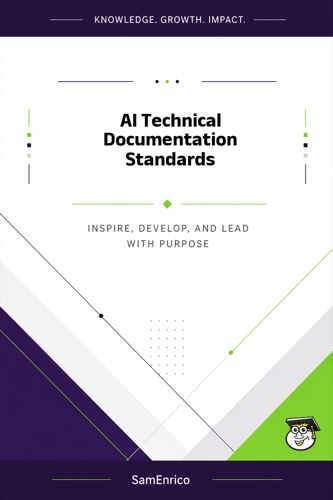
AI Technical Documentation Standards eBook
Prepare mandatory technical files for high-risk AI
Prepare mandatory technical files for high-risk AI systems.
Formats
Free sample
Chapter 1: The €35M Typo...--It begins with a single outdated sentence buried on page 47 of a technical file that no one has opened in eighteen months. The sentence reads: "The model's false positive rate for demographic subgroup X is approximately 2.1%, validated against the November 2024 test set." By the time an auditor discovers that the actual false positive rate is 8.7% for that subgroup, and that the model has been retrained seven times since that test set was retired, the damage is already done. A high-risk AI system deployed across three European countries has been systematically denying services to protected groups. The regulator's fine lands at €28 million. The company's valuation drops by two-thirds in one quarter.
The Chief Technology Officer, who signed the Declaration of Conformity, personally faces a six-year prohibition from serving as a director of any EU-regulated entity.This is not a hypothetical. This is the logical conclusion of treating technical documentation as a static artifact rather than a living, executable asset. And it is happening right now, in boardrooms and engineering slack channels, to teams who believed they were compliant because they had a "checked box" and a PDF on a shared drive.Welcome to the high-risk mandate. If you are reading this book, you are likely one of three people: the engineer who just realized your documentation has drifted fatally from your code, the compliance officer who inherited a technical file that reads like science fiction, or the executive who understands that the EU AI Act's 2026 deadline is not a finish line but a firing squad. This chapter establishes why traditional documentation fails, what is at stake, and how the rest of this book will rebuild your approach from first principles.The Cost of a Stale Paragraph Let us be precise about what we mean by "cost." Under the EU AI Act, violations of documentation requirements for high-risk systems carry administrative fines of up to €35 million or, if the offender is a company, up to 7% of its total worldwide annual turnover for the preceding financial year, whichever is higher.
For context, 7% of a mid-sized AI vendor's global revenue often exceeds €40 million. Unlike GDPR's 4% cap, the AI Act's 7% signals a deliberate escalation: documentation is no longer a paperwork exercise but a core safety obligation.But fines are only the beginning. Article 99 of the AI Act empowers national supervisory authorities to impose corrective actions, suspend deployment, withdraw products from the market, and publicly name non-compliant providers. A public ban on a high-risk AI system—say, an employment screening tool or a credit scoring algorithm—does not merely incur a fine. It destroys customer trust, triggers cascading contractual penalties, and invites private litigation from every individual harmed by the system's outputs.Consider the cascade effect.
A stale paragraph in Section 5 (Risk Management) states that "mitigation M-12 prevents erroneous credit denials." But the model has been updated three times without updating Section 5. When a denial occurs and a plaintiff's attorney discovers the discrepancy between documented mitigation and actual implementation, the company cannot claim good-faith compliance. The documented claim becomes evidence of negligence, not evidence of safety.Then there is the human cost. High-risk systems—defined in Annex III of the AI Act—include critical infrastructure, education and vocational training, employment and worker management, essential private and public services (credit, healthcare, insurance), law enforcement, migration and border control, and administration of justice. A stale paragraph in any of these domains does not merely mislead an auditor.
It actively endangers rights, livelihoods, and lives.The 2026-2027 Deadline Reality The EU AI Act entered into force on August 1, 2024. However, the prohibition on unacceptable-risk AI systems (Article 5) applied six months later, in February 2025. The provisions for general-purpose AI transparency applied in August 2025. But for high-risk systems, the clock runs longer—and more dangerously.Most high-risk systems that are already on the market or placed into service before August 2, 2026, must comply by August 2, 2027. This 12-month extension applies to systems covered by Annex I (product safety legislation) and certain legacy high-risk systems.
However—and this is where confusion proliferates—any high-risk system that undergoes a "significant change" in design or intended purpose after August 2, 2026, must comply immediately, without the 12-month grace period.What counts as a significant change? The answer is deliberately ambiguous, but the European Commission's guidance suggests that retraining a model with new data, modifying the input variables, changing the geographic scope of deployment, or altering the human oversight interface all qualify. In practice, most continuously improving AI systems will trigger significant change criteria within months of the August 2026 deadline.The practical implication is brutal: if your high-risk AI system updates quarterly or retrains weekly, you cannot rely on the 2027 extension. You must achieve full compliance by August 2, 2026, or stop deploying updates. Organizations that misinterpret this deadline will find themselves in January 2027 with a non-compliant product that has been "significantly changed" ten times since the deadline passed.
The penalties, as described above, will follow.Scope Definition: General-Purpose vs. High-Risk One of the most common and costly mistakes is assuming that all AI documentation requirements are created equal. They are not. The AI Act draws a sharp line between two regimes: transparency obligations for general-purpose AI (GPAI) and mandatory technical files for high-risk AI systems.General-purpose AI—chatbots, copilots, search enhancers, code assistants, and similar systems not specifically designed for high-risk use cases—must meet relatively lightweight transparency requirements. Under Article 53, providers of GPAI models must draw up and make publicly available a detailed summary of the training content, disclose that content is AI-generated, and design the system to prevent generation of illegal content.
That is it. No technical file. No notified body. No mandatory risk management system.High-risk systems are an entirely different universe. The technical file required under Annex IV is a comprehensive dossier of between 50 and 500 pages, depending on system complexity.
It must include:A detailed description of the system, its intended purpose, and its limitations (Annex IV §1-2)A complete description of data governance, including training, validation, and testing datasets (Annex IV §3)The design specifications, including the logic of the system, key parameters, and assumptions (Annex IV §4)A description of the risk management system (Annex IV §5)A description of post-market monitoring (Annex IV §9)And more, including logging requirements, cybersecurity measures, and human oversight protocols The difference is not merely one of degree but of kind. GPAI requires a public summary document. High-risk requires a living, auditable, version-controlled evidence pack that ties every claim to a verifiable artifact.Why does this distinction matter for Chapter 1? Because many organizations that are building high-risk systems continue to operate under GPAI documentation practices. They write a "model card," publish a blog post about fairness, and assume they are compliant.
They are not. The gap between a model card and an Annex IV technical file is the gap between a restaurant menu and a health inspection certificate. The former is marketing; the latter is law.Who Is the Provider? Mapping Supply Chain Liability The AI Act defines the "provider" as any natural or legal person that develops an AI system with a view to placing it on the market or putting it into service under its own name or trademark. This definition appears straightforward until you trace the supply…
This is the end of the free sample. Get the eBook to keep going. Buy now
About this book
Details
- Author
- Cisneros Heriberto
- Publisher
- SamEnrico
- Language
- English
- Genre
- Non-Fiction, Annual Checkup, Technical Writing
- Released
- 2026-06-06
- Pages (approx.)
- 144
- Available as
- eBook, Audiobook

Read better in the ZLOADR app
Your eBooks on your phone or tablet. Sign in with your SamEnrico account and start reading.
More by Cisneros Heriberto
 MBSR for InsomniaCisneros Heriberto$11.99
 Exercise Based Burnout Recovery GuideCisneros Heriberto$11.99
 Mirza Ghulam Ahmad AccountCisneros Heriberto$11.99
 Body Image and Intimacy Recovery GuideCisneros Heriberto$11.99
 The Last Supper of the Viking King: A Feast of SecretsCisneros Heriberto$11.99
 Air Traffic ControllerCisneros Heriberto$11.99
 SaaS in Manufacturing GuideCisneros Heriberto$12.99
 Refactoring Assistant PrimerCisneros Heriberto$12.99
 How to Start a Hobby in ShoppingCisneros Heriberto$11.99
 Understanding Kobberling–dunnigan SyndromeCisneros Heriberto$17.99
You may also like
 Hong Kong Handover 1997Dunn Johnnie$11.99
 Zumba For Postnatal Recovery CourseNeal Christian$11.99
 Zumba for BeginnersLadner Nikia$11.99
 YouTube Comment Mining GuideHumes Pandora$12.99
 Worry Box MeditationCarlin Rudy$11.99
 Workplace Stress MeditationNguyen Lynn$11.99
 Workplace Stress and Sleep RepairHawley Ivory$11.99
 Workplace Perfectionism CureDelaney Jeffry$11.99
 Workplace Injustice Anger GuideWallen Isabelle$11.99
 Work Addiction and Burnout LinkGreenwood Ester$11.99
 Women in Yoga and WellnessBeattie Galina$11.99
 Women in Stand Up ComedyChun Evangeline$11.99