
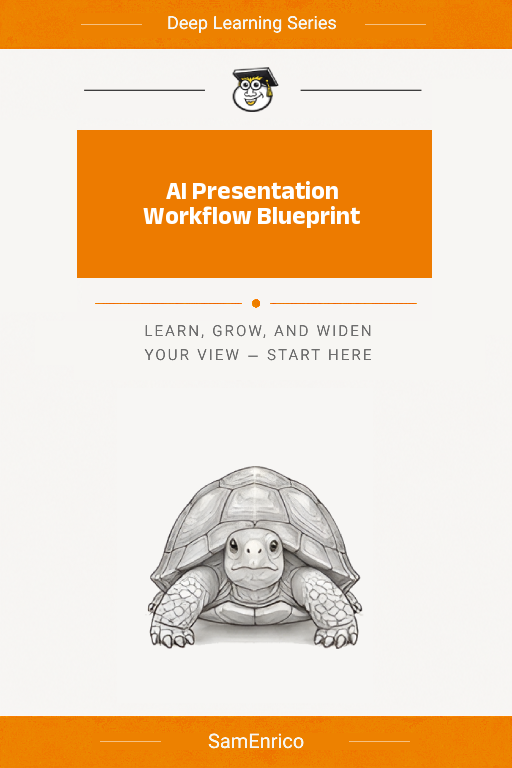
Non-FictionAI OperatorWorkflow Automation
AI Presentation Workflow Blueprint eBook
Create a closed-loop system from outline to final
Create a closed-loop system from outline to final delivery. Covers version control, stakeholder review integration, and automated animation suggestions for impact.
Formats
Free sample
Chapter 1: The State Change Lie...--Every presentation you have ever sat through, every deck you have ever built, and every meeting you have ever left feeling vaguely unsatisfied shares the same hidden pathology. You have been measuring success by the wrong metric. The industry has trained you to ask, "Is the deck finished?" when the only question that matters is, "Did the audience change?"This is not a semantic quibble. It is a fundamental reorientation of what presentation work actually is. A finished presentation that changes nothing is not a success.
It is a well-organized failure wrapped in brand-compliant typography.Consider the venture capital pitch. A founder presents fifty slides of market size, product features, competitive analysis, and financial projections. The deck is beautiful. The data is correct. The logos are perfectly placed.
The venture capitalist says, "Thank you, we need more data before we can make a decision." The founder walks out feeling accomplished. The deck was delivered. The questions were answered. The meeting ended politely.That founder just failed. The audience left in the same state they entered: undecided, unconvinced, and asking for more information.
The presentation did not change their thinking, their feeling, or their decision calculus. It merely transferred information. Information transfer without state change is not communication. It is noise with slides.The AI Presentation Workflow Blueprint begins with this uncomfortable truth because every tool, technique, and workflow in this book is designed to serve one master: audience state change. If you do not define what change you seek, no amount of AI automation will save you.
You will simply produce more finished presentations that change nothing, faster and with better fonts.The Three Loop System: A New Architecture for Presentation Work Before we can fix the problem, we must understand the system that creates it. Traditional presentation workflows are linear. You start with a brief, move to an outline, then to drafting, then to design, then to review, then to delivery, then you stop. This linear model fails for three reasons.First, it assumes that feedback happens in a single, orderly phase. In reality, stakeholders comment at every stage, often contradicting themselves and each other.
Second, it treats delivery as the end of the process, discarding the most valuable data: how the audience actually reacted. Third, it has no memory. Every presentation starts from scratch, repeating the same mistakes because no one captured what worked and what failed last time.This book replaces the linear model with the Three Loop System, an architectural framework that treats presentation creation as a closed-loop, self-improving system.Loop One: The Creation Loop The Creation Loop encompasses everything from initial brief to final draft. It includes outlining, writing, designing, visualizing data, and generating assets. In traditional workflows, this loop is the entire process.
In the Three Loop System, it is only the first phase.The Creation Loop is where AI provides the most immediate value. Large language models can transform a one-page brief into a structured outline. Consistency check agents can scan a deck for number mismatches across slides. Image generation tools can produce bespoke visuals that adhere to a locked character sheet. Animation AI can suggest build sequences based on slide density.But the Creation Loop has a trap.
Because AI makes it so fast to generate slides, teams often skip the critical step of validating narrative logic before investing in design. They go straight from brief to beautiful, skipping the skeleton deck entirely. This is a mistake that the Creation Loop's design must actively prevent. As we will see in Chapter 3, the solution is to separate narrative structure from visual design completely, forcing logic validation before any pixels are touched.The Creation Loop does not operate in isolation. It feeds into and receives feedback from the other two loops.
When the Review Loop demands changes, those changes trigger new passes through the Creation Loop. When the Data Loop identifies what confused the last audience, that insight shapes the next Creation Loop's priorities.Loop Two: The Review Loop The Review Loop is where most workflows die. Feedback arrives from a dozen channels: email, Slack, PDF markup, Zoom chat, hallway conversations, and the dreaded "I have just one more thought" message sent five minutes before the deadline. Each piece of feedback arrives in a different format, with different urgency, addressed to different people. No one knows which version is current.
Critical changes get lost. Stakeholders approve slides they never saw because the version they reviewed is not the version that was delivered.The Review Loop solves this by creating a structured, auditable, and automated feedback architecture. Every piece of feedback, regardless of source, is consolidated into a single action plan. Each action item has an assignee, a deadline, and a status. Approval paths are automated based on content rules: if the slide contains forward-looking financials, it routes to Compliance before it can reach the Manager.
If the slide mentions a patent, it routes to Legal.The Review Loop also introduces the concept of "ghosting detection." An AI compares meeting transcripts with the final slide deck. If a stakeholder said, "Change the Q3 forecast to red," but no change appears in the file, the AI flags the discrepancy and assigns it to the owner. This closes the gap between verbal feedback and digital documentation.Most importantly, the Review Loop is not a one-time gate. It is a continuous process that runs parallel to the Creation Loop. Stakeholders can review skeleton decks before design begins, reducing the cost of changes by an order of magnitude.
They can review individual slides as they are completed, rather than waiting for the full deck. The Review Loop's automation ensures that no feedback falls through the cracks, regardless of when or where it arrives.Loop Three: The Data Loop The Data Loop is the most neglected and most powerful of the three. It captures insights from completed presentations and feeds them back into future work. In traditional workflows, a presentation ends at delivery. The Data Loop argues that delivery is where learning begins.When you present to a live audience, whether in a Zoom room or a physical boardroom, you generate a rich dataset.
Which slides generated the most questions? Which slides had long pauses before anyone spoke? What objections did the audience raise that your deck did not address? Who asked the most challenging questions, and what topics did they focus on?The Data Loop captures this data through post-delivery analysis. An AI ingests the meeting transcript, the Q&A log, and the slide deck.
It identifies confusion spikes, objection patterns, and missed opportunities. It generates an objection handling document that every future deck can use. It updates your archival system with new metadata: this slide survived a hostile question; this claim was challenged successfully; this visual confused three different people.The Data Loop also includes the archival system we will build in Chapter 11. Every approved slide becomes a retrievable asset. When you need to show your Q3 sales methodology, you do not start from scratch.
You retrieve the slide from last quarter, already approved by Legal, and adapt it to new data. Your past best work becomes your future AI's training data.The three…
This is the end of the free sample. Get the eBook to keep going. Buy now
About this book
Details
- Author
- Durant Aubrey
- Publisher
- SamEnrico
- Language
- English
- Genre
- Non-Fiction, AI Operator, Workflow Automation
- Released
- 2026-05-28
- Pages (approx.)
- 132
- Available as
- eBook, Audiobook

Read better in the ZLOADR app
Your eBooks on your phone or tablet. Sign in with your SamEnrico account and start reading.
More by Durant Aubrey
 Thunberg Public Speaking Without Notes GuideDurant Aubrey$11.99
 Failure Fear for ADHD MindsDurant Aubrey$11.99
 Menopause Mouth Discomfort GuideDurant Aubrey$11.99
 George Jones No Show MemoirDurant Aubrey$11.99
 Green Tea Catechins Brain HealthDurant Aubrey$11.99
 The Clockwork Conspiracy: How a 19th-Century Timekeeper Almost Stopped the Industrial RevolutionDurant Aubrey$11.99
 The Hollow Crown: Merlin’s Forgotten ProphecyDurant Aubrey$11.99
 Waterbed CraftDurant Aubrey$11.99
 Understanding Fragile X Syndrome Type 1Durant Aubrey$17.99
 AI Credit Card Recon GuideDurant Aubrey$12.99
 Ultimate Handbook Guide to Wanyuan : (China) Travel GuideDurant Aubrey$11.99
You may also like
 Hong Kong Handover 1997Dunn Johnnie$11.99
 Zumba For Postnatal Recovery CourseNeal Christian$11.99
 Zumba for BeginnersLadner Nikia$11.99
 YouTube Comment Mining GuideHumes Pandora$12.99
 Worry Box MeditationCarlin Rudy$11.99
 Workplace Stress MeditationNguyen Lynn$11.99
 Workplace Stress and Sleep RepairHawley Ivory$11.99
 Workplace Perfectionism CureDelaney Jeffry$11.99
 Workplace Injustice Anger GuideWallen Isabelle$11.99
 Work Addiction and Burnout LinkGreenwood Ester$11.99
 Women in Yoga and WellnessBeattie Galina$11.99
 Women in Stand Up ComedyChun Evangeline$11.99