
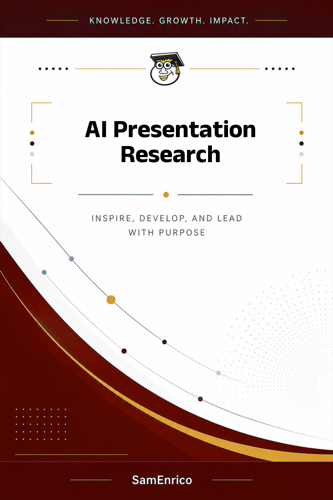
AI Presentation Research eBook
Generate cited slide content using AI with source
by Sears Ione
Generate cited slide content using AI with source verification.
Formats
Free sample
Chapter 1: The Credibility Crisis--Every day, thousands of professionals open Power Point, switch to Chat GPT, and commit the same quiet act of self-sabotage. They type a question into the chat window, receive a paragraph of fluent, confident text, and copy it directly onto a slide. Then they do it again. And again. By the time the deck is finished, they have created something that looks researched, sounds authoritative, and is often dangerously wrong.This is the Credibility Crisis.
And it is the single greatest threat to your professional reputation in the age of artificial intelligence.The crisis is seductive because it feels productive. You asked a question. The AI answered. You moved on. But here is what you did not do: you did not verify the claim.
You did not trace the source. You did not ask whether the statistic actually exists in the real world or whether the AI invented it whole cloth because the pattern of words "sounded right." In the world of AI-generated presentations, fluency has become a counterfeit for truth.This book exists because that counterfeit is about to cost you something valuable. Maybe it already has.The Hidden Failure of Most Presentations Before we talk about AI, let us talk about presentations themselves. The data is damning. According to multiple studies spanning decades, audiences forget approximately ninety percent of what they hear within one hour.
But more relevant to this book: decision-makers actively distrust presentations that make claims without visible support. In a survey of venture capitalists conducted by Doc Send, investors spent an average of only two minutes and thirty seconds reviewing a pitch deck before deciding whether to pass or pursue. And the number one reason for immediate rejection? Unsubstantiated claims. Statements like "We are the fastest-growing company in our space" with no data.
"The market is projected to reach fifty billion" with no source.Before AI, unsubstantiated claims were a sin of laziness. You simply did not bother to find the source. With AI, unsubstantiated claims have become a sin of complacency. You asked a machine that cannot distinguish truth from pattern and you accepted its answer as fact. That is not research.
That is ritual.The core argument of this chapter is simple: most presentations are failing not because the data is wrong, but because the data is unanchored. And AI, used naively, makes this problem worse, not better. It gives you the confidence to sound authoritative without the discipline to be accurate.Consider a typical scenario. A marketing director needs to create a slide about customer satisfaction trends. She asks Chat GPT: "What is the average customer satisfaction score for Saa S companies in North America?" The AI responds: "According to industry benchmarks, the average CSAT score for North American Saa S companies is 78 percent." The marketing director copies this onto a slide, adds a bar chart she asked the AI to generate, and presents it to her executive team.
The slide looks professional. The number is specific. But she has no idea if 78 percent is real, if it comes from a reputable source, if it applies to her specific sub-sector, or if the AI hallucinated it from a single blog post written by a vendor selling survey software.This is the Credibility Crisis in action. And it is spreading through boardrooms, pitch meetings, and conference halls faster than any technology in recent memory.The Difference Between Generative Creativity and Generative Accuracy To understand the crisis, you must first grasp a distinction that most books about AI ignore: the difference between generative creativity and generative accuracy.Generative creativity is what AI does best. You ask it to brainstorm ten headlines for a product launch.
You ask it to rewrite an awkward paragraph in a more conversational tone. You ask it to suggest three alternative structures for a quarterly review. In these tasks, the AI is not required to be correct. It is required to be plausible, diverse, and useful as a starting point. Hallucinations in creative tasks are harmless, sometimes even delightful.
If the AI invents a headline that does not correspond to a real product feature, you simply discard it and move on.Generative accuracy is something else entirely. When you ask an AI for a statistic, a market size, a historical trend, or a competitive benchmark, you are asking it to retrieve or synthesize factual information that corresponds to the real world. In this domain, hallucinations are not harmless. They are professional liabilities. A single fabricated number on a slide can destroy years of trust.
It can cause a bad investment decision. It can lead a board to approve a strategy based on a fiction.The tragedy is that most users do not know which mode they are in. They ask the AI a factual question, receive a fluent answer, and treat it as accurate because it sounds confident. This is the fundamental betrayal of large language models. They are not designed to be truthful.
They are designed to be plausible. Plausibility is a feature for creative writing. It is a bug for presentation research.The V.I.R.T.U.E. Framework: A Six-Pillar Antidote This book introduces a methodology to replace the Credibility Crisis. It is called the V.I.R.T.U.E.
Framework. Each letter stands for a pillar of trustworthy AI-assisted research. And each pillar will reappear throughout the subsequent chapters.Verification – Every claim that appears on a slide must be checked against a live, human-readable source. Not a source the AI says exists. A source you have opened, read, and confirmed.
Verification is the non-negotiable floor of credible work. Without it, nothing else matters.Integrity – When you extract a claim from a source, you must preserve its original meaning. No cherry-picking a sentence that supports your argument while ignoring the paragraph that contradicts it. No decontextualizing a statistic to make it seem larger or smaller than the author intended. Integrity means representing the source honestly, even when honesty complicates your narrative.Reference – Every verified claim must be accompanied by a citation that follows a consistent, professional format.
The format itself matters less than the consistency. Your audience should learn where to look for your sources. Chapter Ten provides the standard this book recommends, but the principle holds regardless of style: reference every claim, every time.Traceability – A reviewer or audience member should be able to go from a claim on a slide to the original source in under sixty seconds. This means your citations must be specific enough to find the exact page, paragraph, or data point. A URL to a hundred-page PDF is not traceable.
A URL plus a page number and a quoted excerpt is traceable.Utility – Every piece of research you include must answer the question: so what? A verified, correctly cited, perfectly traceable statistic that does not help your audience make a decision is noise. Utility means ruthlessly cutting research that does not serve the narrative. This is the pillar where most researchers fail. They confuse thoroughness with usefulness.Evidence – The final pillar distinguishes between opinions and facts, anecdotes and statistics, estimates and measurements.
Evidence is not simply a number. Evidence is a number that comes with a methodology, a confidence interval, and an…
This is the end of the free sample. Get the eBook to keep going. Buy now
About this book
Details
- Author
- Sears Ione
- Publisher
- SamEnrico
- Language
- English
- Genre
- research, AI Operator
- Released
- 2026-06-07
- Pages (approx.)
- 152
- Available as
- eBook, Audiobook

Read better in the ZLOADR app
Your eBooks on your phone or tablet. Sign in with your SamEnrico account and start reading.
More by Sears Ione
 The Beginner's Sound MeditationSears Ione$11.99
 Strength Training For Martial ArtsSears Ione$11.99
 Autogenic Training Self Trance HandbookSears Ione$11.99
 Scar Acceptance GuideSears Ione$11.99
 Produce Recall TimelineSears Ione$11.99
 Lithuanian Fintech Hub ProjectionSears Ione$11.99
 Alexandria Ocasio CortezSears Ione$11.99
 Holocaust LiberatorSears Ione$11.99
 The Annihilation of Mitanni: The Hittite Blitzkrieg That Reshaped the Bronze AgeSears Ione$11.99
 The Day the World Watched: Apollo 11’s Silent TriumphSears Ione$11.99
 The Apothecary's Legacy: How Western Pharmacy Transformed MedicineSears Ione$11.99
 Understanding Acromesomelic Dysplasia Campailla Martinelli TypeSears Ione$17.99
You may also like
 Scientific Research On TM GuideMartens Nathanial$11.99
 Research Proposal Methodology Section MasteryPauley Debroah$11.99
 Research Proposal Appendix CompilationRaines Tyisha$11.99
 Academic Researcher Distraction GuideFord Virgil$11.99
 TM Research and ScienceCovert Nicki$11.99
 Social Anxiety Research ReviewRoberge Cole$11.99
 Research Proposal Significance Section GuideBock Tory$12.99
 Research Proposal Reviewer PsychologyLugo Tawanda$11.99
 Research Proposal Research Questions DesignLara Robbi$11.99
 Research Proposal References and CitationsPatten Shanice$11.99
 Research Proposal Mixed Methods DesignCameron Omega$11.99
 Research Proposal Data Management PlanAnderson Roberto$12.99