
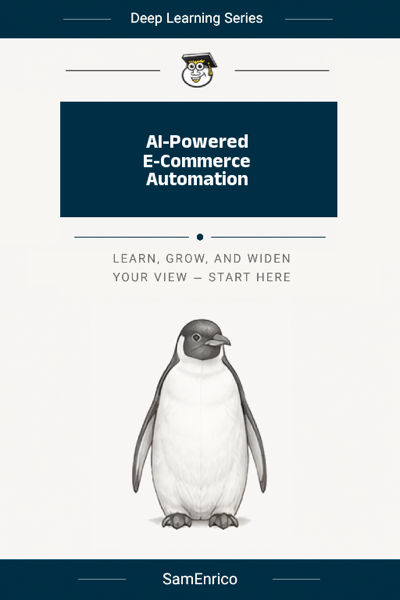
Non-FictionInformativeEducational
AI-Powered E-Commerce Automation eBook
A Coursebook on AI-Powered E-Commerce Automation
by Edgar Awilda
A Coursebook on AI-Powered E-Commerce Automation
Formats
Free sample
Chapter 1: The 3 AM Reckoning--–- The glow of the spreadsheet was the only light in Alex’s home office. Twenty-three columns. Fourteen hundred rows. Three thousand two hundred and forty-seven individual cells, each one representing a decision made, a dollar earned, or a mistake waiting to happen. Outside the window, the neighborhood slept.
Inside, Alex was drowning in the business of running a business.The pet supply store had done $2.1 million in revenue last year. By any external measure, it was a success. But Alex hadn’t taken a vacation in three years. The last book read for pleasure was somewhere under a pile of shipping invoices. And the relationship with a partner had ended six months ago, casualties of canceled dinners and the perpetual excuse: “I just have to finish this one thing.”At 3:17 AM, a notification pinged.
Another return request. A customer’s dog didn’t like the grain-free kibble. The dog didn’t like it. Not a quality issue. Not a shipping delay.
The dog had preferences, and now Alex had to process a return, issue a refund, update inventory, and probably send a follow-up email to salvage the relationship. For a dog’s opinion.That was the moment something cracked. Not the computer screen. Not the coffee mug that had been sitting there for three days. Something inside Alex.
The realization that this wasn’t a business anymore. It was a prison built from other people’s expectations, platform algorithms, and the exhausting weight of manual everything.What if the store could run itself? What if the 3 AM return requests were handled by something that didn’t need sleep, didn’t resent the dog, and didn’t mourn the loss of a Friday night?This book is the answer to that question.The Invisible Cage of Manual E-Commerce Before we can build the autonomous store of the future, we need to understand exactly how most e-commerce businesses are killing their owners today. Not with a single blow, but with a thousand small cuts.The average independent e-commerce operator spends 60% of their time on tasks that could be fully automated. That’s not an exaggeration pulled from marketing copy.
It comes from a 2024 study of 500 store owners who tracked their hours for ninety days. The breakdown is almost identical across categories, from apparel to electronics to pet supplies.Thirty percent of time goes to inventory and fulfillment. Checking stock levels. Comparing supplier prices. Printing labels.
Updating tracking numbers. Answering “where’s my order” emails. Twenty percent goes to customer service. The same questions, answered five hundred times. “What’s your return policy?” “When will this restock?” “Do you have this in a larger size?” Fifteen percent goes to financial reconciliation.
Matching Pay Pal deposits to Stripe deposits to Shopify payouts to bank statements. Fifteen percent goes to marketing operations. Scheduling social posts. Formatting email campaigns. Exporting and importing CSV files.
The remaining twenty percent is split between actual strategy, product development, and everything else.Here’s the math that keeps founders awake at night. If you’re doing $2 million in revenue at a 15% net margin, you’re making $300,000 per year. But if you’re working sixty hours per week, your effective hourly wage as the founder is about $96 per hour. That’s not nothing. But it’s also not the wealth and freedom that the e-commerce dream promised.
You could make that as a mid-level marketing manager with none of the risk, none of the sleepless nights, and none of the 3 AM return requests from picky dogs.The problem isn’t that e-commerce is broken. The problem is that most e-commerce businesses are still operated like it’s 2015. Manual data entry. Spreadsheet reconciliation. Copy-paste customer service.
The tools have evolved, but the operating model hasn’t.Until now.Introducing the Running Case Study: Alex’s Store Throughout this book, we’re going to follow a fictional but painfully realistic character. Alex owns a premium pet supply store called “Paws & Provisions.” The store sells high-end leashes, grain-free food, orthopedic beds, and a subscription box for anxious dogs. Revenue is $2.1 million per year. Gross margin is 45%. Net margin after all expenses including Alex’s reasonable salary is 12%.
The store has three full-time employees and two part-time warehouse staff.Alex is not a technical genius. Alex cannot write code, does not understand API architecture, and once spent four hours trying to connect a printer to Wi-Fi. But Alex is smart, motivated, and completely out of time.Every chapter of this book will include a section called “Progressive Case Study Integration” where we apply the chapter’s concepts to Alex’s Store. By the final chapter, we will have transformed Paws & Provisions from a manual prison into an autonomous profit machine. And you will have the blueprint to do the same for your business.But before we can fix Alex’s store, we need to understand where e-commerce has been, where it is now, and where it’s going.The Evolution from Web 2.0 to E-commerce 5.0Most people think e-commerce has been around forever.
In reality, the modern era of online selling is barely twenty years old. And the pace of change is accelerating faster than almost any other industry.E-commerce 1.0: The Static Catalog (1995-2005)The early days. Websites were digital brochures. Customers browsed, added items to a cart, and waited for a human to process the order. Payment was often a check sent by mail.
Inventory was updated weekly, maybe. Customer service meant an email address that might get a response in three to five business days. The only “automation” was the shopping cart software itself, which was a miracle at the time.E-commerce 2.0: The Platform Era (2005-2015)Shopify launched in 2006. Amazon opened its marketplace to third-party sellers in 2007. Suddenly, anyone could start a store without knowing HTML or merchant accounts.
This era brought basic automation: automated tax calculation, shipping label printing, and email receipts. But behind the scenes, most operations were still manual. Inventory was updated by hand. Returns were processed individually. Customer service was still a human typing responses.E-commerce 3.0: The RPA and Chatbot Era (2015-2024)Robotic Process Automation (RPA) entered the scene.
Tools like Zapier and Make connected apps without code. Chatbots appeared on storefronts, though most were terrible decision trees that frustrated customers. This era brought rule-based automation: “If the customer asks about shipping, respond with this canned answer.” “If inventory drops below 50 units, send a Slack message.” “If a return is requested, send the customer to this FAQ page.”E-commerce 3.0 is where most stores live today. Including Alex’s store. It’s better than manual, but it’s not intelligent.
It can follow rules, but it cannot make decisions. It can execute scripts, but it cannot adapt to novel situations. It can respond to triggers, but it cannot anticipate needs.E-commerce 4.0: Agentic AI with Human Approval (Now - 24 Months)This is where we are today. Large Language Models (LLMs) and agentic architecture have transformed what’s possible. Instead of rigid rules, AI agents can reason about situations, generate novel responses, and make recommendations.
However, in E-commerce 4.0, humans are still in the loop for important decisions. The AI suggests. The human approves. The AI executes within…
This is the end of the free sample. Get the eBook to keep going. Buy now
About this book
Details
- Author
- Edgar Awilda
- Publisher
- SamEnrico
- Language
- English
- Genre
- Non-Fiction, Informative, Educational
- Released
- 2026-06-02
- Pages (approx.)
- 159
- Available as
- eBook, Audiobook

Read better in the ZLOADR app
Your eBooks on your phone or tablet. Sign in with your SamEnrico account and start reading.
More by Edgar Awilda
 Resume Japan Specific GuideEdgar Awilda$11.99
 Grief Rituals For Complicated LossEdgar Awilda$11.99
 CRE Capital Reserve PlanningEdgar Awilda$11.99
 Depreciation of Telecommunications InfrastructureEdgar Awilda$11.99
 Chunking for PilotsEdgar Awilda$11.99
 Distraction Proof Studying ManualEdgar Awilda$11.99
 Mossy Forest FloorEdgar Awilda$11.99
 Surviving the Chaos Household WorkbookEdgar Awilda$11.99
 Patrick Collison StripeEdgar Awilda$11.99
 The Lost Caravans: Unlocking the Secrets of the Trans-Saharan TradeEdgar Awilda$11.99
 The Sweet Deception: How Sugar Lobbyists Shaped the World Health OrganizationEdgar Awilda$11.99
 The Iron Philanthropist: Elijah McCoy's Legacy of Innovation and GenerosityEdgar Awilda$11.99
You may also like
 Hong Kong Handover 1997Dunn Johnnie$11.99
 Zumba For Postnatal Recovery CourseNeal Christian$11.99
 Zumba for BeginnersLadner Nikia$11.99
 YouTube Comment Mining GuideHumes Pandora$12.99
 Worry Box MeditationCarlin Rudy$11.99
 Workplace Stress MeditationNguyen Lynn$11.99
 Workplace Stress and Sleep RepairHawley Ivory$11.99
 Workplace Perfectionism CureDelaney Jeffry$11.99
 Workplace Injustice Anger GuideWallen Isabelle$11.99
 Work Addiction and Burnout LinkGreenwood Ester$11.99
 Women in Yoga and WellnessBeattie Galina$11.99
 Women in Stand Up ComedyChun Evangeline$11.99