
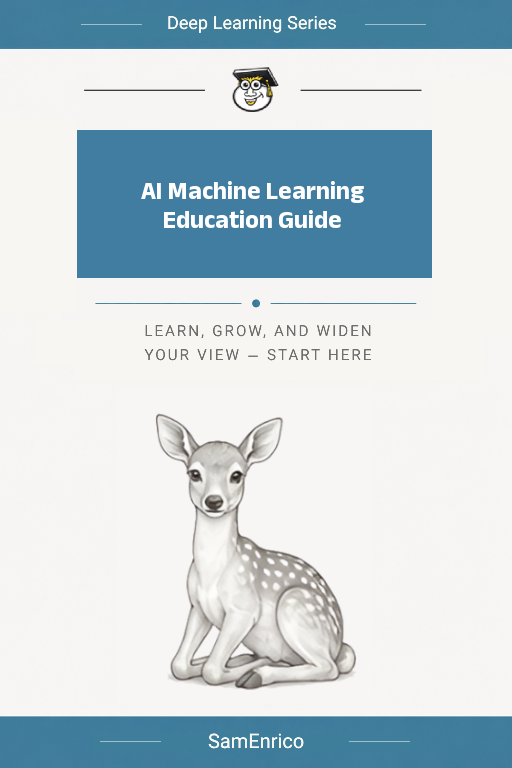
Non-FictionStudent's ShortcutArtificial IntelligenceML Careers
AI Machine Learning Education Guide eBook
Compare AI bootcamps and graduate degrees includin
Compare AI bootcamps and graduate degrees including math prerequisites research opportunities and industry roles.
Formats
Free sample
Chapter 1: The $100,000 Mistake--–- Sarah had done everything right. She graduated summa cum laude with a degree in computer science from a respected state university. She worked for two years as a software engineer at a mid-sized fintech company, grinding through feature releases and late-night bug fixes. Then she saw the headlines: "AI Will Replace 300 Million Jobs" (Goldman Sachs), "The New Era of Generative AI" (Sequoia Capital), "Six-Figure Salaries for AI Engineers" (Forbes). She felt the familiar pang of FOMO, that fear of being left behind while others boarded the rocket ship.So Sarah applied to a top-10 Master's program in Artificial Intelligence.
She took on 85,000instudentloans,quitherjobthatpaid85,000 in student loans, quit her job that paid 85,000instudentloans,quitherjobthatpaid92,000 per year, and moved across the country. For eighteen months, she studied transformers, diffusion models, and reinforcement learning. She wrote papers for conferences, stayed up late debugging Py Torch code, and listened to professors who had spent decades in academia. She graduated with honors.That was seven months ago. Today, Sarah works as a barista.Meanwhile, David – a former truck driver with no college degree – completed a twelve-week AI bootcamp in 2024.
He built a portfolio of five deployed projects, including a RAG chatbot for legal documents and a fine-tuned Llama model for customer support. He documented everything on Git Hub with clean READMEs and live demos. He sent out 147 applications, received twelve callbacks, and eventually accepted an offer as an AI Engineer at a Series B startup. His starting salary: $135,000 plus equity.This book is not an attack on higher education. It is not a celebration of bootcamps.
It is an autopsy of how smart, well-intentioned people make catastrophic career decisions in the AI gold rush – and a step-by-step manual for being David, not Sarah.The Great AI Mania: 2020–2025To understand why we are here – and more importantly, where we are going – we must rewind the clock. The period from 2020 to 2025 saw an unprecedented explosion in AI hiring. Fueled by the release of GPT-3 (2020), Chat GPT (2022), and a cascade of generative models (Midjourney, Stable Diffusion, Llama, Claude), companies of every size rushed to hire anyone with "machine learning" on their resume. Job postings with the term "AI" grew by 450% between 2020 and 2023, according to Lightcast data. Salaries for entry-level AI engineers climbed past $150,000 at top firms.This was the Gold Rush Era.
And like every gold rush in history, it attracted two types of people: the miners who actually found gold, and the merchants who sold shovels. The shovels in this story were educational programs – both degree programs and bootcamps – that promised to turn ordinary professionals into AI experts in record time. And for a few years, it seemed like everyone who bought a shovel struck gold.But the market has matured. The chaotic, "move fast and break things" hiring frenzy of 2020–2023 has given way to something more sober. Employers have been burned by candidates who completed a Coursera specialization and called themselves "AI engineers" but could not explain the bias-variance tradeoff or deploy a model to production.
They have seen portfolios filled with identical MNIST classifiers and Titanic survival predictions. They have learned to distinguish signal from noise.The data confirms this shift. According to a 2025 survey by the hiring platform Indeed, the number of job postings requiring AI skills increased by 38% over the previous year – but the number of applicants per posting increased by 215%. Competition has intensified. At the same time, a separate analysis by Burning Glass Institute found that the "AI literacy premium" – the wage boost for having AI skills on your resume – has decreased from 42% in 2022 to 27% in 2025.
The easy money is gone.What remains is a more sophisticated, more demanding, and ultimately more honest market. Employers no longer ask, "Do you know AI?" They ask, "Can you build a production RAG system with retrieval evaluation?" "Can you fine-tune a 7-billion-parameter model on a single GPU?" "Can you debug a transformer's attention collapse?" These are not questions that a three-month bootcamp or a theory-heavy degree program can answer on their own. They require the right combination of skills, projects, and credentials – a combination that depends entirely on your goals.The Fragmentation of AI: Three Sub-Domains You Must Understand Before we can compare educational paths, we must understand the terrain. "Artificial Intelligence" is no longer a single field – if it ever was. The past five years have seen the emergence of three distinct sub-domains, each with its own tools, employers, and career trajectories.Sub-Domain 1: Generative AI – This is the domain that captured the world's imagination.
Generative AI encompasses large language models (LLMs) like GPT-4, Claude, and Llama; image generation models like Midjourney and Stable Diffusion; and increasingly, multimodal models that can process text, images, and audio simultaneously. Generative AI engineers build chatbots, code assistants, content generation tools, and retrieval-augmented generation (RAG) systems that connect LLMs to private data sources.The skills required for generative AI include prompt engineering, fine-tuning, retrieval systems (vector databases like Pinecone or Weaviate), and evaluation frameworks (ROUGE, BERTScore, human preference ratings). Employers in this space range from startups building vertical AI agents (legal research, medical coding, customer support) to tech giants developing foundation models (Open AI, Anthropic, Google Deep Mind).Sub-Domain 2: Computer Vision – While generative AI grabbed headlines, computer vision continued its quiet revolution. Autonomous vehicles (Tesla, Waymo, Cruise), medical imaging diagnostics (radiology, pathology), industrial inspection, and augmented reality all rely on computer vision. Engineers in this domain work with convolutional neural networks (CNNs), vision transformers (Vi Ts), object detection models (YOLO, DETR), and image segmentation architectures (U-Net, Mask R-CNN).Computer vision roles tend to be concentrated in hardware-adjacent industries – automotive, healthcare, manufacturing, robotics.
They often require more mathematical depth than generative AI roles, particularly in geometry and signal processing.Sub-Domain 3: Predictive Analytics – Before generative AI became a household term, "machine learning" meant predictive analytics: using historical data to forecast future outcomes. Credit risk models, demand forecasting, churn prediction, fraud detection, and recommendation systems all fall under this umbrella. These models are typically smaller (millions of parameters rather than billions), tabular rather than unstructured, and focused on interpretability and statistical rigor.Predictive analytics remains the largest employer of data scientists and ML engineers, particularly in traditional industries like banking, insurance, retail, and logistics. The tools of the trade include gradient-boosted trees (XGBoost, Light GBM, Cat Boost), time series models (Prophet, ARIMA), and interpretability frameworks (SHAP, LIME).Why does this fragmentation matter for your educational decision? Because a bootcamp that excels at teaching generative AI (building RAG chatbots, fine-tuning LLMs) may provide little to no coverage of computer vision or predictive analytics.
Conversely, a computer vision-focused master's program may leave you unprepared for the generative AI roles that currently dominate job listings. Before you choose a program, you must choose a sub-domain.The Critical Role Distinction: AI Engineer vs. Data Scientist vs. ML Researcher Sub-domain is one axis of differentiation. Role type is another – and arguably more important.Across all three sub-domains, AI jobs cluster into three distinct role types.
Understanding these roles is the single most important factor in choosing between a bootcamp and a degree. The book will reference this distinction repeatedly (we established it here in Chapter 1, and subsequent chapters will refer back…
This is the end of the free sample. Get the eBook to keep going. Buy now
About this book
Details
- Author
- Heaton Cherri
- Publisher
- SamEnrico
- Language
- English
- Genre
- Non-Fiction, Student's Shortcut, Artificial Intelligence, ML Careers
- Released
- 2026-06-01
- Pages (approx.)
- 156
- Available as
- eBook, Audiobook

Read better in the ZLOADR app
Your eBooks on your phone or tablet. Sign in with your SamEnrico account and start reading.
More by Heaton Cherri
 Umayyad Cordoba Caliphate GuideHeaton Cherri$11.99
 Growth Hormone and Wound HealingHeaton Cherri$11.99
 Self Hypnosis AffirmationsHeaton Cherri$11.99
 Parental Anger Exposure HierarchyHeaton Cherri$11.99
 Panic Disorder Acceptance Commitment CourseHeaton Cherri$11.99
 The Phantom Hacker: How a Teen Cracked the PentagonHeaton Cherri$11.99
 Plowshare to Pen: The Untold Story of Johnny Cash’s Farming RootsHeaton Cherri$11.99
 Same Day Delivery Outlook 2030Heaton Cherri$12.99
 Understanding Bright's DiseaseHeaton Cherri$17.99
 Licensed Service PlumberHeaton Cherri$11.99
 How to Become a Scagliola MechanicHeaton Cherri$11.99
You may also like
 Hong Kong Handover 1997Dunn Johnnie$11.99
 Zumba For Postnatal Recovery CourseNeal Christian$11.99
 Zumba for BeginnersLadner Nikia$11.99
 YouTube Comment Mining GuideHumes Pandora$12.99
 Worry Box MeditationCarlin Rudy$11.99
 Workplace Stress MeditationNguyen Lynn$11.99
 Workplace Stress and Sleep RepairHawley Ivory$11.99
 Workplace Perfectionism CureDelaney Jeffry$11.99
 Workplace Injustice Anger GuideWallen Isabelle$11.99
 Work Addiction and Burnout LinkGreenwood Ester$11.99
 Women in Yoga and WellnessBeattie Galina$11.99
 Women in Stand Up ComedyChun Evangeline$11.99