
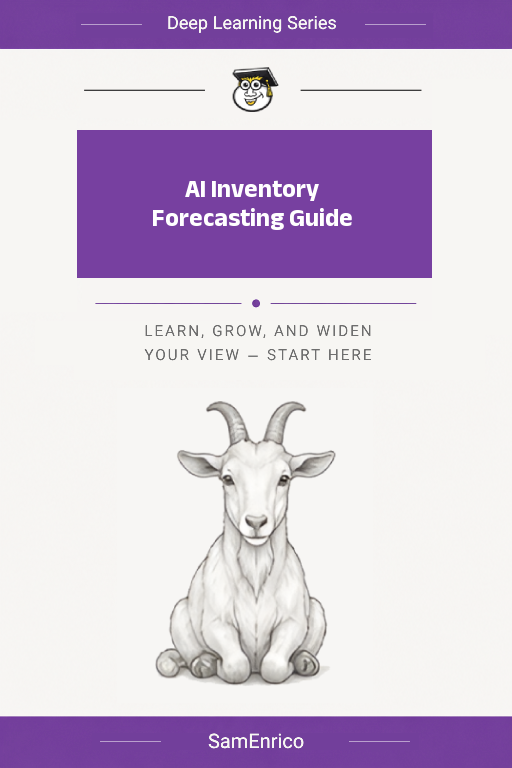
Non-FictionAI OperatorLogistics Optimization
AI Inventory Forecasting Guide eBook
Use AI to predict demand, optimize stock levels, a
by Phipps Hsiu
Use AI to predict demand, optimize stock levels, and reduce carrying costs across your supply chain.
Formats
Free sample
Chapter 1: The Forecast Trap--Every inventory manager has lived through the same nightmare. You run the numbers in your spreadsheet—moving averages, seasonal adjustments, maybe a simple exponential smoothing model. The forecast says you need 5,000 units. You order 5,000 units. Your CFO approves the purchase order.
The warehouse reserves space on the shelves. And then the trucks arrive... on the same day that demand drops by 40% because a competitor launched a surprise promotion. Suddenly, you are sitting on $2.3 million of slow-moving inventory, your carrying costs are eating next quarter's budget, and the CFO is asking questions you cannot answer.Alternatively, the opposite nightmare. You forecast 3,000 units.
You order lean, as management has been demanding. You want to reduce carrying costs. But demand surges—a social media influencer mentioned your product, or a storm is coming, or a supplier in Vietnam shut down unexpectedly. Now you are out of stock. Customers are defecting to competitors.
Your sales team is furious. And those lost sales will never come back.This is not a failure of effort. This is not a failure of experience. This is a failure of the tool itself.The spreadsheet is lying to you.Not because it is malicious. Not because you made a typo.
But because the underlying logic of traditional forecasting—the mathematics of moving averages, the assumptions of normal distributions, the linear thinking embedded in every Excel forecast function—was designed for a world that no longer exists. That world was stable. It was predictable. It moved slowly. Seasonality came and went like clockwork.
Suppliers delivered on time. Customers behaved reasonably.That world died sometime around 2008. The pandemic buried it. And supply chain volatility has only accelerated since.Welcome to the reality that most inventory professionals are still denying: your current forecasting method is not just inaccurate—it is structurally incapable of being accurate in the modern environment. The gap between what spreadsheets can do and what supply chains require has become a chasm.
And that chasm is filled with cash. Yours.The $1.2 Trillion Mistake Let us put a number on the problem. According to a multi-year study by the Supply Chain Insights consulting group, companies across North America and Europe write off approximately $1.2 trillion annually in excess, obsolete, or expired inventory. That is not a typo. Trillion with a T.
To put that in perspective, it is roughly the GDP of Australia or Mexico. It is more than the entire market capitalization of Amazon or Google. And it is money that was spent, stored, insured, financed, and eventually thrown away or sold at a loss.But that is only the visible cost. The hidden costs are even larger: lost sales due to stockouts (estimated at another $800 billion annually), expedited shipping fees when the wrong product is in the wrong place (averaging 15-20% of logistics budgets), and the labor cost of manually correcting forecast errors (which supply chain planners report consumes 30-40% of their time).The average company carries inventory equal to 20-30% of its annual cost of goods sold. For a mid-sized manufacturer with 500millionin COGS,thatmeans500 million in COGS, that means 500millionin COGS,thatmeans100-150 million sitting in warehouses at any given moment.
Of that, 10-15% is typically excess or obsolete—dead money. Another 5-10% is safety stock that never gets used because the assumptions behind it were wrong.If you are reading this book, you already suspect that your inventory is too high in some places and too low in others. You have probably experienced the frustration of expediting a shipment from a supplier across the world because your forecast missed by two weeks. You have probably looked at a warehouse report and wondered, "Why do we have 18 months of supply of item 4472?" You have probably been told to "do better forecasting" without being given better tools.This book is not about doing better forecasting the way you have been doing it. It is about replacing the entire paradigm.The Three Eras of Forecasting To understand where we are going, we must first understand how we got here.
Inventory forecasting has passed through three distinct eras, and most companies are still stuck in the second.Era One: The Rule of Thumb (Pre-1970s). Before computers, inventory decisions were made by experienced buyers who "knew" their products. They used rules like "order when the bin is half empty" or "keep three months of supply for winter items." This worked reasonably well in stable, local markets. It failed completely as supply chains globalized and product variety exploded. But the core insight of Era One—that human judgment matters—was not wrong.
It was just insufficient.Era Two: Statistical Spreadsheets (1970s-2010s). The rise of personal computers brought forecasting into spreadsheets. Methods like moving averages, exponential smoothing, and Holt-Winters became standard. These methods are based on a simple assumption: the past predicts the future, and the relationship between past and future is linear. If sales went up by 5% last year, they will probably go up by 5% next year.
If there is a seasonal pattern, it repeats exactly. If demand is random, it follows a normal bell curve.These assumptions were never really true, but they were close enough when markets were stable. In the 1980s, a consumer goods company could forecast 80-90% of its demand within 20% error. That was acceptable. Today, the same company might see forecast errors of 50-100% for a third of its SKUs.
The assumptions have broken down because the world has changed.Era Three: AI-Driven Forecasting (2020s and beyond) . This is where we are heading. AI forecasting does not assume linearity. It does not assume that the past repeats. It does not require a human to specify which factors matter.
Instead, it learns from data—all the data, internal and external—and finds patterns that no spreadsheet could detect. It can incorporate weather forecasts, social media trends, competitor pricing, macroeconomic indicators, and even news events. It can predict demand for products that have never sold before by finding look-alikes. It can quantify uncertainty, not just provide a single number. And it can update its predictions in real-time as new information arrives.This book is your guide to Era Three.Why Your Spreadsheet Is Lying To You Let us get specific about the failures of spreadsheet forecasting.
If you are currently using Excel or a legacy ERP system's built-in forecasting module, you are suffering from at least three fatal limitations.Limitation One: Linearity Assumption All traditional statistical models assume that the relationship between variables is linear. If price goes up by 10%, demand goes down by 5%. If advertising doubles, sales increase by 20%. These linear relationships are easy to calculate and easy to understand. They are also almost always wrong.Real markets are non-linear.
A price increase from 10to10 to 10to11 might have almost no effect on demand (if the product is a necessity). A price increase from 11to11 to 11to12 might cause a 30% drop (if customers have a mental threshold). A 10% discount during a slow week might generate 5% more sales. That same 10% discount during a holiday might generate 200% more sales because it interacts with gift-giving psychology. Spreadsheets cannot model these interactions because they require the user to specify every possible interaction in advance.
AI can.Limitation Two: Stationarity Fallacy Traditional models assume that the underlying statistical properties of demand—the mean, the variance, the seasonality—are…
This is the end of the free sample. Get the eBook to keep going. Buy now
About this book
Details
- Author
- Phipps Hsiu
- Publisher
- SamEnrico
- Language
- English
- Genre
- Non-Fiction, AI Operator, Logistics Optimization
- Released
- 2026-06-01
- Pages (approx.)
- 153
- Available as
- eBook, Audiobook

Read better in the ZLOADR app
Your eBooks on your phone or tablet. Sign in with your SamEnrico account and start reading.
More by Phipps Hsiu
 Merchant Marine ConvoyPhipps Hsiu$11.99
 NVC For Social JusticePhipps Hsiu$11.99
 The Cope Ahead DBT SkillPhipps Hsiu$11.99
 Gacy Property TodayPhipps Hsiu$11.99
 The Dragon and the Don: The Sicilian Mafia's Asian ExpansionPhipps Hsiu$11.99
 How to Start a Clinic (health Service) Business (Beginners Guide)Phipps Hsiu$11.99
 Geyser GazingPhipps Hsiu$11.99
 Learn to Play the Contra-alto FlutePhipps Hsiu$11.99
You may also like
 Hong Kong Handover 1997Dunn Johnnie$11.99
 Zumba For Postnatal Recovery CourseNeal Christian$11.99
 Zumba for BeginnersLadner Nikia$11.99
 YouTube Comment Mining GuideHumes Pandora$12.99
 Worry Box MeditationCarlin Rudy$11.99
 Workplace Stress MeditationNguyen Lynn$11.99
 Workplace Stress and Sleep RepairHawley Ivory$11.99
 Workplace Perfectionism CureDelaney Jeffry$11.99
 Workplace Injustice Anger GuideWallen Isabelle$11.99
 Work Addiction and Burnout LinkGreenwood Ester$11.99
 Women in Yoga and WellnessBeattie Galina$11.99
 Women in Stand Up ComedyChun Evangeline$11.99