
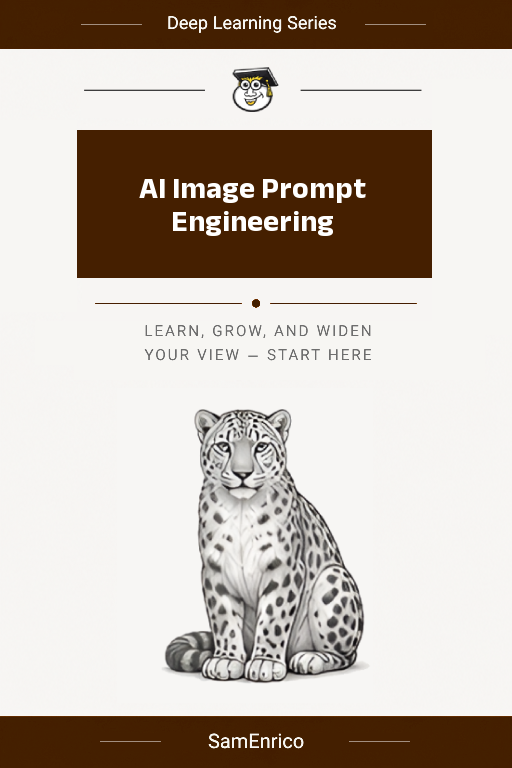
Non-FictionAI OperatorCreative Operations
AI Image Prompt Engineering eBook
Create stunning marketing visuals using Midjourney
by Beane Kenna
Create stunning marketing visuals using Midjourney, DALL-E, or Stable Diffusion. Master prompt techniques for brand assets.
Formats
Free sample
Chapter 1: The Stock Photo Funeral--–- On a Tuesday morning in March 2024, a marketing director at a mid-sized athletic apparel company did something that would have been career suicide eighteen months earlier. She deleted the company’s 48,000annualstockphotographysubscription,archivedfiveyearsofphotoshootassets,andtoldhercreativeteamofsevenpeoplethattheywouldnothireasingleexternalphotographerfortheupcomingquarter.Instead,theywouldgenerateeverysingleasset—productshots,lifestyleimages,socialmediabanners,emailheaders,evenbillboardbackgrounds—usingtextpromptstypedinto Midjourney,DALL−E,and Stable Diffusion.Her CFOaskedifshehadlosthermind.Herheadofbrandaskedwhowouldownthecopyright.Herjuniordesigneraskedwhatanegativepromptwas.Bytheendofthatquarter,theteamhadproduced1,200uniquemarketingassetsatacostof48,000 annual stock photography subscription, archived five years of photoshoot assets, and told her creative team of seven people that they would not hire a single external photographer for the upcoming quarter. Instead, they would generate every single asset—product shots, lifestyle images, social media banners, email headers, even billboard backgrounds—using text prompts typed into Midjourney, DALL-E, and Stable Diffusion. Her CFO asked if she had lost her mind. Her head of brand asked who would own the copyright.
Her junior designer asked what a negative prompt was. By the end of that quarter, the team had produced 1,200 unique marketing assets at a cost of 48,000annualstockphotographysubscription,archivedfiveyearsofphotoshootassets,andtoldhercreativeteamofsevenpeoplethattheywouldnothireasingleexternalphotographerfortheupcomingquarter.Instead,theywouldgenerateeverysingleasset—productshots,lifestyleimages,socialmediabanners,emailheaders,evenbillboardbackgrounds—usingtextpromptstypedinto Midjourney,DALL−E,and Stable Diffusion.Her CFOaskedifshehadlosthermind.Herheadofbrandaskedwhowouldownthecopyright.Herjuniordesigneraskedwhatanegativepromptwas.Bytheendofthatquarter,theteamhadproduced1,200uniquemarketingassetsatacostof347 in compute credits. The stock photo company sent a “we miss you” email. She did not reply.This is not a speculative future. This is the present reality of visual marketing, and it is accelerating faster than most marketing textbooks can be revised.
The old model—brief a photographer, hire models, rent a studio, shoot for two days, wait for retouching, pay licensing fees for stock images that ten thousand other companies also use—has been rendered not obsolete, but inefficient. The new model is prompt-driven, iterative, and radically democratic. A solo entrepreneur with a 10monthlysubscriptionto DALL−Ecannowgenerateproductcatalogimagesthatwouldhavecost10 monthly subscription to DALL-E can now generate product catalog images that would have cost 10monthlysubscriptionto DALL−Ecannowgenerateproductcatalogimagesthatwouldhavecost5,000 to shoot professionally. A marketing team of two at a startup can produce a full social media campaign across four platforms in an afternoon. An enterprise brand with strict visual guidelines can train a custom model on their product line and generate infinite variations without ever hiring a product photographer again.But here is the truth that the hype articles and Linked In thought leaders are not telling you: most marketers who try AI image generation fail.
Not because the technology is weak—it is astonishingly powerful—but because they approach it like a search engine rather than a design tool. They type “beautiful coffee shop ad” into Midjourney, get a gorgeous but unusable image (wrong aspect ratio, text that looks like alien runes, a coffee cup with two handles), and conclude that AI is not ready for prime time. They are wrong about the technology but right about their own approach. Prompt engineering is not typing. It is engineering.
And like any engineering discipline, it requires a structured framework, a vocabulary for diagnosing failures, and a systematic method for achieving brand consistency across thousands of outputs.This book is that framework.The Four Shifts That Killed Stock Photography To understand why prompt engineering for marketing visuals has become an essential skill, you must first understand the four simultaneous shifts that have transformed the industry between 2022 and 2025. These shifts are not technological curiosities. They are economic and operational realities that have permanently changed the cost structure of visual content production.Shift One: From Licensing to Generation The stock photography industry was built on a scarcity model. A company needed a photo of “smiling diverse team in modern office.” There were only so many such photos in existence. A photographer had to be paid.
A model had to be released. The image had to be uploaded, tagged, and licensed. The cost reflected that scarcity: anywhere from 10forabasicwebimageto10 for a basic web image to 10forabasicwebimageto500 or more for exclusive rights. Generative AI obliterates that scarcity. The marginal cost of generating one more image is effectively zero after you pay your monthly subscription.
This does not mean stock photography will disappear—there will always be a market for authentic, human-created, legally-cleared images of real people and events—but the commodity end of the stock market (generic business handshake, generic happy family eating dinner, generic city skyline at sunset) is already collapsing. In 2024, Shutterstock reported a 12% decline in single-image downloads. Adobe Stock saw a 20% increase in AI-generated submissions. The economic incentive has flipped: it is now cheaper to generate than to license, for most routine marketing use cases.Shift Two: From Photoshoot to Prompt A traditional product photoshoot for a single SKU costs between 500and500 and 500and5,000 depending on complexity. That covers a half-day of studio time, a photographer, a digital tech, basic retouching, and usage rights.
For a brand with two hundred SKUs, that is six figures before you have shot a single lifestyle image. Generative AI replaces the photoshoot with the prompt. But here is the critical nuance that most commentary misses: AI does not replace the creative direction. It replaces the execution. You still need to know what lighting works for your product.
You still need to understand composition. You still need to know whether your brand looks better on a white background or in a contextual scene. The prompt is simply the translation of that creative direction into a syntax the AI understands. The skill of art direction becomes the skill of prompt engineering. The art director who cannot write effective prompts will be replaced by the junior designer who can.
This is already happening.Shift Three: From Generic to Brand-Specific The first wave of AI-generated marketing images (2022–2023) had a distinctive look: hyper-saturated, slightly dreamy, deeply generic. You could spot a Midjourney ad from across the room. That era is over. The current generation of tools—Midjourney V6 and above, DALL-E 3, Stable Diffusion XL—allows for granular control over style, color, and composition. More importantly, techniques like Lo RA training (covered in Chapter 6) and image prompting (Chapter 4) allow you to teach the AI what your specific product looks like.
You can generate a thousand variations of your sneaker in a thousand different environments, and the sneaker will remain identical across every image. The brand consistency that was once the domain of expensive photoshoots and meticulous retouching is now achievable with a few hours of model training and careful CPEL syntax (introduced in Chapter 3). The gap between “AI-generated” and “professionally photographed” has narrowed to the point where most consumers cannot tell the difference, and many professionals cannot either without magnification.Shift Four: From Still to Motion to Interactive The fourth shift is still unfolding as this book goes to press, but its direction is clear. Static images are no longer the final output. Chapter 11 of this book covers video generation from prompts: turning a single keyframe generated in Midjourney into a 5-second animated ad using Runway Gen-2 or Pika Labs.
The logical endpoint is interactive, personalized, real-time generation: a retail website that generates a unique background for every user based on their browsing history, or a social media ad that changes its product color based on the viewer’s location. These applications are not theoretical. Early adopters are already testing them. The prompt engineer of 2026 will not just generate static assets. They will design generative systems…
This is the end of the free sample. Get the eBook to keep going. Buy now
About this book
Details
- Author
- Beane Kenna
- Publisher
- SamEnrico
- Language
- English
- Genre
- Non-Fiction, AI Operator, Creative Operations
- Released
- 2026-06-01
- Pages (approx.)
- 132
- Available as
- eBook, Audiobook

Read better in the ZLOADR app
Your eBooks on your phone or tablet. Sign in with your SamEnrico account and start reading.
More by Beane Kenna
 Pediatric Migraine GuideBeane Kenna$11.99
 Dark Chocolate Metabolic HealthBeane Kenna$11.99
 Listening For Teen ConnectionBeane Kenna$11.99
 Opioid Craving NeuroscienceBeane Kenna$11.99
 The Last Family of St. John’s: The Chilling Case of John SnowBeane Kenna$11.99
 How to Start a Activities of Households As Employers of Domestic Laundresses Business (Beginners GuiBeane Kenna$11.99
 Construction Labourer and HelperBeane Kenna$11.99
 Learn to Play the Bass/baritone OboeBeane Kenna$11.99
You may also like
 Hong Kong Handover 1997Dunn Johnnie$11.99
 Zumba For Postnatal Recovery CourseNeal Christian$11.99
 Zumba for BeginnersLadner Nikia$11.99
 YouTube Comment Mining GuideHumes Pandora$12.99
 Worry Box MeditationCarlin Rudy$11.99
 Workplace Stress MeditationNguyen Lynn$11.99
 Workplace Stress and Sleep RepairHawley Ivory$11.99
 Workplace Perfectionism CureDelaney Jeffry$11.99
 Workplace Injustice Anger GuideWallen Isabelle$11.99
 Work Addiction and Burnout LinkGreenwood Ester$11.99
 Women in Yoga and WellnessBeattie Galina$11.99
 Women in Stand Up ComedyChun Evangeline$11.99