
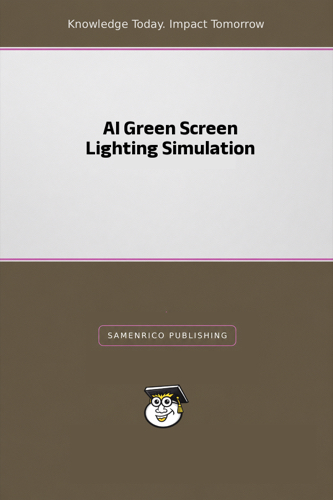
Non-FictionAI OperatorVirtual Production
AI Green Screen Lighting Simulation eBook
Generate realistic lighting on virtual backgrounds
Generate realistic lighting on virtual backgrounds that matches original footage using neural relighting.
Formats
Free sample
Chapter 1: The Cardboard Cutout...--The first time you see it, you can’t unsee it. A beautifully produced video—good camera, professional actor, expensive background plate—yet something is deeply, fundamentally wrong. The actor stands in front of a stunning sunset, but they look like a cardboard cutout someone propped up at the beach. Their edges are too sharp. Their skin has a sickly green tint.
And their shadows? They fall in the wrong direction entirely. Your brain screams “fake” within milliseconds, even if you can’t articulate why. This chapter is about teaching you to articulate exactly why—and why that knowledge is the foundation of everything that follows in this book.The Uncanny Valley of Bad Composites Every visual effects artist has a graveyard of failed composites. These are the shots that looked promising in the keying stage, survived the color correction pass, and then died the moment they were placed next to a real background plate.
The phenomenon has a name in computer graphics: the uncanny valley. But for lighting, it’s not about imperfect skin rendering or dead eyes. It’s about the physics of photons colliding with surfaces—physics that your audience has spent their entire lives learning to read.Consider how a child learns to navigate the world. Long before they understand words like “shadow” or “reflection,” they understand that a ball rolling across a floor should darken slightly as it passes under a table. They know that a face turned away from a window looks different than a face facing toward it.
This isn’t taught. It’s absorbed through millions of hours of visual experience. And when you break those rules in a composite, the audience feels it instantly, even if they can’t name the crime.The three most common crimes—the ones that separate Hollywood blockbusters from You Tube tutorials—are Light Wrap, Color Spill, and Black Level Mismatch. Master these three concepts, and you will never again look at a composite the same way. You will become the forensic analyst who can walk into a room, glance at a screen, and say, “The light wrap is off by three pixels on the left shoulder,” while everyone else just senses that something feels wrong.Crime One: Light Wrap – The Invisible Glue of Reality Light wrap is the single most important concept in compositing that almost no beginner understands.
Here’s the physics: when a subject stands in front of a bright background—say, a sunny sky or a white wall—photons from that background don’t just stop at the subject’s edges. They scatter. They bounce. They wrap slightly around the subject, creating a thin halo of background color that softens the edge between foreground and background.In the real world, this happens constantly. Hold your hand up against a bright window.
Notice the thin line of sky color that bleeds onto the edge of your fingers? That’s light wrap. It’s subtle, but your brain expects it. Remove it entirely, and the subject looks like they were cut out with scissors and pasted onto the background. Add too much, and they look like a ghost.
Get the amount wrong, and they look like a poorly rendered video game character from 2005.Traditional compositors created light wrap manually. They would duplicate the background plate, blur it heavily, and use it as a soft edge light on the foreground subject. The process was time-consuming—often taking hours for a single shot—and required constant tweaking as the background changed. If the scene had camera movement, the light wrap had to be recalculated frame by frame. This is why so many indie films have perfect keying and perfect color grading yet still look amateur.
They forgot the light wrap.Neural relighting solves this problem not by simulating light wrap as a separate effect, but by understanding the entire physics of how light travels from the background, wraps around the subject, and falls onto their edges. The AI learns to predict exactly how much background bleed should appear on each pixel of the foreground subject, based on the subject’s geometry, the background’s brightness, and the distance between them. It doesn’t guess. It calculates. And it does it in milliseconds instead of hours.But here’s the crucial point that will be reinforced throughout this book: AI is not magic.
It still needs you to understand what light wrap is, why it matters, and when the AI’s prediction might be wrong. Chapter 11 will teach you exactly how to spot when the AI has undercooked or overcooked the light wrap, and how to fix it with traditional techniques. For now, just train your eye. Look at every composite you see—in movies, on You Tube, in advertisements—and ask: does the light wrap look real?Crime Two: Color Spill – The Green Ghost on Skin If light wrap is the invisible glue, color spill is the visible stain. Every cinematographer who has ever shot against a green screen knows this nightmare.
You light the screen evenly. You key the subject cleanly. You drop them onto a beautiful new background. And then you notice it: a faint green cast on the actor’s skin, especially in the shadows under their chin, along their hairline, and on the edges of their clothing.This happens because green screens are not invisible. They are physical objects that reflect light.
When you blast bright green light onto a green screen, that light bounces off the screen and onto your subject. The actor is literally being lit by a giant green lamp from behind. Their skin, being semi-translucent and slightly oily, absorbs some of that green and reflects it back to the camera. The result is a subject who looks slightly sick, slightly alien, and completely wrong when placed against a non-green background.Traditional compositing battles color spill with a weapons-grade arsenal of tools: spill suppressors, desaturators, hue rotators, and manual roto masks. The process is maddening because removing the green cast often introduces new problems.
Desaturate too aggressively, and skin looks gray and dead. Rotate the hue too far, and lips turn orange. Mask too tightly, and you get hard lines between corrected and uncorrected areas. A single shot can take a skilled compositor an entire day to clean up.Neural relighting approaches color spill fundamentally differently. Instead of trying to remove the green after the fact, the AI learns to separate the actor’s true albedo (their actual skin color under neutral light) from the green spill that contaminated it during capture.
This is the de-lighting process that Chapter 5 will explore in depth. Once the AI knows the true albedo, it can relight the actor under any new lighting condition without any green contamination at all. The spill doesn’t need to be removed because it was never baked into the albedo in the first place.However—and this is critical—the AI’s ability to remove spill depends entirely on the quality of your capture. If you shot your green screen footage with the actor standing two inches from the screen (maximizing spill), or with poorly lit screens (creating uneven spill patterns), even the best AI will struggle.…
This is the end of the free sample. Get the eBook to keep going. Buy now
About this book
Details
- Author
- Mclain Yasuko
- Publisher
- SamEnrico
- Language
- English
- Genre
- Non-Fiction, AI Operator, Virtual Production
- Released
- 2026-06-06
- Pages (approx.)
- 138
- Available as
- eBook, Audiobook

Read better in the ZLOADR app
Your eBooks on your phone or tablet. Sign in with your SamEnrico account and start reading.
More by Mclain Yasuko
 Parent of ADHD Child GuideMclain Yasuko$11.99Parent of ADHD Child GuideMclain Yasuko$11.99
 Growth Hormone and Thyroid LinkMclain Yasuko$11.99
 Agoraphobia Intimacy Fear WorkbookMclain Yasuko$11.99
 The Lottery Ticket Addiction GuideMclain Yasuko$11.99
 The Last Flight of the Concorde: Speed, Tragedy, and the End of an EraMclain Yasuko$11.99
 The Crown's Shadow: How Prince Andrew's Privilege Shielded ScandalMclain Yasuko$11.99The Crown's Shadow: How Prince Andrew's Privilege Shielded ScandalMclain Yasuko$11.99
 Understanding Budd–chiari SyndromeMclain Yasuko$17.99
 Quality Assurance Tester (Games)Mclain Yasuko$11.99
 AI Depreciation Calculation GuideMclain Yasuko$12.99
 Canadian Medical Exam GuideMclain Yasuko$12.99
You may also like
 Hong Kong Handover 1997Dunn Johnnie$11.99
 Zumba For Postnatal Recovery CourseNeal Christian$11.99
 Zumba for BeginnersLadner Nikia$11.99
 YouTube Comment Mining GuideHumes Pandora$12.99
 Worry Box MeditationCarlin Rudy$11.99
 Workplace Stress MeditationNguyen Lynn$11.99
 Workplace Stress and Sleep RepairHawley Ivory$11.99
 Workplace Perfectionism CureDelaney Jeffry$11.99
 Workplace Injustice Anger GuideWallen Isabelle$11.99
 Work Addiction and Burnout LinkGreenwood Ester$11.99
 Women in Yoga and WellnessBeattie Galina$11.99
 Women in Stand Up ComedyChun Evangeline$11.99