
Non-FictionAI OperatorSecurity
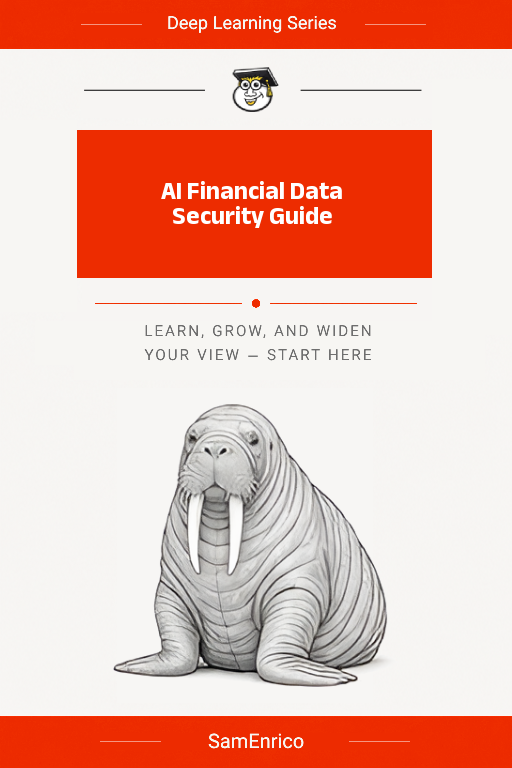
AI Financial Data Security Guide eBook
Secure financial data used in AI analysis with enc
by Sides Nilsa
Secure financial data used in AI analysis with encryption and access controls.
Formats
Free sample
Chapter 1: The $100 Million Query...--–- The email arrived at 11:47 PM on a Tuesday. Sarah Chen, Chief Information Security Officer of Nexus Global Bank, was still in her office, reviewing Q3 risk reports. The subject line read: "Urgent – Customer Data Incident." She opened it expecting the usual: a phishing test, a false positive, a minor configuration issue. Instead, she found a message from the bank's Head of AI Engineering that would change her career—and the bank's future—forever."We have a problem with the fraud detection chatbot," the email read. "It appears to be answering questions it shouldn't.
Customers are receiving information about other customers' accounts. We've taken the system offline, but we don't know how much data was exposed. Please call immediately."Sarah didn't call. She ran.What she discovered over the next 72 hours would become a case study taught in cybersecurity programs worldwide—not because Nexus Global was uniquely vulnerable, but because it wasn't. Every bank, every fintech, every financial institution deploying AI faced the same hidden danger.
Most of them still do.This is the story of how a seemingly innocent question—"What was my average balance last year?"—unlocked a vault containing 47 million customer records, triggered $59 million in fines and remediation costs, and ended with a CEO's resignation. It is also the story of how Nexus Global rebuilt itself, emerging stronger and more secure than before. But the journey from breach to recovery required understanding a fundamental paradox that most financial institutions have yet to confront.The AI Paradox Artificial intelligence has an insatiable appetite for data. Machine learning models improve with more training examples, more features, more context, more history. A fraud detection model trained on ten million transactions will almost always outperform one trained on one million.
A credit scoring model that incorporates dozens of data points—income, debt, payment history, employment stability, geographic trends—will be more accurate than one limited to a handful.This is not a flaw. It is the entire point of AI. Data is the fuel that powers intelligence.But financial data security operates under an opposite principle: minimize exposure. Limit access. Encrypt everything.
Share nothing unless absolutely necessary. The entire regulatory framework of modern finance—GDPR in Europe, GLBA in the United States, PIPEDA in Canada, APPI in Japan—is built on the premise that customer data is a liability to be protected, not an asset to be exploited.These two principles—AI's need for abundant, centralized data versus finance's demand for minimal, compartmentalized data—create what this book calls the AI Paradox.The paradox is not theoretical. It manifests in every financial AI deployment, from the smallest credit union to the largest global investment bank. Every time an AI system accesses customer data for training or inference, it creates an attack surface that did not exist before. The more accurate the AI becomes, the larger that attack surface grows.
And traditional security models—designed for static databases and predictable network perimeters—are utterly unprepared for the dynamic, unpredictable nature of AI data flows.To understand why, we must first understand the three specific ways AI systems leak data. These are not hypothetical vulnerabilities discovered in academic papers. They have been demonstrated in production systems, in real financial institutions, with real customer data. They have resulted in regulatory fines, lawsuits, and bankruptcies.The Three Attackers You Didn't Know You Were Fighting The Ghost: Model Inversion Attacks Imagine you are an attacker with no direct access to a bank's database. You cannot break encryption, cannot bypass firewalls, cannot steal credentials.
But you can talk to the bank's AI—specifically, a fraud detection model exposed through a public API. You can send it transaction descriptions and receive a score: "probability of fraud: 0.03" or "probability of fraud: 0.97."Now imagine you send the same query thousands of times, making tiny changes each time. Instead of asking "Is this transaction fraudulent?" you ask "What would the fraud score be for a transaction of exactly $47.23 from a merchant named 'ABC Store' in zip code 90210?" You record each response. You build a map of the model's decision boundaries.What you are doing, whether you know it or not, is a model inversion attack. With enough queries—often surprisingly few—you can reconstruct the training data that the model was built on.
You can extract credit card numbers, transaction histories, customer names, and addresses. Not because you broke encryption, but because the model itself, in its mathematical structure, encodes the data it was trained on.The 2020 attack on a Canadian credit union demonstrated this with chilling clarity. The credit union had deployed a loan approval AI that accepted applications through a public web form. An attacker—later identified as a former employee of a competing institution—submitted 147,000 synthetic loan applications over six weeks. Each application contained variations on real customer data that the attacker had partially obtained from public records.By analyzing which applications were approved and which were denied, the attacker reverse-engineered the model's decision boundaries.
Within two months, they could predict with 94% accuracy whether a specific real customer was approved for a loan—and more damagingly, they could extract enough information to reconstruct the customer's credit profile, including their approximate credit score, debt-to-income ratio, and even their employer.The credit union discovered the attack only when a customer complained that a competitor had sent them a pre-approved offer referencing their exact loan terms. The investigation that followed revealed that 1.2 million customer records had been compromised. The settlement: 3.2millionindirectfines,plusanestimated3.2 million in direct fines, plus an estimated 3.2millionindirectfines,plusanestimated7 million in remediation, customer notification, and legal fees.The Ghost had walked through a door that the credit union didn't even know existed. The door was the AI model itself.The Poisoner: Data Poisoning Attacks Now consider a different kind of attack. Instead of extracting data from a model, the attacker corrupts the model from within.
This is data poisoning.A hedge fund in London had developed a sophisticated AI that predicted stock price movements based on news articles, social media sentiment, and trading volume. The model was highly profitable, generating returns that consistently beat the market by 8-12%. The fund's data pipeline automatically ingested news from hundreds of sources, including a financial forum where anonymous users posted market analysis.Over a period of three months, a coordinated group of attackers—operating through multiple anonymous accounts—posted thousands of fabricated "news" items. These posts were not random nonsense. They were carefully crafted to exploit specific weaknesses in the hedge fund's natural language processing pipeline.
Certain phrases and syntactic structures, invisible to human readers, triggered the model's feature extraction in ways that skewed its outputs.The attackers had studied the fund's public patent filings and research papers, which inadvertently revealed details about the model's architecture. Using this information, they designed posts that would cause the model to overestimate the importance of certain trading signals and underestimate others.On a Tuesday in March 2022, the model recommended a series of trades that, in retrospect, made no sense: buying overvalued tech stocks and shorting stable utilities. The hedge fund executed the trades automatically, trusting the model that had performed so well for two years. By Friday, the fund had lost…
This is the end of the free sample. Get the eBook to keep going. Buy now
About this book
Details
- Author
- Sides Nilsa
- Publisher
- SamEnrico
- Language
- English
- Genre
- Non-Fiction, AI Operator, Security
- Released
- 2026-05-29
- Pages (approx.)
- 160
- Available as
- eBook, Audiobook

Read better in the ZLOADR app
Your eBooks on your phone or tablet. Sign in with your SamEnrico account and start reading.
More by Sides Nilsa
 Cat Purr RelaxationSides Nilsa$11.99
 COVAX Facility ExplainedSides Nilsa$11.99
 TM Teacher Training Overview GuideSides Nilsa$11.99
 Self Esteem for Insecure Partners GuideSides Nilsa$11.99
 Phone Affirmation App GuideSides Nilsa$11.99
 The Radiant Minds: Black Nobel Laureates Who Lit the Path of ScienceSides Nilsa$11.99
 A Beginners Guide to Cowboy Action Shooting (Volume 1)Sides Nilsa$11.99
 Understanding Münchausen SyndromeSides Nilsa$17.99
 Nvidia SWOT Analysis GuideSides Nilsa$12.99
 Transportation and Excise Tax ConsultantSides Nilsa$11.99
You may also like
 Hong Kong Handover 1997Dunn Johnnie$11.99
 Zumba For Postnatal Recovery CourseNeal Christian$11.99
 Zumba for BeginnersLadner Nikia$11.99
 YouTube Comment Mining GuideHumes Pandora$12.99
 Worry Box MeditationCarlin Rudy$11.99
 Workplace Stress MeditationNguyen Lynn$11.99
 Workplace Stress and Sleep RepairHawley Ivory$11.99
 Workplace Perfectionism CureDelaney Jeffry$11.99
 Workplace Injustice Anger GuideWallen Isabelle$11.99
 Work Addiction and Burnout LinkGreenwood Ester$11.99
 Women in Yoga and WellnessBeattie Galina$11.99
 Women in Stand Up ComedyChun Evangeline$11.99