
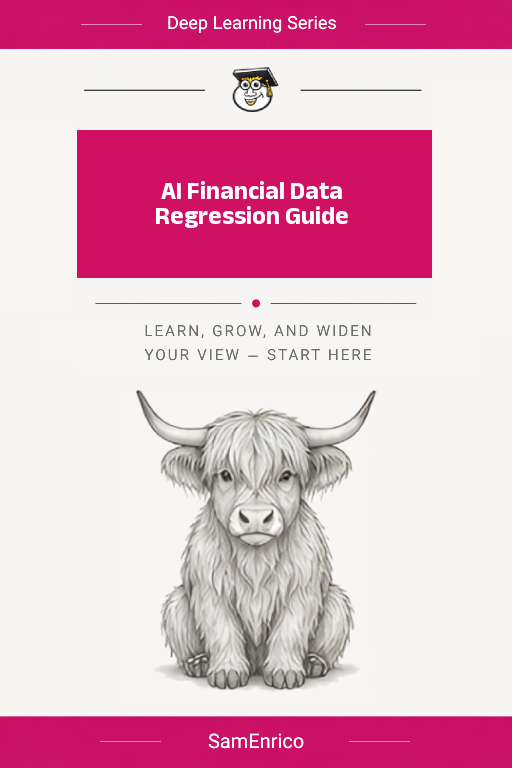
AI Financial Data Regression Guide
Apply AI-powered regression analysis to financial
by Cruz Taylor
Apply AI-powered regression analysis to financial data for driver-based forecasting.
Formats
About this book
Free sample
Chapter 1: The Illusion of Certainty--–- The senior risk officer stared at the spreadsheet, her knuckles white against the conference room table. “We’ve used linear regression for fifteen years,” she said, her voice taut. “It’s never been wrong three quarters in a row.” Across the table, the new quantitative analyst hesitated, then pulled up a chart showing the bank’s loan loss provisions against twelve macroeconomic drivers. The scatterplot looked like a constellation—points scattered everywhere, no clear line, no simple relationship. “That’s the problem,” the analyst replied quietly.
“It wasn’t wrong before. But the old relationships broke. Inflation moved differently. The yield curve inverted in a way our model never saw. And we kept forcing a straight line through a world that stopped being straight.”That scene, fictional but drawn from dozens of real conversations across Wall Street and the City of London, captures the central crisis of modern financial forecasting.
For decades, financial analysts and quantitative professionals relied on a trusted workhorse: Ordinary Least Squares (OLS) regression. It was elegant, interpretable, and—for a long time—sufficient. But financial markets have changed. Data has exploded in volume, velocity, and variety. Relationships between economic drivers have become non-linear, conditional, and regime-dependent.
And the old assumptions that made OLS reliable have been violated so persistently that continuing to use it without modification is not merely naive—it is dangerous.This chapter does not declare OLS dead. That would be both wrong and hyperbolic. Rather, this chapter diagnoses why classical statistical methods struggle with modern financial data, introduces the concept of driver-based forecasting as a superior framework, and sets the stage for the AI-powered regression techniques that will fill the remainder of this book. By the end of this chapter, you will understand the specific ways financial data violates classical assumptions, why the bias-variance tradeoff matters for asset prices, and how shifting from “correlation hunting” to “driver identification” transforms your approach to forecasting. Most importantly, you will leave behind the illusion of certainty that simple models project and embrace a more nuanced, powerful, and realistic approach to financial prediction.The…
This is the end of the free sample. Get the eBook to keep going. Buy now
Contents
- Chapter 1
- Chapter 2
- Chapter 3
- Chapter 4
- Chapter 5
- Chapter 6
- Chapter 7
- Chapter 8
- Chapter 9
- Chapter 10
- Chapter 11
- Chapter 12
Details
- Author
- Cruz Taylor
- Publisher
- SamEnrico
- Language
- English
- Genre
- Non-Fiction, AI Operator
- Released
- 2026-05-29
- Pages (approx.)
- 157
- Available as
- eBook, Audiobook

Read better in the ZLOADR app
Your eBooks on your phone or tablet. Sign in with your SamEnrico account and start reading.
More by Cruz Taylor
 The Cold Call AnxietyCruz Taylor$11.99
 Midnight Waking RescueCruz Taylor$11.99
 Mindfulness Meditation for Panic AttacksCruz Taylor$11.99
 One Page Business Plan GuideCruz Taylor$12.99
 EQ For First Generation StudentsCruz Taylor$11.99
 Switzerland Remote Tax GuideCruz Taylor$11.99
 Peg System for TaxonomyCruz Taylor$11.99
 Neuropathic Pain ExerciseCruz Taylor$11.99
 Loci for Medical TerminologyCruz Taylor$11.99
 Bipolar Eating Disorder ConnectionCruz Taylor$11.99
 The Deep Unknown: The Titanic’s Last Secrets RevealedCruz Taylor$11.99
 Orpheus: The Lyre That Moved GodsCruz Taylor$11.99
You may also like
 AI Presentation WorkbookSommers Tonda$11.99
 PowerPoint Copilot MasteryConway Lanita$11.99
 Branded AI DecksWindham Loni$11.99
 AI Presentation CourseGrooms Olin$11.99
 AI Presentation CertificationBlank Dolly$11.99
 AI Deck Version ControlMedley Lorina$11.99
 AI Deck Update AutomationFraser Tresa$11.99
 AI Deck Myths DebunkedCrittenden Romelia$11.99
 AI Deck Customization GuideDove Hannelore$11.99
 AI Bullet to Slide ConverterKohn Eloisa$11.99
 AI Deck Notes CreatorBarela Sunday$11.99
 AI Deck Outline GeneratorAshmore Morgan$11.99